Logo

impellor "set"... old wive's tale?

bobct

Advanced Contributor
I found this to be interesting and forgot to post this spring. I normally remove the RWP belt so I can occasionally rotate the pumps by hand over the winter so they don't develop a "set". It also allows me to winterize and then fog the engines as the last step.

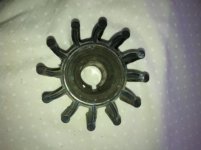
Last year, I didn't do that and wanted to change both as preventative maintenance. The "before" pic was how it looked when I removed it. Four of the vanes are formed in position it was hard as a rock. I was having a couple of beers with guys in the marina and passing on my infinite knowledge. I said "wait til you see this" and ran to my wetbar to show the gathering crowd firsthand ;)

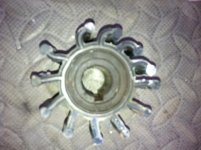
Overnight, it completely went back to it's original shape and was as pliable as a new one. Everyone threw tomatoes at me and went about their business. Figured I would share this and wondering if a lot of good impellors get tossed because they look like mine did.

Bob
 

Attachments
  • imp_before.jpg
    imp_before.jpg
    35.9 KB · Views: 79
  • imp_after.jpg
    imp_after.jpg
    29 KB · Views: 75
Last edited:
Impellers do take a " set " it is not an old wives tale.-------Was the impeller removed when it was cold ?----With time the vanes will recover on an old impeller.------Rubber is not a permanent material by any means.----It is vulcanized in a short time with heat applied to the mold.----With time the vulcanization keeps on going but at a much slower rate.-----Install a new impeller every 3 years as it is cheap insurance !!
 
If "set" was a real problem , then new water pumps would need an expiration date! But seriously, in my experience of short impeller life, the failures were caused by silt, sand, running dry (hot), and a bad cam (sharp leading edge). A 5 year old unit makes a fine spare, and it has lots of time to set..
 
Vanes must straighten very quickly in order for these pumps to work!-------If they straighten overnight you are taking a risk with your cooling system performance.
 
Time for the skeptics to take a close look at how these impellers actually work.----When the pump is rotating with a good impeller then the volume between the vanes changes.-This is how the pump sucks in water when the volume between vanes increases.----Water is expelled when the volume between vanes is decreasing.----------If the vanes are not flexible then efficiency is compromised.
 
..............

Oh boy.... we may need some beer and popcorn for this one.
:D


I found this to be interesting and forgot to post this spring. I normally remove the RWP belt so I can occasionally rotate the pumps by hand over the winter so they don't develop a "set". It also allows me to winterize and then fog the engines as the last step.
Bob.... I love your take on this! Your thoughts on this echo mine to the "T"!

I always recommend a quick/short "dry start" with the sea water pump either disengaged, or with the impeller removed.
Non-TBI and non-MPI engine fogging can take place within this time frame of 8 to 10 seconds or so.


Last year, I didn't do that and wanted to change both as preventative maintenance. The "before" pic was how it looked when I removed it. Four of the vanes are formed in position it was hard as a rock.
This the "set" that I so often mention in that we want to avoid this when possible. The best way to avoid this, is to remove the impeller for the lay up duration.

I was having a couple of beers with guys in the marina and passing on my infinite knowledge. I said "wait til you see this" and ran to my wetbar to show the gathering crowd firsthand ;)

Overnight, it completely went back to it's original shape and was as pliable as a new one.
Yes... if the composite material is OK.... these will recover some... even more so when we remove them for the lay up period.

Everyone threw tomatoes at me and went about their business. Figured I would share this and wondering if a lot of good impellors get tossed because they look like mine did.
Take the tomato throwing with a grain of salt...... these guys are not fully educated.
Plus.... there's a good chance that these guys will likely be the ones with sea water pump impeller issues.


Bob


If "set" was a real problem , then new water pumps would need an expiration date!
Honestly.... that's not a bad idea.
A new sea water pump, sitting on the shelf, should NOT yet have the impeller installed in it.
:mad:

But seriously, in my experience of short impeller life, the failures were caused by silt, sand, running dry (hot), and a bad cam (sharp leading edge).
No argument there at all.

A 5 year old unit makes a fine spare, and it has lots of time to set..
Oooooo.... I must disagree.
Used parts should be tossed, and spare parts should be NEW..... unless you are totally comfortable that the part is still functional. And if it's still functional... why was it removed in the first place.
:rolleyes:


Vanes must straighten very quickly in order for these pumps to work!-------If they straighten overnight you are taking a risk with your cooling system performance.
Actually, the folding over of the vanes against the cam (or as with the Mercs.... the eccentric positioning) is the more important aspect of an impeller's function... IMO.
Intrinsically, the suction side (vanes expanding and straightening out) will function correctly if the pressure side (vanes being folded) is working.

Time for the skeptics to take a close look at how these impellers actually work.----When the pump is rotating with a good impeller then the volume between the vanes changes.-This is how the pump sucks in water when the volume between vanes increases.----Water is expelled when the volume between vanes is decreasing.----------If the vanes are not flexible then efficiency is compromised.
No argument there.


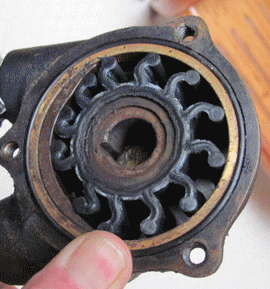
Sherwood pumps.

attachment.php


impeller.gif


Imagine this impeller's attitude after a few months in lay up captivity.

"Hey guys... let me out of here, and take me over to the work bench where I can rest and relax for a while!"

Water_Pump_Impeller.jpg


Question.... do your car/truck windshield wiper blades wear out in the winter while they are active........ or do they wear out during the summer when they are folded over against the glass?


Can I grab a beer for anyone?
:D


BTW... I've been removing my sea water pump impellers during lay up for longer than I can recall.
I won't post just how many years I can get from an impeller (as to not imply that this is advisable for average Joe), but you'd be surprised at how much impeller life can be extended when/if we do this.


Can I grab more popcorn for anyone? :D


.
 
Last edited:
I have never had to replace an impeller that was just worn out. It was always the result of some type of restriction to the intake,a bag or clogged strainer. I just keep running them until it happens. I carry new spares. Have 5 years on the current ones. With "fresh"water cooling any vanes that break off will usually get caught in the heat exchanger & are easy to remove. Raw water cooled engines run the risk of a vane getting trapped in the engine cooling passage where it is almost impossible to remove. I would not take the chance with raw water cooling.
 
People will spend thousands of $$$$ on unneeded crap for their boats to personalize them. But god forbid you spend $50-100 on a very important service part every couple of years.
 
It has been my experience that people will not listen to a " reasonable mechanic " on some maintenance issues.-----------They will wait untill they learn the lesson through their wallets , empty wallets that is !
 
I have never had to replace an impeller that was just worn out.
You only THINK that it's not worn out.
Check the resiliency of the impeller vanes against a new one.


It was always the result of some type of restriction to the intake,a bag or clogged strainer. I just keep running them until it happens.
.............. Have 5 years on the current ones.
A less than wise move.


People will spend thousands of $$$$ on unneeded crap for their boats to personalize them. But god forbid you spend $50-100 on a very important service part every couple of years.
Chris sums this up for me! :D

(Let's see........ the cost of a new sea water pump impeller -vs- the cost of a new engine!)


.
 
Last edited:
People will spend thousands of $$$$ on unneeded crap for their boats to personalize them. But god forbid you spend $50-100 on a very important service part every couple of years.

For the record, I did (and do) replace these on regular basis... probably too often. My point was most people don't normally have a before/after view which I got by accident. It happened to be overnight but for all I know it bounced back into shape in the first 5 mins. I carry new spares but wouldn't hesitate to reinstall the one above in a pinch.

Now, I don't think a vane set is necessarily "fatal" because they all look like that when first removed. Also, notice that my before pic only has the vane curl on the ones that were against the cam.... the others are ok.

Bob
 
Last edited:
You guys aren't gonna believe this, but one of my Marinette buddies INSISTS that his raw water pump impellers went 12 years before being replaced--and they were still working properly!

Jeff
 
You guys aren't gonna believe this, but one of my Marinette buddies INSISTS that his raw water pump impellers went 12 years before being replaced--and they were still working properly!

Jeff

I'm a believer. I only have 7 years to go. As far as my old impeller burning up my engine, my fiberglass exhaust lines without cooling water would set the boat on fire long before that happens.
 
You guys aren't gonna believe this, but one of my Marinette buddies INSISTS that his raw water pump impellers went 12 years before being replaced--and they were still working properly!

Jeff
Jeff, what would you honestly like to tell this guy?

He probably needs to hear about;
  • marine engine load detonation caused due to over-heating
  • loss of lubrication value due to an oil viscosity change from over-heating
  • head gasket failure due to over-heating
  • burned and damaged cooling hoses
  • burned and damaged composite exhaust system components
  • the food and cocktails that would have been otherwise enjoyed had it not been for the tow back in :mad:


Let's see.......
Labor to R&R an engine
Cost of a replacement engine
Unexpected additional parts replacement
A personal level of frustration
-VS-
a rather "inexpensive" impeller replacement :rolleyes:


I'm a believer. I only have 7 years to go. As far as my old impeller burning up my engine, my fiberglass exhaust lines without cooling water would set the boat on fire long before that happens.

So ..... let me see if I have this right! ;)
Your sea water pump impeller failure warning system is/would be the smoke coming from your glass exhaust components???? :rolleyes:

Hey... I'm just ribbing you, but with hopefully a fair degree of common sense.


Last chance.... can I get anything for you guys?

beer-and-popcorn-assortment.jpg


.
 
Last edited:
So ..... let me see if I have this right! ;)
Your sea water pump impeller failure warning system is/would be the smoke coming from your glass exhaust components???? :rolleyes:

That's all I have left. I mounted my beer holder in front of the gauge, put tape over that MIL light thingy & cut the wire to that buzzer that keeps going off.
 
.... Intrinsically, the suction side (vanes expanding and straightening out) will function correctly if the pressure side (vanes being folded) is working.
Actually, it's the other way around. The "vanes expanding" action is required to get the water into the pump...if that works well, delivering the product to the output port only requires the cam to compress the vanes...

You can talk to any of the PUMP OEMs and every one will tell you a flexible impellor have a finite lifetime due to a number of factors all of which are beyond their control...thats why they have recommended inspection and replacement intervals...
 
Back
Top