Logo

HP differences-what changes

I see some 350 V8 engines with 260 HP, 300 HP and I think 330 HP. What is the difference . camshaft, carb, intake ?
Excellent question.

Yes, there will be camshaft profile differences.

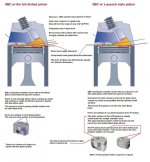
The 260 hp SBC uses the full dished pistons and 64cc chambers. This engine is rated at an RPM that allows it to develop 260 hp.

The 300 hp version still uses the full dished pistons and 64cc chambers, but I believe that the engine is rated at a higher RPM.

The 315 or 320 hp version uses a similar piston and chamber volume, but with the Vortec style quench surface, (of which is not used to it's potential with this piston) Nonetheless, this engine is rated at near 5,300 RPM. Who runs their cruiser at 5k rpm????


If you're looking for a true SBC Marine Engine that makes more torque, you'll most likely need to build it yourself, or have it custom built.
See this thread beginning with post #7.
 
Thanks Ricardo. Like I have said I am just starting to get back into boating and from what I recall my 260 HP OMC Cobra developed that HP @ 4600 rpm.When I jumped up from a 20" pitch prop to a 22" pitch the engine got sluggish and max rpm was about 3800 rpm if I recall.Was just wondering if there was simple things that chnged HP ratings so that I could maybe squeeze a tad more out of n engine to beable to run the next bigger prop without losing power.I do remember though that the 4.3 175 HP and the 205 HP was just a 2 bbl carb to a 4 bbl carb back then.
 
..............

Thanks Ricardo. Like I have said I am just starting to get back into boating and from what I recall my 260 HP OMC Cobra developed that HP @ 4600 rpm.
That is probably correct.

When I jumped up from a 20" pitch prop to a 22" pitch the engine got sluggish and max rpm was about 3800 rpm if I recall.
Yes.... over-propping overburdens an engine. This is why the OEM offers us a WOT RMP spec.

Was just wondering if there was simple things that chnged HP ratings so that I could maybe squeeze a tad more out of n engine to beable to run the next bigger prop without losing power.
Torque is what needed, not necessarily horse power.

In order to gain torque from this engine, the LPCP needs to be placed differently in terms of crankshaft angle.
Many Engineers will suggest an optimum LPCP of 12 to 14 degrees ATDC.

The full dished pistons cannot offer a quench area. It is not possible.
With no quench, ignition advance is held back to avoid marine load/ignition induced Detonation.
When the ignition advance is held back, it makes for a lazy LPCP..... perhaps as lazy as 16 to 17 degrees ATDC.

That silly, stupid full dished SBC piston was a result of the 70's emmissions control requirements for autos. And it worked!
GM has continued using it as well as many rebuilders..... including in the Marine version SBC.

The correct build is suggested in this thread.
http://www.marineengine.com/boat-forum/showthread.php?394668-V6-to-V8-engine-swap

.
 
Last edited:
Hey Rick ----do you wanna be my neighbor ? LOL

I am just looking for my kids as I have stated by as I approach retirement---I am 55 a nice little sleeper engine would be nice to have to show up all the younger crowd.
 
A nice mild performance marine cam would probably be your best "Bang for the Buck", of course I would hafta go with thru-hull exhaust, & straight thru mufflers myself.

Wait, just thought about this, it's gotta be way easier putting a cam in a boat then in a car!
 
If we look at what Mercruiser had available starting in the '80's thru the mid to late 90's........

V8 350 came in two basic 4 barrel carb configurations and one 2 barrel carb configuration (all before TBI/MPI/EFI)

230 hp 2 barrel configuration

260 hp, the base motor was the heavy duty GM truck block, still available. Just marineized.
270/280 hp (mag) version was nothing more than a recalibrated carb and a slightly higher intake manifold (I think) and a larger flame arrestor (more air).

Years ago I did complete parts comparison research on this.

ALL internal parts are the same.

WHen they reached 300 hp and higher I believe that is when they went to EFI/MPI. Also when they switched to the LS motor that was also a big boost in HP as the LS is a better small block design than the original.

If dealing with the the motors I have described above and you want more, of course as Rick said a good cam shaft choice would be first and a better intake manifold and a better flame arrestor allowing more air to motor and of course a better carb (not better operation but better for higher horse power)
but if motor replacement is a option then a standard old design small block 383 is the ticket. They seem to go to 400+ hp.......

If it is a LS based block then start with the 327 5.3 ltr and you can go all the way up to 454 7.4 ltr small block configuration........ummmmmmmmm.
 
1..... A nice mild performance marine cam would probably be your best "Bang for the Buck"

2.... Wait, just thought about this, it's gotta be way easier putting a cam in a boat then in a car!

1..... That is typicallly a nice "Bang for the Buck".... but unless the the GM full dished pistons are omitted in lieu of Quench style piston, torque is left on the table for the Marine SBC.

2.... Yes, if there is space in front of the engine, it is usually much easier.


The 6.2L (377) or 6.3L (383), even more so benefits from a Q/E within the combustion chamber.
But once again..... GM's 6.2L (377) and the re-builder's 6.3L (383) comes with the full dished piston! :mad:
I don't know what they are thinking when it's so dang easy to use the correct pistons. :confused:


Side note:
Look at a few engine rebuilder specs for their re-manufactured SBC Marine engines.
They go into detail re; their process, what parts are new, what parts are refurbished, what parts or components have been machined, etc..... and they even mention brand names.
However, when it comes to pistons, they will list most everything, including brand name, type of material (cast aluminum,
Hypereutectic, forged aluminum, etc) and some will even list the C/R ........ but they will NOT list the piston profile. :rolleyes: :confused:
Why do you think that is???


Attachments

  • Quench and Squish area explained.jpg
    Quench and Squish area explained.jpg
    80.4 KB · Views: 91
Last edited:
Back
Top