Logo

how do you know if you need to replace your exhaust manifolds/risers?

outobie

Regular Contributor
hello I am a new boat owner and have some general questions .

I always seem to find things to worry about and have visions every time I go to the marina that my boat will be sitting on the bottom!

what's on my mind now is...how do you know if your exhaust manifolds and risers need replacing?

my engines are 2001 with 450 hours always lift kept since new (kept in the water now as of this april) and hardly any maintenance except oil and filter changes. boat has been commissioned and winterized every year (I know the prior owner) and used sparingly every year about 30 hours/season on average. boat is kept in the water in a river off of the Chesapeake bay

everything seems fine...boat runs great but I don't want to break anything through ignorance.
since I've purchased I've been having some preventative maintenance done on the things that seem to be overdue including:
* new OEM water water pumps on both outdrives
* New spark plugs
* new fuel pumps and fuel filters
* engine oil and filters
* caps, rotors, and ignition triggers
* thermostats
* outdrives pulled and serviced (new bellows and gear oil)
* all new annodes on hull, trim tabs, and outdrives
* bottom painnted and outdrives painted (with antifouling paint since they are always below water line)
* new Propellers & hubs (old ones weren't bad but there were a few dings and a chip)

now I'm wondering if my exhaust needs freshening up.

how can I tell?

advice and suggestions welcome
 
Last edited:
how can I tell?

Ayuh,..... The usual failure point is the gasket surfaces 'tween the manifold, 'n riser,....

So, takin' the risers off, 'n cleanin' both gasket surfaces is step #1,....

I clean 'em with a big ole flat file myself,....

There should be 'bout 1/4" of iron to support the gasket,...
Thinner than that, replace the offendin' part,....

I hear 5 to 8 years is 'bout all you can get outa the exhaust in the brine,....

Up here in the sweetwater seas, exhaust systems last Forever,...
 
Well... need some bits of information first.
1) is engine raw water cooled or does it have a heat exchanger
2) if it has a heat exchanger, are the manifolds inside or outside the antifreeze coolant circuit? Elbows are always
"outside" the antifreeze coolant circuit.
3) regardless... you say you are on a river off the Chesapeake.. how far up? does you boat "live" in salt, brackish or fresh water?
 
Last edited:
When water gets into the engine after it sits a while, the risers/ manifolds/ etc. need changing. You'll know this if the motor fights the starter on initial, cold start up.

Jeff
 
engine is raw water cooled
I'm not sure I know the difference exactly to say but I'd guess brackish with low saltiness is where it lives.
I asked my father (who's owned boats for 60 years) he said his manifolds and heat exchanges are 35 years old with no issues (closed cooled diesels) in the same environment.

his advice was similar to bondo's above...pull the risers to inspect and if the risers are good keep running everything. If there's a lot of scale / rust in the risers then consider replacing. Dad said both motors are running good and there are no signs of issues so when I pull the boat in the fall to do the riser inspection then
 
[h=1]FYI - I bought "2002 MERCURY Mercrusier SERVICE MANUAL 37 V-8 DRY JOINT 90-864260020 Supplement" on ebay for under $10. It maybe free somewhere if interested. Anyway, it got exhaust manifolds/risers details. (I gave up on salt water long ago, just fresh now)[/h]
 
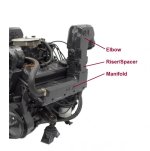
Let's make sure that we're all speaking the correct language regarding manifolds, spacers/risers and elbows.
(see image below)

Raw Water cooled engines will subject the Manifolds and Elbows to the corrosion produced by brackish water.

Take heed of Bob's post #3.
Pull things apart and physically inspect the transfer ports and closely check out the material that divides them from the main exhaust chamber.
 

Attachments

  • Exhaust riser space vs elbow explained 5 .jpg
    Exhaust riser space vs elbow explained 5 .jpg
    45 KB · Views: 509
re: "I asked my father (who's owned boats for 60 years) he said his manifolds and heat exchanges are 35 years old with no issues (closed cooled diesels) in the same environment."

Same environment, yes, same situation, no. He has the best case scenario for your area, you have the worst.
In his case, the only things that are subject to undue corrosion is the heat exchanger and the elbows.
Diesel stuff is usually better built as they are bought typically by folks who use boats for their livelihood. The part of the heat exchanger that is subject to corrosion is usually made of brass which is more corrosion resistant than cast iron. If you have dry joint elbows you are ahead of the game. No real way to estimate your potential issues in "brackish" water, though ending your trips in brackish even after running in salt is a big improvement from a 100% salt environment.
 
what's the difference between dry joint and I suppose the opposite is wet joint?

how can you tell what you have?
 
Easiest way. Classic, i.e. non dry joint sit directly on the exhaust manifold. Dry joints look as if they have "outriggers" coming from just above the mounting surface down towards the exhaust manifold. Dry joints mate to the manifold with three visible "ports", classic's with one large rectangular one.
 
what's the difference between dry joint and I suppose the opposite is wet joint?

how can you tell what you have?

in looking at the manual 37 referenced above, my motors are serial number 0M092xxx...dry risers start at serial number 0M6xxxxxx so mine are wet?

should I or can I upgrade to the dry manifolds?

what about aftermarket manifolds...I was on the Stainless Marine website and their manifolds look like they might last longer. thoughts on aftermarket vs OEM?
is there another brand I should consider?
 
Last edited:
Back
Top