Logo

Fuel starvation

I have a 115 Johnson engine on my boat and I have had a mechanic looking at it as the engine stalls after 4 or 5 minutes in low revs and less time with higher revs. He has told me the internal fuel pump in the engine is knackered and suggested fitting an external fuel pump. However he says (I am slightly disbelieving on what he tells me at the moment) that he replaced the internal fuel pump with one from another engine which he knows works but the problem still happens. He has replaced all the pipework from the fuel tank to the engine already.

If what he tells me is true, does anyone have any suggestions on what I should try next as the mechanic has washed his hands of the problem and I wanted to get some suggestions before using another mechanic.

Thanks
 
It definately sounds like fuel starvation. If there isn't a fuel restriction or issue with the pump, the only other alternative is an air leak in the fuel line. Think of a drinking straw with a hole in it, and how difficult it can be to drink through it.
 
If the fuel primer bulb has a tendency to be drawn flat...........

(Fuel Anti Siphon Valve)
(J. Reeves)

Many of the later OMC V/6 engines incorporate a fuel restriction warning via a vacuum device attached to the powerhead. If the engine overheats, or if you have a fuel restriction, the warning is the same.... a steady constant beep.

NOTE... Only the V/6 & V/8 engines have the above "Fuel Restriction Warning". The warning horn will not sound on the other models.

The fact that a engine is not overheating, but the warning horn sounds off with a constant steady beep, and that the rpms drop drastically would indicate that the engine is starving for fuel due to a fuel restriction. Check the built in fuel tank where the rubber fuel line attaches to the tank fitting. That fitting is in all probability a "Anti Siphon" valve which is notorious for sticking in a semi closed position. It will be aluminum, about 2" long, and the insides of it will consist of a spring, a ball, and a ball seat. If this valve exists, remove it, knock out those inner components which will convert it to a straight through fitting, then re-install it. Hopefully that cures the problem.

The above procedure will cure a restriction problem with the anti siphon valve as stated. BUT, it may also allow fuel to drain backwards to the fuel tank when the engine is not running (siphoning backwards) due to the fact that the carburetors/fuel pump etc are higher than the fuel tank. This condition is not an absolute as the valves in the fuel primer bulb usually prevent this backwards siphoning problem. However.... if this does take place, the cure would be to install a new anti siphon valve.

Thousands of parts in my remaining stock. Not able to list them all. Let me know what you need and I'll look it up for you. Visit my eBay store at:
http://stores.ebay.com/Evinrude-Johnson-Outboard-Parts-etc?refid=store

Curious as to why a mechanic would wash his hands of a problem.
 
Thanks for the responses. I have tested the engine by supplying fuel direct from a jerry can where the fuel pipe exits the fuel tank so I know it is not the fuel pipe. When I had connected everything to the fuel tank I disconnected the venting pipe to make sure the fuel tank is venting and it still didnt cure the problem.

My remaining choices seem to be that the jerry can option was higher then the engine and therefore it was sucessfully gravity fed where as the fuel tank is lower then the engine and therefore the internal fuel pump is not working the fuel starvation is an issue. Is there any other options I need to consider.

Thanks
 
Also to check for a failing fuel pump, simply have someone pump the fuel primer bulb (acting as a manual fuel pump),
 
It does seem to me to be a failing fuel pump because when I pumped the bulb by hand the engine picks up again.

Can anyone give me an indication of the cost of a replacement and how difficult it is to fit.

Thanks
 
airleack in the fuel line.
are you running any sorft of fuel fliter/water sep.?
i would cheack the out-put of the fuel pump that he instaled to make sure it is actully pumping enught fuel.
 
I am not sure of the year of the engine. I did have a look and on top of the engine is the following

1899 64LS

Does this help? If not how do I tell the year of the engine?

How do I check the output of the fuel pump to make sure its actually working?

Thanks for the help so far
 
Look on the port transom bracket for a small plate. It would have the model and serial number on it. The model number is what we would need. Also, if the plate is missing, there would be a small core plug (looks like a quarter size freeze out plug) on the powerhead somewhere..... hopefully that plug has the model number on it also.

Later model engines may have a heavy duty decal at the top portion of the steering swivel bracket, between the bracket and the engine's long exhaust housing.
 
If we don't have the model number, lets see if we can narrow it down without it.

Is it a fourstroke?

Does the motor cover have vents on the side, or the "handle" on top rear?

Is it oil injected (VRO)?

is it a Ficht?

on the front of the air box does it say "Loop Charged V4 Made in USA" or "FFI Ficht Fuel Injection", or just a plain cover?


A picture is worth a thousand words! This will help us narrow it down and provide more specific information.
 
Yes it is a four stroke

The cover has a handle on the top rear

It is oil injected VRO althought I have taken that offline

I will take some pictures and post them here.

Thanks
 
Ok, so if it has a VRO it's not a fourstroke, it's a two stroke. VRO places it 1984 or later. The cover with the handle places it as a Crossflow V4. 1984-1995.

If the engine runs properly when fed fuel from an alternate source, the issue is likely with the fuel pickup in the tank, or the anti siphon fitting between the tank and the fuel hose. As Joe suggests above, if the bulb is flat, there is a restriction. If the bulb isn't sucked flat, it's more likely an air leak. Make sure the fuel filter is screwed together tight.

Often the fitting on top of the fuel tank will unscrew and the pickup can be removed. check for blockage on the intake screen as well as cracks that could be an air leak. Buy a new anti siphon valve. Coat all the threads with gasoline resistant pipe dope and snug them down good.
 
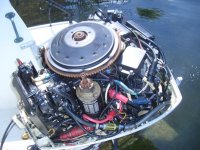
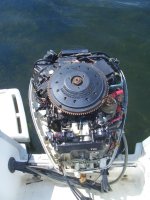
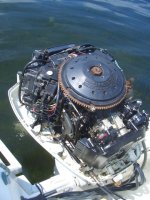
OK I have now been able to take some photos which I have loaded

It has four spark plugs and therefore I am assuming it is a 4 stroke (I am not great at these things I admit) but it also has a VRO (again I am assuming this means the oil/fuel pump as this is what I was told by the mechanic) but I am probably wrong.

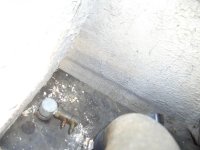
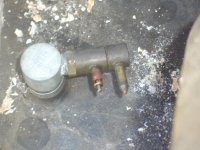
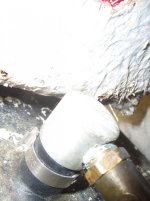
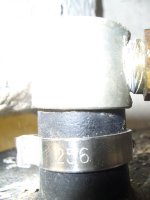
With regard to the fuel tank, I am attaching photos of the fuel connection which I am unable to extract from the tank. The squeeze clip spins round and therefore I do not think that is solely responsible for not being able to remove it.

Any help gratefully received.
 

Attachments

  • Johnson 115 Outboard 069.jpg
    Johnson 115 Outboard 069.jpg
    88.5 KB · Views: 158
  • Johnson 115 Outboard 073.jpg
    Johnson 115 Outboard 073.jpg
    96.7 KB · Views: 174
  • Johnson 115 Outboard 074.jpg
    Johnson 115 Outboard 074.jpg
    92.8 KB · Views: 166
  • Johnson 115 Outboard 075.jpg
    Johnson 115 Outboard 075.jpg
    94.8 KB · Views: 162
  • Johnson 115 Outboard 083.jpg
    Johnson 115 Outboard 083.jpg
    88.6 KB · Views: 160
These are the rest of the photos
 

Attachments

  • Johnson 115 Outboard 084.jpg
    Johnson 115 Outboard 084.jpg
    91.7 KB · Views: 140
  • Johnson 115 Outboard 089.jpg
    Johnson 115 Outboard 089.jpg
    87.2 KB · Views: 139
  • Johnson 115 Outboard 090.jpg
    Johnson 115 Outboard 090.jpg
    80.5 KB · Views: 145
OK here is an update.

I have managed to get the connector to the fuel tank out. In the tube there were one or two small flakes of dirt which I took out but to my inexperianced eye they did not seem to be enough to restrict the fuel supply.

I took off the fuel pump and had a good look at it. I can n ot see any obvious signs of cracks etc. Is there an easy way to get the pump tested to make sure that it is working or is this a mechanics type job?

When I reconnected the pump I ran the engine with the cover off. First of all I disconnected the engine crankcase pulse fitting and I could feel the pressure coming from the engine which presumably works the fuel pump so that appears to be ok.

When the top cover was off I was able to run the engine in neutral for 20 minutes without problem at 2500 rpm. I did throttle up and down and it seemed fine. I put the cover back on and the engine seemed to have the same fuel starvation problem. I therefore thought it was the fuel line getting bent by the cover.

I was very careful about making sure the fule line under the cover was not kinked and it seemed to have resolved the problem. I therefore took the boat out and it seemed fine until I pushed the revs up when I had the engine stall on my again. The primer bulb was soft and I then had the problem.

Any further help is gratefully received.
 
Did you try running on the water without the cover? An exhaust leak can sometimes act as you describe. If the engine is sucking in it's own exhaust instead of fresh air it won't run right. The other thing to check is whether the air intake under the "handle" at the back of the cover is not obstructed.
 
Thanks I will try that.

One other thought has come to kind having read a billion threads on fuel issues. I noticed that the engine revs would vary on its own while I was running the engine. Sometimes it would climb up or sometimes drop down. Is this indicative of carb problems?

Thanks
 
Back
Top