Logo

Engine rebuild issues

Andrey Silkin

New member
Hey everyone.


I am hoping someone can help me get some answers to questions my mechanic cannot answer. I have an issue with one of the engines in my Cruisers 3270 (the engine being Cruisaders 350, 5.7L).
Last year I lost power in one of the engines. When we started the boat this year my mechanic told me there is no compression in 3 cylinders. They pulled the engine out and sent it in to be rebuilt. When it came back they stated that all the inside parts were changed (rings, pistons, valves, etc), the engine was sent back rebuilt into the marina where the mechanic installed the manifolds and assembled the engine. From my perception the gaskets and manifolds were self-made at that time. We took the boat for a ride, watched the temp which did not go over 145 on both engines. After a 2 hour cruise I started to loose power in the same engine again. We took it back to the marina, remeasured the compression in the cylinders; 3 of the cylinders didn't have any compression at all, and the plaques which we took out from these cylinders were smashed (like someone hit it with a hammer). The mechanics took the engine out again and sent it to the same rebuilder. When they took it apart they told me that the 3 cylinders were overheated and practically melted. They now want me to pay for these repairs once more and are claiming that I overheated the engine.


If anyone can help give me some solid advice whether this was really my doing or they are taking me for a ride it would be most appreciated. Thank you for the replies in advance.


Andrey
 
...................

Can you post a photo of the damaged pistons?

Question: was the same ignition distributor re-used on the new engine?

If this damage is from "Detonation", it may have been ignition induced. IOW, an ignition advance that is coming on too aggressively and too ealy, can and will cause detonation. The first clue would have been the three burned pistons.

Detonation is a particular issue with the Marine gassers. It can be caused by a lean fuel/air scenario, or by an incorrect spark lead.

I find that many Marine Mechanics will set BASE advance only, and will look no further.
A good Marine mechanic should have caught this when checking ignition advance..... if this is what caused the damage.

I would be doing some forensic work.
Get a hold of the ignition distributor, and have it tested on a distributor machine.
See what the progressive advance is doing, and see what the BASE advance would have allowed for Total Advance.
If this is not to specs, it may be the cause of the damaged pistons. "May" being the key word here.


I woul ditch the idea of using the GM full dished pistons. These should NEVER be used in a SBC Marine engine.


These are much more prone to detonation issues.
If the rebuilder used this piston style, he is not doing good service as a SBC Marine Engine rebuilder, IMO.

See this thread beginning at post #7.

And please post some photos of these bad pistons for us.


.
 
Last edited:
Sounds to me like the issue is really between your mechanic and the rebuilder...and this issue will show you the caliber of the mechanic.
 
Sounds to me like the issue is really between your mechanic and the rebuilder... and this issue will show you the caliber of the mechanic.
I fully agree with you, Mark.

However, I think that there are some unknowns at this point.

  • Was the original ignition distributor re-used?
  • How was the ignition total advance verified?
  • Is the piston damage due to detonation, or other?
  • If detonation, was the detonation damage due to excessive ignition advance?
  • Do we have a lean fuel scenario at these cylinders?

I'm as curious as the next guy!


.
 
Lots of unknowns - thats a given.

Based on what the OP's input, I think somebody's trying to exploit him and I was trying to answer his question by suggesting he tell his mechanic to resolve the issue...I'd go further and recommend he explicitly add the "..and without another dollar from me!" caveat, too.
 
Hey guys thank you so much for the great replies, its greatly appreciated. The mechanic stated that he is indeed using GM grade pistons and this program unfortunately will not let me upload pictures off of the iPad. Is there an email I can send them to or another page they can be uploaded?
 
The mechanic stated that he is indeed using GM grade pistons
Yes, I'm sure that he's telling you the truth as per what he's been led to believe....... but what does GM grade pistons mean to him?

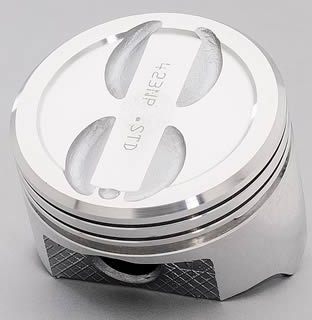
I'll bet you a nickel to your doughnut that these are this piston profile below. :mad:
This is the God Awful and dreaded GM full dished piston that should never be used in a SBC Marine engine.

attachment.php


Do these work? Yes they do work, but these can in no way possible create a quench effect.
Without a good quench, ignition lead must be held back, otherwise we increase the risk of detonation damage.
All it takes is a few degrees out of whack.......... and is why I suggested having your ignition system tested.

If I recall, this damage not only occurred to the original engine, but also occurred to the replacement engine.... correct?
I'd want to know what the common denominator is. Is it fuel/air.... or is it ignition timing?


Without seeing the actual piston damage, I'll bet you two nickels to your two doughnuts, that these became damaged due to detonation.
In which case you'd better use some caution if going back together a third time with the same ignition system... and/or the same fuel delivery system.

I'm not trying to tell you what to do..... I'm just trying to help you avoid yet another failure.


.
 
Last edited:
Hi Ricardo!!!!!!
can you please tell me what kind of pistons he should use for my engine
thank you for your help!!!!!!!!!!!
andrey


Yes, I'm sure that he's telling you the truth as per what he's been led to believe....... but what does GM grade pistons mean to him?

I'll bet you a nickel to your doughnut that these are this piston profile below. :mad:
This is the God Awful and dreaded GM full dished piston that should never be used in a SBC Marine engine.

attachment.php


Do these work? Yes they do work, but these can in no way possible create a quench effect.
Without a good quench, ignition lead must be held back, otherwise we increase the risk of detonation damage.
All it takes is a few degrees out of whack.......... and is why I suggested having your ignition system tested.

If I recall, this damage not only occurred to the original engine, but also occurred to the replacement engine.... correct?
I'd want to know what the common denominator is. Is it fuel/air.... or is it ignition timing?


Without seeing the actual piston damage, I'll bet you two nickels to your two doughnuts, that these became damaged due to detonation.
In which case you'd better use some caution if going back together a third time with the same ignition system... and/or the same fuel delivery system.

I'm not trying to tell you what to do..... I'm just trying to help you avoid yet another failure.


Hi Ricardo!!!!!!
can you please tell me what kind of pistons he should use for my engine
thank you for your help!!!!!!!!!!!
andrey

.
 
Andrey, I can't completely answer your question without knowing more about your engine components... in particular your cylinder head chamber volume.

Earlier I posted a link to this thread.

If you'll read it beginning from post #7, it should help you understand what I've been speaking about.

This build is not completely necessary, but it sure makes for a better SBC Marine Engine, and especially for larger hulls.


.
 
Andrey, I can't completely answer your question without knowing more about your engine components... in particular your cylinder head chamber volume.

Earlier I posted a link to this thread.

If you'll read it beginning from post #7, it should help you understand what I've been speaking about.

This build is not completely necessary, but it sure makes for a better SBC Marine Engine, and especially for larger hulls.


Hi Ricardo !!!!
the engine is Crusader 350 volume 5,7 L
serial number 14102193
this is all I know
thank you!!!!!

.
Hi Ricardo !!!!
the engine is Crusader 350 volume 5,7 L
serial number 14102193
this is all I know
thank you!!!!!
 
..................


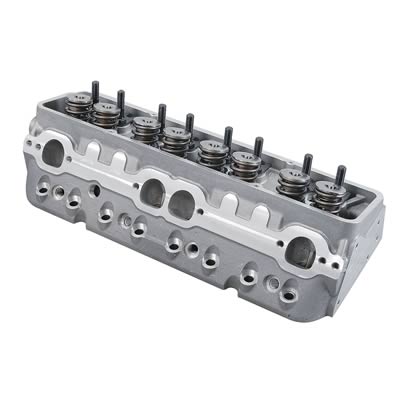
The 14102193 is a cylinder head casting number... not a serial number.
These are considered a swirl port chamber and were available with small valves, and either 58cc or 65cc chambers.
They are light weight castings (noted by the multiple scallopes), and some will recommend that they NOT be used for a Marine SBC.

mS0I-IuxndTOXSEeulb7ARg.jpg


This is a heavy casting below (noted by only two scalloped areas).


The piston that would compliment the 14102193 small chamber, would need to a D-Dished style, with a dish volume that creates the correct static compression ratio for either 58cc or 65cc chambers.

Go to this Static C/R calculator, and plug in your numbers.

Bore............................................................... = 4.030" (this would be first over-bore)
Stroke............................................................ = 3.480"
Compressed head gasket thickness.................... = .038" to .040" minus the piston deck heigth dimension.
Piston deck heigth target.................................. = .016" or so... (based on a 9.025" deck heigth).
Piston dome volume........................................ = play with this number until you get the correct C/R (probably no more than 9.4:1 for Q build).
Cylinder head chamber volume......................... = either 58cc or 65cc depending on which heads you have.

Once you enter the data, click on "Calculate" and your S/C/R will be displayed.

The piston dish volume that gives the correct C/R is what the piston will need to offer.

A good piston supplier will know what you're talking about, and should be able to provide the correct pistons.


.
 
Last edited:
Examples:

Using the 58cc chambers:

Bore = 4.030"
Stroke = 3.480"
Gasket thickness = .022"
Deck heigth = .016"
Piston top volume = 22cc
Chamber volume = 58cc

Static Compression Ratio = 9.27:1


If we switch to the 65cc chambers:

Bore = 4.030"
Stroke = 3.480"
Gasket thickness = .022"
Deck heigth = .016"
Piston top volume = 16cc
Chamber volume = 65cc

Static Compression Ratio = 9.17:1

So you can see that when the chamber volume is changed, the piston dish volume must also change in order to maintain close to a 9.2:1 ratio.


.
 
The SAME 3 cylinders lost compression--that's the clue. There's gotta be a coolant blockage somewhere inside the block in that area that's burning them up.

The machine shop should have removed the freeze out plugs and boiled that block out before rebuilding it, so THEY are responsible.

Another case where you should have bought a rebuilt long block from a responsible rebuilder instead of "Joe's Machine Shop".

Jeff
 
The SAME 3 cylinders lost compression--that's the clue. There's gotta be a coolant blockage somewhere inside the block in that area that's burning them up.
Jeff, I hear you..... but what machine shop would NOT bake or boil a block out, nor do a check for cracks, prior to any machine work?


Andrey, find out which 3 cylinders these were for us.


.
 
Back
Top