Logo

engine overheating

Hey guys this is my first post I've joined because i fit something i just can't figure out
I've got a 1966 donzi st tropez cc fishing boat with a 1969 gm 5.7 l 350 in it
I noticed try the freeze plus were leaking last time out so i killed the engine and called vessel assist a my engine was
Overheating. Replaced all the freeze plugs and ran her and my 290 out drive isn't shooting out water at all. Replaced impeller checked risers nothing. I'm not getting any water to the pump at all. How do i go about checking the line from the intake to where the hard line turns into a soft line? Do i have to remove the whole bottom of the stern drive?
I'm a marine so taking this bad boy to a shop just isn't going to happen. Plus I'm a diy kind of guy
 
Check the raw water hose connector in the outdrive intermediate housing. It is probably perforated due to corrosion, in which case the raw water pump will be sucking air.
 
I've got a 1966 donzi st tropez cc fishing boat with a 1969 gm 5.7 l 350 in it

Overheating. Replaced all the freeze plugs and ran her and my 290 out drive isn't shooting out water at all. Replaced impeller checked risers nothing. I'm not getting any water to the pump at all. How do i go about checking the line from the intake to where the hard line turns into a soft line? Do i have to remove the whole bottom of the stern drive?
I agree with Eduardo. If you have a suction breach here, the sea water pump will not pull water.
Also, the water neck fitting rises up out of the water once on plane.

BTW, unless this drive has been replaced, in 1966 this would not have been a Volvo Penta 290.
Perhaps post a few photos of your out drive.

You'll want to familiarize yourself with your sea water path.
Learn where the sea water enters the lower unit (look for crustaceans here), learn how it travels up through the pivot tube (there is an O-ring seal at the lower-most portion of this tube).
Learn where the water neck fitting is, and learn about the special "beaded" gasket underneath the water neck.
(the beaded gasket will fail shortly, if the upper pivot tube bushing is worn badly)

Follow the "S" hose through the transom shield, and follow the suction hose to the sea water pump.

If you test any of these components, use "vacuum", not pressure. Pull a vacuum on the system with a shop vac.
Use shaving cream at any suspect locations. If the shave cream disappears, you've found a suction breack.

BTW, in 1969, this engine very likey has a belt driven sea water pump... probably a Sherwood pump.
These pumps are bi-directional regarding their installation orientation, and it is very easy to re-install one reversed (these are ambidextrous).
If you pulled the pump body to replace the impeller, you may have re-installed the pump in a reverse direction. If so, it will not pull water, and you may have burned the impeller by now.

Let's assume that you have this sea water pump.
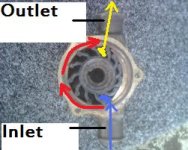
The first two images below shows a pump impeller turing in the correct direction for a Standard LH rotation engine (of which all AQ series Volvo Penta's require).
The third image shows the pump body positoned correctly for a Std LH engine (note the inlet/outlets ports to the Port side).
The forth image shows the same pump body positoned correctly for a REV RH rotation engine (note the inlet/outlets ports to the Stbd side).

If by chance you re-installed this pump body as per the forth image, it will not pull water, and you may have burned the impeller up by now.
 

Attachments

  • Sherwood impeller Direction LH.jpg
    Sherwood impeller Direction LH.jpg
    13.2 KB · Views: 117
  • Sherwood impeller bent over.jpg
    Sherwood impeller bent over.jpg
    9.8 KB · Views: 73
  • Sherwood pump for LH engine.jpg
    Sherwood pump for LH engine.jpg
    3.3 KB · Views: 255
  • Sherwood pump for RH engine.jpg
    Sherwood pump for RH engine.jpg
    3.3 KB · Views: 253
Last edited:
Our has the Volvo penta 290 emblems on it. This boat also had a v6 stock so i assume when they repowered they replaced the out drive. To check the hose in the out drive do i just take the bottom off?
 
Also it's a Johnson pump and i took the impeller cover of then replaced it
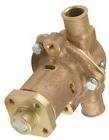
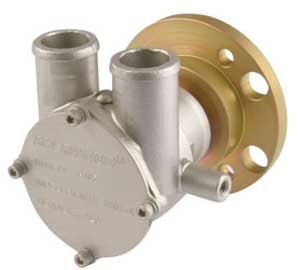
OK, if this is a Johnson crankshaft pump, it will look like this pump, and w/ only four cover screws.


If the pump body is SS, it's likely a Sherwood crankshaft pump.


If the cover uses six screws, it is an older Jabsco crankshaft pump.

Either of these pumps can also pose an issue regarding inadvertantly reversing flow direction, if the inlet/outlet ports became reversed.
However, this mistake is seldom made, unlike with the Sherwood belt driven pumps.

NOTE: the large volume Jabsco and Johnson F6B-9 share an impeller diameter, vane count, and shaft size, but they do not share the same impeller depth dimension. (Sherwood impeller is not the same, nor interchangeable)

The Johnson F6B-9 impeller is 1.900" in depth.
The Jabsco impeller is 1.990" in depth.
To the untrained eye, it's hard to see the .090" difference in depth.

Parts counter people often make this mistake, and they end up selling the customer the wrong impeller.
If you installed the Johnson 1.900" impeller in the Jabsco pump body, it will not pull water.
The .090" difference prevents this.


And once again, if you ran this engine for any length of time, and did not see water flow, you very likely burned the impeller.


.
 
Last edited:
Without knowing more about your engine/drive, it's tough to say or suggest what the cause may be.
I've thrown these potentials out here for you just as to give you a place to start looking.
It may or may not be a sea water pump issue.

Here's the water neck fitting that Eduardo mentioned.


This fitting is attached to the upper-most cross section of your main suspension fork.
These fittings are prone to corrosion, and should be considered a "wear" item.


The "S" hose may be another part to look at.
If the shift cable has been wearing against this hose, it may have damaged it.
This is a 250/270/275/280/285 style.... your 290 will be similar.


.
 
Back
Top