Logo

drilling out edelbrock 1410

old hatt

Contributing Member
Just received new1410 carbs. I know through this forum that they need to be drilled out but not sure of the depth. thanks
 
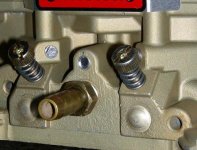
You want to drill UP from the bottom with an 1/8 " bit to the centerline of the other hole. Drill IN from the front with a 5/16 " bit until the two holes meet, then tap the hole with an 1/8 " NPT pipe tap.

Yes; I'm still PISSED that we have to do this to a brand new carb since the doofusses at Edlebrock won't!

Jeff
 

Attachments

  • Edelbrock-1.JPG
    Edelbrock-1.JPG
    70.3 KB · Views: 588
  • Edelbrock-4.JPG
    Edelbrock-4.JPG
    50.7 KB · Views: 438
Jeff and old hat.... I don't use this carburetor.... what exactly are we doing here?
Are we equalizing low speed metering circuits, or sump'n?
 
Creating a passageway for the PVC valve circuit. For some unfathomable reason Edelbrock does not provide one, even though the street version of this carb has one front and back.

In the words of David Hobbs (discussing brave race drivers), it takes a "pair of large attachments" to go drilling on your brand new, 300 buck carb!

Jeff
 
Last edited:
Thats a great question Rick which I don't have the answer to so I'll wait for Jeff to explain. All I can say is that I put 1409 edelbrock's on a pair of small block mercruisers 2 years ago and did not have to worry about doing it to those.
 
I am following this thread with interest as well. My 440s both have PCVs and they are circa 1979. If your engine had a PCV, how would you eliminate it, and why would you eliminate it? What would be the harm in not having one?
 
Why run a PVC system? To get rid of the moisture that builds up in the oil, moisture that creates sludge and acid (that eats the bearings).

A marine engine--which runs far colder on the average auto engines--doesn't burn the moisture out anywhere near as well, so it needs a PCV system even more.

Jeff
 
Jeff, I don't have anything against the pvc per 'se, I'm just not sure that it's needed. <br>Here's a few thoughts.... see what you think. <br><br><br>
<br><br><br>
When crankcase gasses are at their greatest potential, intake manifold pressure is near it's lowest potential due to throttle plate postion. <br><br><br>
Due to the point of attachment at the carburetor, we need manifold pressure to operate the PCV system while at these higher RPM. <br><br><br>
<br><br><br>
Now, intake manifold/carburetor/flame arrestor air flow is near it's greatest potential during high crankcase gass potential.<br><br><br>
Why not take advantage of an existing air flow scenario? <br><br><br>
<br><br><br>
<br><br><br>
Here's a CV system. Note the flame arrester and points of hose attachment. <br><br><br>
The hose placement should allow the intake air to pull gasses in from each valve cover. <br><br><br>
A positive crankcase ventilation valve would not be required. <br><br><br>
<br><br><br>
<br><br><br>
<img border="0" alt="" src="http://t1.gstatic.com/images?q=tbn:ANd9GcR2HIjgKVmqcb1hc8ncQyDSZBuSgZXyMl2m2JaYCd1TcuFLbf5O1xqsnsMc"><br><br><br>
<br><br><br>
Apparently some did use the vavle... but I'm not sure that it's necessary. <br><br><br>
<br><br><br>
<br><br><br>
<img border="0" alt="" src="http://www.dougrussell.com/partscatalog/images/CRUISER/79202/10.gif"><br><br><br><br>.
 
None of that came thought, the links (or your logic).

Moisture is a sludge generator and motor killer. Cold running marine engines, therefore, need a PCV system far more than hotter running auto engines. (The damp marine environment is also a negative contributing factor.)

On the vacuum needed/ available to suck out the moisture, I agree with you that marine engines--that are always "going uphill"--have less of it more often. But when they do, the moisture is getting removed...IF there's a functioning PCV system.

Jeff
 
Jeff, I got a glicth with IE while posting that. This morning there were six IE pages open behind my main IE page...., nothing launched.

In reading your post, you make perfect sense, and I do understand that.
I don't have anything against the pvc per 'se, I'm just not sure that it's needed.
Here's a few thoughts.... see what you think.


When crankcase gasses are at their greatest potential, intake manifold pressure is near it's lowest potential due to throttle plate position.
Due to the point of attachment at the carburetor, we need manifold pressure to operate the PCV system while at these higher RPM.


Now, intake manifold/carburetor/flame arrestor air flow is near it's greatest potential during high crankcase gas potential.
Why not take advantage of an existing air flow scenario?


Here's a CV system. Note the flame arrester and points of hose attachment.

The hose placement should allow the intake air to pull gasses in from each valve cover.
I'm thinking that the positive crankcase ventilation valve would not berequired.

images


Apparently some did use the valve (21) ... but again, I'm not sure that it's necessary in order to pull these vapors from the crankcase.


10.gif


No arguement.... just conversation! :D
 
Last edited:
... so if you have a set-up with the PCV running from the valve cover up to the flame arrester, do you still need to drill out the carb. ????:confused:
 
... so if you have a set-up with the PCV running from the valve cover up to the flame arrester, do you still need to drill out the carb. ????:confused:
Of the crankcase vents that attach to the flame arrestor, typically the PCV valve itself is not required.

The PVC valve unit is somewhat gravity restricted via the valve unit inside.
These are meant to be installed vertically, and typically connect to a more direct source of manifold pressure (vacuum) I.E., the carburetor port that you mention.

Jeff, does that sound correct????
 
Last edited:
..."so if you have a set-up with the PCV running from the valve cover up to the flame arrester, do you still need to drill out the carb. ?"

There's a bunch of confusion going on here. That hose to the flame arrestor is there to SEND oil fumes from blowby to the arrestor, so they get burned up (and don't present a fire harzard in the bilge). The ONLY way moisture can be removed from the oil is with VACUUM, and that hose to the arrestor never sees a vacuum.

Fastjeff's Second Law: Moisture not removed from the oil via a PCV system crates sludge that plugs the passages of an engine, and acid that eats bearings.

Jeff
 
Thanks one and all for kicking this subject around. I sure have learned a lot from you guys since joining this forum and it looks like i'll be doing some drilling.
 
You're right Jeff, thanx for clearing that up. Bottom line.. make sure your PCV valves are clear and change that oil frequently !!!

Hey Jeff you gettin' bombed with snow today too ??
 
You want to drill UP from the bottom with an 1/8 " bit to the centerline of the other hole. Drill IN from the front with a 5/16 " bit until the two holes meet, then tap the hole with an 1/8 " NPT pipe tap.

Yes; I'm still PISSED that we have to do this to a brand new carb since the doofusses at Edlebrock won't!

Jeff

Edelbroch told me that the fitting would lose the "USCG approved" rating. They said that old motors are an exception "grandfathered".
 
Technical ignorance (or ultra conservative advice from their legal department) from Edelbrock. Read the CFR requirements; this hole won't have any impact satisfying them.
 
Chrysler had a lot of engineers design these engines and they put the PCV there so why would we remove it? The biggest benefit I see on my engines is keeping the blowby fumes out of the boat, at low power settings the carb doesn't draw all the fumes coming out the large hose from the opposite valve cover but with the PCV system the engine room stays fume free.

My original carbs had the hose on the rear so when I bought my 1410s I called Edelbrock about it and they said I could drill the front or rear, I drilled out the rear like the original carbs and it works great.

Dan
 
Back
Top