Logo

Compression Test on a 25HP 1987 Mercury

rmcderm313

Regular Contributor
Hi All,

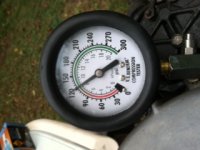
I did a compression test on a recently purchased 25 HP 1987 Mercury. It doesn't run so I had to do the test cold. My results were 120 psi on the top plug and 140 psi on the bottom. Is that a concern? It's outside the 10% differential range, but what does that mean?

I tested the spark and I am getting a spark in both plugs so I'm going to move on to cleaning the carb to see if I can get it to start.

Any thoughts on what I might expect if I can get it to start? Also, is it possible the compression difference has something to do with it not starting?

Any help appreciated.
Thanks,
Rob

Here are pics of the results:
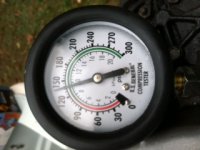
photo 2 (1).JPGphoto 1 (1).JPG
 
I wouldn't be concerned too much about the difference on a 1987 engine...both are well above 100 psi.
I tested the spark and I am getting a spark in both plugs
The spark needs to be loud, snapping and blue. Can it jump 3/8" gap?
 
I used a spark plug tester from Harbor freight that goes between the plug and the wire http://www.harborfreight.com/90-inline-ignition-spark-checker-69023.html

So I'm not sure how strong the spark is. It was lighting up but I'm not sure how much a strong spark makes it light up. Is there a better way to test? I've seen videos of people pulling the plug wires off a bit with the engine running and seeing the spark, but remember I can't get it running.

Thanks for the reply.
Rob
 
Squirt a little 50:1 gas:eek:il mix into the carb and see if it fires. That will tell you if the spark is strong enough. WD-40 will also light off thru the carb. Give the carb a long soak and good cleaning. Blow out all passages w/comp. air.
 
Good compression.

If it has gas, spark and compression it should start. Since it won't, either the carb is screwed up, the flywheel key is sheared (it happens), or there's reed valve problems--these motors use a rubber seal to separate the two cylinders and it tends to fail.

I'd shoot some starting fluid into the carb--throttle open--and see if it will go. You might also try cleaning the plugs a few times, blowing any excessive gas out by pulling here over with the plugs out.

Jeff
 
Well, it started. I'm not sure why but all of a sudden it sprang to life. It was smoking pretty good, but I think that was because the previous owner had it winterized so there was probably fogging oil throughout. Since I had disconnected the motor from the controls (see my other post), I realized I had no way of stopping the motor, so I disconnected the gas and let it run out.

After that, it wouldn't start. Each time I pumped the priming bulb, or even pulled the starter rope, gas would pour out of the front of the carb. I'm assuming a stuck float. I think this is good news, because I'm not worried about rebuilding the carb. So I think the fact that it started and ran (even just that one time) tells me that I'm getting good enough spark. That fact that it ran for a while (maybe 10 minutes) points to a healthy fuel pump. Combine that with decent compression readings and I'm guessing (hoping) that a rebuild of the carb will get me back in business.

I'm ordering the rebuild kit now and we'll see.

Thanks for all your help! Any pointers on the carb rebuild on this model? I've done it several times on a newer 4 stroke and it was pretty simple. Wish I could find a YouTube video ;).

Rob
 
Fire me an email ([email protected]) make the subject something obvious (25 horse carb) and I'll send you a pdf that will walk you through it.

There is a little "ball" (bearing) in the primer (contraption) that has a habit of jumping out of place when you reassemble, then it floods - you pull your hair out trying to figure what you did wrong (never happens to me :)) - anyhow, aside from that it's really straight forward.

I've rebuilt a couple of hundred of these little walbro's over the years - it can't be that difficult (and most times they worked fine) :)
 
Graham, I sent you an email (Thanks!). I had been pressing down on that primer when the engine finally started, so I'm speculating that it might be that ball bearing that is causing the engine to flood right now... I will keep an eye out for that. I really appreciate all the assistance.

Rob
 
Merc sometimes used a slightly different carb for rope start and electric start models - don't know for sure but suspect it was to accommodate the electric choke on the smaller models.

Unfortunately, I don't have a breakdown of which was used on what.

Can only suggest that you have a look on the carb itself. There is normally numbers cast into the side (sometimes alot of numbers).

It will usually be on the outside of the throat (so the convex part on the side of the carb or directly above it - can be on either or both sides.

Sometimes it's a merc part number (eg. 1390-xxxxxx) or you will see a Walbro style (WMC31A).

I have looked at both of the kits and can't pick out the immediate difference. My (guess) would be the more expensive of the two is for electric start models - otherwise the jets, seats, gaskets etc are all exactly the same, so it has to be just some extra piece different between the kits...
 
Spoke too soon and did guess correctly.

Yes, the difference is to accommodate the electric choke.

The primer cover on the carb is a little different.

All the earlier carbs have been superseded - WMC 31 and WMC 31A are the current versions.

Anyhow, I went on the Merc parts site (not Iboats) and here's what they have listed

Repair kit for WMC 31 - merc part number 1395-8237072

Repair kit for WMC 31 - merc part number 1395-8237072

Look the same? that's why I couldn't see a difference. The older kits either had/didn't have the little plate that would cover where the electric choke mounts.

Now that Merc has dropped it from the kit, the parts are identical.

(ps. just flashed that pdf your way)
 
Last edited:
Excellent! Thanks (again). On page 3A-20 they refer to, and show an "air intake cover". My motor doesn't have one (anymore?) and I don't see it referenced in any part diagram I can find. Do I need one? I assume it's an air filter mechanism which would seem kind of important????? Right now the intake on the carb is covered only by the upper cowl.. This is what the face of my carb looks like... exposed. (not sure why my pictures are all posting sideways)

photo (4).JPG
 
Last edited:
No yours "never" had one. The manual covers motors a fair bit newer than yours (or mine for that matter).

As time went on they did try and (improve) some things but often times these changes didn't always work as planned.

So while a filter in front of the carb would help save the reeds (maybe 1 in 50 or 100 carbs would suck in crud and chip a reed), it restricted air flow, caused a little richer running (burned more gas, fouled plugs quicker, carboned up the cylinders quicker etc).

So do you risk a chipped reed (maybe) or cause maint issues (that would kill the motor unchecked) - roll the dice...

I have 3 small mercs, when you look at the carb it looks like your pic there. The "youngest" one is 20 something now - no filter/cover whatever - that's how I run them, for what it's worth...
 
Back
Top