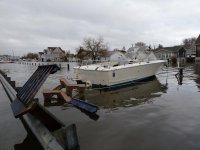
My boat is an oldie classic 23 ft without self bailing which means every drop of water that ends up on the deck has to be pumped out. In addition, I leave my boat in during named storms. My boat was in the water, 2 miles west and less than one south from ground zero for Sandy. That said... My battery setup is one I've used for a decade. The battery setup is part of a system than includes choice and placement of my bilge pumps.
Setup... A Start duty only battery bigger than specified and a second dual purpose battery that is the highest capacity one in a size 24 that I could find. I have these wired to the boat with a A-Both-B-Off battery switch located out of the weather but accessable without removing the engine cover, located and wired so that the wiring from the Start battery to the engine via the switch is a short as possible. I have a fused, dedicated feed one wire gauge larger than the minimum size as indicated in the "wire charts" for the load I'm feeding (within 12 inches of battery) from the second (dual purpose) battery. In my case this load consists of my VHF radio, separate GPS/Plotter and separate Sonar units. I do not have an on board charger as I manage charging using the "out on one battery, back on the other" method. However, if I did install a dockside charger, I would only install a single battery charger and wire that just to the dual purpose battery.
At this point, by bilge pump strategy comes into play. I have two, one is a 500gph pump and the other is a 2000 GPH one. I gotten away from pumps with built in sensor circuits as their reliability is poor. Instead, I use caged float switches, the one with a small test lever on them. Once many years ago, I had some debris in my bilge hang up a open float switch and kill the pump ( ran dry until the battery went dead).
The smaller pump is hard wired thru one float switch to the dual purpose battery with a locally wired manual override switch ( optional, I only added this switch this season after 10 years of not having one). The other pump, the 2000 GPH one is also wired via its own caged float switch to the Start battery. This is my "OH S##T!" pump. The float is mechanically installed so that it only comes on if the water level is an inch higher that the turn on level of the 500GPH pump. I am also installing a manual override switch on this pump later this season. Both pumps, of course, are wired directly to their respective batteries via water proof blade type fuses. I'm contemplating replacing the pump fuses with circuit breakers, but I'm not thrilled with their reliability, especially in an open boat like mine.
How this setup works in the real world.... I was not able to get to my boat until 4 and a half days after SANDY passed. The dual purpose battery was dead. The start battery was slightly down, but the engine started quite easily. Water level in the bilge was consistent with the system operating on the float levels as set on the 2000GPH pump. For those not familiar with 23 ft Chris Craft Lancers, it is an open cuddy (about 6ft) cabin boat with a 7ft 10 inch beam. If storms are predicted, I remove all canvas from the boat and let the pumps earn their keep.
I remove the batteries from the boat in the fall and store them in my basement. I have a microprocessor controlled charger with battery restoration capabilities and "float charge" capability. The batteries take turns on this charger. I try very hard to never have two batteries the same age on the boat ( owned boats for over 50 years).
I never run the engine with the battery switch on BOTH, which contributes to my 5+ year battery life.
The photo below is as boat was found after SANDY. I had to wade over 2 blocks thru water to get there. Those are someone's deck stairs in my stern lines and a kid's roller hockey net hung over the bow stbd piling.