Logo

Cdi voltage out put

Shearpin2

New member
2011 yamaha T50TLR EFI
Can someone tell me the voltage output to coil from to cdi to supply the coils ( wast spark) system.
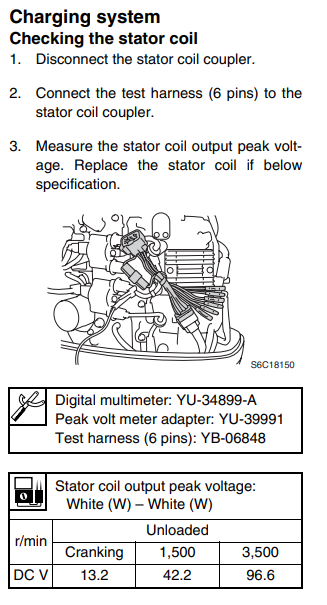
Also what voltage , at cranking , for the stator y1,y2 and y3 . Tasted at the voltage reg. Connection.
I have already installed new coils have same problem. One plug per. coil fires.
Ty.
 
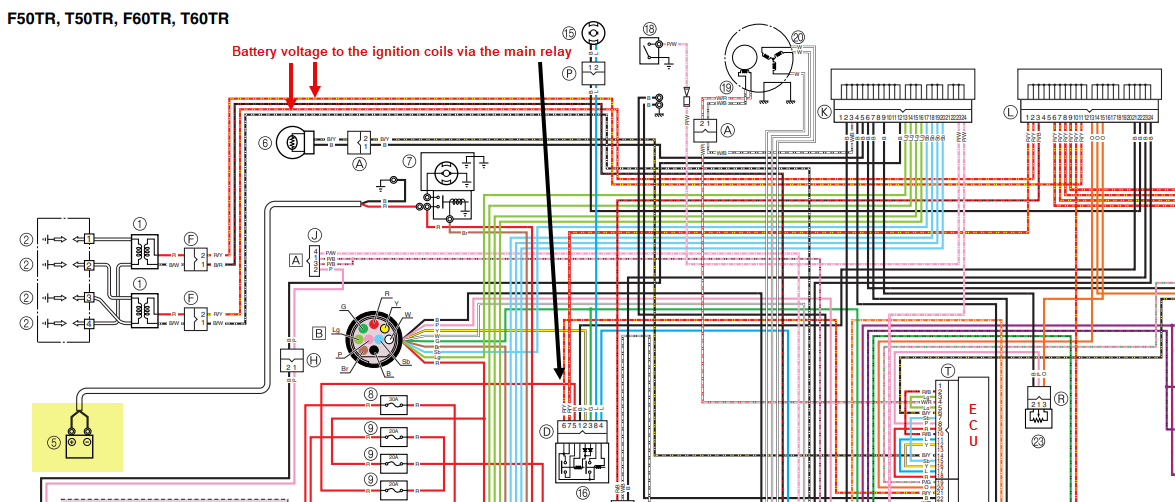
A 2011 T50TLR does not use a CDI assembly. Being an EFI model, it has an ECU.

The ECU causes the ignition coil to deliver high voltage to the spark plug by terminating battery voltage to the coil.

The lighting coil (stator) portion of the alternator has nothing whatsoever to do with ignition in a T50TLR. It purpose is only to provide AC electrical power to the rectifier/regulator.
 
Interesting, your thought reinforce's my thoughts on this system but not completely. Your see inside the the ecu , whether in one section, of the ecu or spread out the containment is a functioning " box" is the operation of a cdi, that is controlled, by the ecu.
It sends out a controlled voltage to the coil of the amount needed for operation. It also controls the ground side of the coil for field "coil" collapse.
My question was whats the voltage value min. For operation of the coil.

Second if the "ecu" to operate properly it has to have the voltage supplied, battery will last only so long. The stator will provide the voltage needed for all operational items : fuel pump, injectors , sensors, ECU, .... SO voltage output value generated by the stator is needed.
The stator has three " stages / section / phazes" for generating the power to support the operation.
Im asking with regards to the stator what is the value of the " Y1-Y2, Y2-Y3, Y1-Y3 from the stator at the voltage reg. Connection. At cranking rpm to determine if the stator has failed.
A failing stator can alter powers to the ECU --->IGNITION needed for operation.
 
There are two basic types of Yamaha ignition systems. Capacitor discharge ignition (CDI) and battery powered transistorized ignition.

CDI ignitions create their own electrical power via what Yamaha calls a charge coil. The charge coil charges a capacitor. Another coil (pulser) tells the capacitor when to discharge the electricity into the ignition coil. The discharge of electricity into the primary side of the ignition coil induces a much higher voltage into the secondary side of the ignition coil. The voltage is high enough to cause an electrical spark in the spark plug. In many CDI systems a battery is not even needed. The motor will run just fine forever without a battery.

In the battery powered transistorized ignition system, battery voltage normally flows through the primary side of the ignition coil. When the ECU stops the flow of current through the ignition coil (by opening the ground circuit of the ignition coil) a high voltage is induced in the secondary side of the ignition coil. The voltage is high enough to cause an electrical spark in the spark plug.

Yes, an ECU needs battery power to function. For fuel pumps. For fuel injectors. For the ignition coils. For the ECU. But the motor can function just fine without the battery being charged. If and when the battery charging system fails to operated the ECU ignition system will run just fine. For a while anyway. Hopefully, long enough to get home on. But as you note, once the battery runs out of juice the transistorized ignition system will no longer function.
 
Back
Top