Logo

CAT C32 SCAC — What is causing high inlet manifold temperature on Port engine?

Ewangonzalles

New member
Hi all,

During sea trial the Port engine inlet manifold temp runs ~90°C (alarm set at 85°C). Starboard under same load is normal. I need ideas on possible causes.

Details
  • Engine: CAT C32 SCAC
  • Load: ~100%, 2200 rpm
  • Coolant temp: ~89–90°C
  • Aftercooler coolant in/out: 55°C → 65°C (Port same as Stbd)
  • Boost: ~200 kPa (similar both sides)
  • Fuel rate: ~293 L/h
  • Engine hours: ~4735 h

What I have done
  • Swapped inlet manifold temp sensor — no change
  • Swapped heat exchanger — no change
  • New aftercooler core fitted — no change
  • Fresh check on FW pump — OK
  • Tappet clearance adjusted
  • No obvious difference in seawater cooling performance vs starboard

Question:
What could cause the inlet manifold to run high on just one side while aftercooler coolant temps and boost look normal?
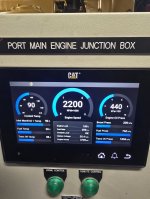
 

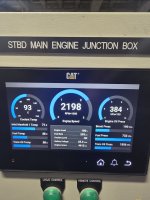
Attachments

  • Screenshot_20250926_121739_Gallery.jpg
    Screenshot_20250926_121739_Gallery.jpg
    1,000.5 KB · Views: 66
  • Screenshot_20250926_121751_Gallery.jpg
    Screenshot_20250926_121751_Gallery.jpg
    888.4 KB · Views: 60
Heat build up in Turbo, maybe
Use a IR temp gun and compare intake air side of turbo. Also check for restriction with intake side

1758888099566.png
 
Thanks for the input. I already checked with an IR temp gun:


  • Turbo compressor outlet air side: ~220°C both Port and Stbd
  • Exhaust temp: ~650°C both sides

So turbo heat build-up looks normal and consistent with the Stbd engine.
The only difference is the Port inlet manifold temp, which is running too high compared to Stbd.
Heat build up in Turbo, maybe
Use a IR temp gun and compare intake air side of turbo. Also check for restriction with intake side

View attachment 36234
 
So turbo heat build-up looks normal and consistent with the Stbd engine.
The only difference is the Port inlet manifold temp, which is running too high compared to Stbd.
Understand you swapped the sensors, but have you verified with temp gun?
Reason for question is wonder if there is maybe some corrosion on a connection somewhere. Your measurements leads me you are probably using European standard and not North American standard for measurements
 
I’ve attached two photos. The first shows the inlet manifold where the temp sensor takes its reading. The second shows the aftercooler attached to the inlet manifold. It’s almost impossible to get an accurate temp reading on the inlet manifold using a temp gun, because heat from the cylinder head will interfere with the measurement.


Do you think there’s a better way to verify the actual inlet manifold temp, or could there be another cause I might be overlooking?
1000668056.jpg
2025-09-20 17(1).jpg
 
I believe your doing the best you can and achieving the most accurate results
Right now, we know the reading for inlet temp is higher, but what we don't know is it accurate?


My personal opinion is there is no difference between motors, the issue is the wiring differences between the two. I wish I had a wiring diagram to determine where the reading differences could happen

What you could try but this could be costly if something out of the ordinary happens. You could swap the computer control modules and see if the readings move. If done without a static discharge than we would know if it's the computer or the wiring
 
I already swapped the sensor with the Stbd engine – same result.
Also swapped the ECM, thinking maybe bad module – but no change.

Here’s what I’ve done so far:

1. First noticed inlet manifold temp creeping up to 87–89 °C.

2. Pulled out the aftercooler – tubes clogged with carbon. Cleaned chemically, reinstalled with new seals + integral seal.

3. Pulled out the heat exchanger – chemical cleaned, fitted back with new O-rings.

4. New coolant filled.

5. Sea trial – still 87 °C.

6. Swapped sensor – no change.

7. Swapped ECM – no change.

8. Swapped heat exchanger – no change.

9. Swapped aftercooler – small improvement, temp dropped steady at 83 °C. Suspected aftercooler issue.

10. Installed brand new aftercooler – condition got worse, temp shoots up fast to 90 °C.

This problem should be simple, but it’s getting tricky. On C32 SCAC the cooling is a split system – jacket water has its own pump and HX, and the aftercooler has its own pump and HX, with both only sharing the sea water pump for heat rejection. If there was a sea water flow issue, both jacket water and aftercooler circuit should be affected, but jacket water temp is always normal.

Anyone seen this before on C32 SCAC? What else could cause high inlet manifold temp after all these swaps?
 
but jacket water temp is always normal.
The only thing left is the flow rate thru the after cooler. The jacket shows it's the same but somewhere inside it's not the same

I can see how the raw water is routed thru the system but unable to see the actual parts that make up the system. Things like is there a check valve or restrictor to make sure one area gets more cooling than the other.

Is there a place to measure flow rate of the of the pump. The unit having 2 pumps and thermostats, maybe it has something to do with it.

There is a guy on the heavy equipment forum (Nige) who knows CAT inside and out. What he doesn't know he has access to all of CAT manuals. Could post there to see if he or another might have an idea
 
For the jacket water side, yes it has its own pump and thermostat.
But for the aftercooler, the flow path is much simpler – from tank → pump → aftercooler → heat exchanger → back to pump.
No valve or thermostat in this circuit, it’s all direct piping.
 
Back
Top