Logo

Backflushed cooling system... raining out mid section, quick video PLEASE HELP! 92 merc 40hp

Spencer Breeden

New member
To start off I was having over heating issues, 1992 merc 40hp inline 4cyclinder. She was pissing fine great water pressure but too hott and would steam after a minute or 2 running under load.... Also side note it seamed to take a long time (35-45 seconds) to start pissing

Started with water pump, everything looked perfect, no burns cracks or missing fins, going to replace anyways with all new gaskets etc.

I thought maybe I sucked something up so I took the air compressor and blew it in thru the pisser exit. Nothing came out

I then decided to backflush with water thru the pisser exit when I noticed this... (see video)

http://www.youtube.com/watch?v=rlwNlTd1zIk&feature=youtu.be

Does anyone know the cooling schematic of water flow for this engine, I thought water would only come out the copper pipe but its coming from someplace else and I can't see where its coming from.
 
I watched your video but am having a really difficult time trying to figure out what I'm seeing. I can't quite get a (reference) as to what you are showing.

Is that your lower unit, upside down???
 
The overboard indicator / pisser is but a wee portion of the water that goes through the block.-------Water will come out in places other than the copper tube from the water pump !
 
no thats looking up into the middle leg with the lower unit off running water from the pisser backwards.

I think water is also supposed to exit the exhaust correct? Well when I took off the lower unit, the exhaust tube hangs down, it is not connected to the bottom of the motor... is that normal or is there a sealed connection there that i screwed up
 
Yes, I was trying to get some perspective to what I was seeing.

The exhaust tube should be connected to the exhaust plate (same basic "base" as what the motor is bolted to).

Your video was a little too "close" to see everything that is going on but to me, initially, it looked like your powerhead base gasket was leaking from all over the place - but with the (leg) missing that simply could have been the result of the leg being removed.

However, the symptom you describe could be indicative of a bad powerhead base gasket.

The water travels from the pump (impeller and housing) up the water tube to the base of the powerhead (immediately behind the carbs).

From there it travels (sort of) across the bottom of the engine, in channels, towards the rear of the motor, then takes a turn, up channels to the top rear of the powerhead. Since this is a mid horse motor, flow from that water channel is controlled by the thermostat up near the top cylinder.

If the thermostat is closed (engine cold - or not up to operating temp), water is prevented (or severely restricted) from travelling through the cylinders water jackets and is ported (again via channels) directly to the exhaust.

When the engine gets up to temp, the thermostat opens/closes as necessary to allow water to travel through the jackets around the cylinders to keep them cool (some still will go directly into the exhaust no matter what).

IF (IF) the powerhead base gasket is toast, water will leak out of the lower channels and (bleed) down the leg. Water/gravity do not work in your favour if the base gasket is leaking - the water won't "climb a hill" if it doesn't have to.

So a leaking base gasket will still allow "some" water to get up to the water jackets but far too much will leak down the leg and get ported to the exhaust. That results in "steam" coming from the tell tale since the bit of water that does get to the "head" is immediately vapourized...
 
only thing that might through a wrench in your theory is this motor has no thermostat. I don't think that will matter much when I tell you this next part.

I decided to try running water via the hose into the copper pipe up the through the motor the way it would normally flow. I wasn't surprised to see the water coming down the leg because I know it comes out the exhaust, however I was surprised to see whatever already exiting the motor through the exhaust before exiting the pisser, it did eventually come out the pisser, but it seams like half of my water being pumped up the motor is exiting before it really gets to the motor...

my other question regarding the exhaust, you said it should be connected to the exhaust plate... how does it connect? is it just compressed into the plate when the lower unit is put on, or should be actually be attached because right now its not
 
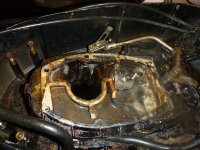
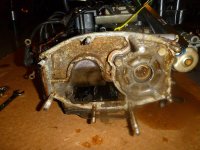
powerhead.jpgpowerhead2.jpgpowerhead3.jpg
alright... i believe this is the gasket you have in mind, without being too much of a pain in the ass, where does the copper tube from the water pump come into play? I don't see where it connects trying to figure out where my my leak is
 
The copper tube connects to the adapter plate that is below the power head.

That water flow in your video is normal--that's where much of the water exits the power head.

I suspect the gasket below the power head is leaking, so insufficient water goes up into the block.

Jeff
 
didn't get the temp gauge hooked up but my hand gauge says its heating up WAY to fast for a no thermostat motor, excellent water flow from the pisser, but heating up crazy fast and it feels like the top cylinder is hotter than the rest
 
got 2 bolts out of the cylinder cover, thought i was doing good, broke the 3rd one... damn it. Is there any bulletproof way to extract broken bolts? Ive read horror stories of people breaking there easy outs and I know its all but impossible to drill tool steel
 
The "cylinder cover" is just that, a cover, not a typical "head" so it's real purpose is to cover the water jackets etc, it doesn't have to withstand the compression/combustion of the cylinder.

The bolts that hold the cover in place are not grade 8 steel or anything like that so they are a little easier to drill than a typical head bolt.

There is no trick to get these out. Unless they are removed every few years and re-coated with anti-seize you will inevitably break a couple when you try and remove them.

I personally have tried easy out's of every description over the years and no longer ever bother trying. If I snap off a bolt now I simply drill it out. Start with small drill (maybe 3/32's) and try and drill the hole as close to the center of snapped bolt as possible (a center punch to get a dimple started helps).

I then move up a couple of drill sizes and redrill. When you are close to the bolt size (maybe 3 drills later) THEN a big easy out will usually remove what's left. If not, I simply re-tap the hole and go with that.

You do not have to go with an OEM Merc bolt. When I re-tap it's often a tiny bit smaller than the original bolt (since some of it is "welded" into the original threads) - in that case I use a standard "body bolt" from an auto supply place - they look remarkably similar to a Merc "cover bolt" and cost about 10% of the "marine" bolt...
 
cylinder.jpgimpeller.jpg pulled all these old impeller chunks out of that bottom left hand cooling passage, the passage that fills the whole cylinder jacket, im SHOCKED it was pissing as good as it was. The impeller i just removed looked brand new because it was, the moron I got the boat from put in a new impeller but didn't pick out the pieces of the old grenaded one. And as you can see I broke plenty of bolts, 8 out of 10 to be exact, didn't seem to matter how much heat or how many taps or wiggles or pb blaster, if it was going to break there wasn't **** that could be done about it. I don't see too many posts where people actually write about them solving the problem, so I wanted to show my problem solved encase someone ever has a similar issue
 
Looking at your picture there, there is significant mineral build-up in your water jackets (that white crud - probably calcium or lime). The rest of the water channels are probably similar.

Once you get the water jacket cover re-installed it would be well worth your time to get that crap cleaned out (that also restricts heat displacement quite a bit - not good for the motor).

There are number of products on the market that can take care of it, some quite expensive.

Since this is just a 40 horse you can do it quite cheaply with plain old white vinegar.

Once you have it buttoned back up (the jacket covers that is), leave the lower unit off and plug the tell-tale hole.

Turn the motor upside down and fill the cooling channels (right through the exhaust is often the easy entry point) with white vinegar (a buck or two a gallon at the grocery store) - pour it in until she's good and full and leave it like that for 24 hours.

It will eat up all that build up and is otherwise very safe for everything else (won't hurt plastic/rubber/metal etc).

When you are ready to dump it, flush it well with water (if you can jury rig a hose to the water tube and just let her run for a bit) - it will flush out anything that wasn't completely dissolved by the vinegar.

So for a days patience and a couple bucks of vinegar you will have a very clean cooling system..

(also works on salt water run motors - just find it's impractical to turn larger motors upside down - 60 horses is about the max, then weight really becomes a factor for the vinegar trick, because you do need to let it sit for a good 24 hours - the acid in the vinegar is not super strong).
 
well at the moment I have a broken ex out in 1 bolt and a broken tap in another, I have 3 open and 5 more broken, once i get through that madness ill worry about the crud
 
A machine shop would be able to remove the broken bolts, etc. Making a steel plate jig to bolt on the engine will help you drill out the old bolts. Use a sheet of thin cardboard for a bolt pattern. Hold/tape it into place over the bolt holes and tap it w/a small hammer to mark the bolt holes then layout onto a plate and centerpunch and drill. Using a drill press will keep the bits straight.
 
Back
Top