Logo

AQ280 gearbox front seal leak

joe_merchant

Regular Contributor
While doing the winterizing pressure test, discovered that the front seal on the gearbox was leaking. Was easy to find since the bellows was blown up like the Goodyear blimp! There was no water in the oil when I drained the outdrive - I was looking for that specifically when I pulled the plug. No water in the bellows either and the u-joints and yokes all look brand new so there was no apparent water intrusion.

This gearbox was resealed 2 seasons ago by a pro so I'm curious as to why it would begin to leak so soon and if it's a problem with this particular gearbox that I'll be seeing again. I've only put about 50 hours of fresh water use on it and also disassembled and pressure tested last season so the use doesn't seem to be excessive.

I'll attempt to tackle the reseal myself this time but wondering if there's something in particular to inspect to determine if there's something else going wrong. Any help is appreciated.
 
Joe, what amount of pressure did you apply when you performed this pressure test?
If you exceeded what the seal is designed to hold, then what you witnessed is normal, IMO.

To do this with best results, both pressure and vacuum "Leak-Down" tests should be performed.
"Leak-Down" also involves a time frame, and the reading may fall to a value, and then hold.
The value that is being maintained, is the important part.

(we can get almost any seal to breach under certain pressure values)

FYI: In order to be accurate, a pressure test requires that ALL oil be removed. Not necessary for a vacuum test.
 
Pressure test was after the oil was drained and it had sat for at least a half hour. First step was at 5 lbs (21-35 kpa in the manual) and hold for a few minutes. It started to bleed down right away and seemed to stabalize around 3 lbs. I then took it up to 10 lbs to get a better idea of the location of the leak. That's when I heard the bellows start to creak and flex.

There didn't seem to be any point of any further tests since the leak had allready been identified. I also did the pressure and vacuum tests this spring before putting the drive back on the boat. It passed both full tests. After having said that, I realized that I only identified a leak at the forward end of the gearbox, not a specific area or component. There was oil in the bellows but the source is no mystery after pressurizing the outdrive.

I plan on replacing the forward washer along with the seals and o-rings. I have several concerns at this point. The first is removing the clamping ring bolts without damaging them. It got a little spendy last time! Then I'm concerned about the bolt penetration areas and the actual clamping ring to housing mating surface as it appears these are the boundaries. I'll use Permatex aviation sealant on those. My next concern is measuring the rolling torque and keeping an eye on the crush sleeve while tightening the shaft torq screw. It's described in the manual so shouldn't be a problem. I just haven't done it before. This is probably a good time to check the split ring for wear and clearance as well.

Any other ideas and recommendations are appreciated.
 
The washer surface must be fairly pristine, in order for the seal to work correctly. Otherwise, a new seal will likely fix it
If replacing the main drive gear seal washer on a 280, it requires re-shimming as to bring the main drive gear bearing rolling torque back to within spec.
(none of these washers are machined exactly the same.... and they control the rolling torque value)

Drives heat and cool, thus the pressure changes within some...... both positive and negative pressure.
Honestly, so long as it will hold 3-4 psi, and if you aren't loosing oil into the bellows area, you would be safe to run it!
Just keep your bellows in good working order, and keep an eye on the oil level.

.
 
Disassembled the gearbox yesterday and discovered that the o-ring in the seal washer was torn and smashed. Was obvious that was the source of the leak. Replaced all the o-rings and front seal, put it together, and ran pressure and vacuum tests. It passed with flying colors! Hardest part was holding the u-joint knuckles while torquing the shaft screw down tight. Not a hard job at all! :cool:
 
Joe, just a friendly FYI...... if you replaced the seal surface wear washer (and these are often rusty and need to be either polished or replaced), the rolling torque value at the main drive gear changes.
It changes because each washer is machined slightly differently from one another...... causing the original OEM shims to set the pre-load differently.
It may be greater..... it may be lessor.
The OEM instructions offer rolling torque values for both NEW and re-used bearings.

Later drives use a crush sleeve for bearing pre-load control!
 
Yes - I do understand the issues with replacing the washer and measuring rolling torque to determine if more or fewer shims are required. I've kept track of your posts, the archives, and the recent video from the BOC forum about working on the gearbox so was prepared before I tore into this job. Believe it or not, some of us actually pay atention to what you have to say. You were more help than you realized. Thanks ;)
 
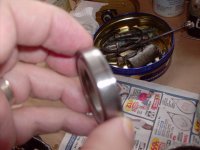
Pictures of the washer are attached. A little fuzzy but you can tell that the o-ring is deteriorated and the rest of the washer is clean and smooth.

At the end of season before last, the drive passed pressure and vacuum tests without any problems. Had I not tested this fall, and had a bellows leak sometime next season, may have had a serious problem with the outdrive. Preventative maintenance is significantly cheaper than repair!
 

Attachments

  • HPIM0773.jpg
    HPIM0773.jpg
    53.6 KB · Views: 137
  • HPIM0772.jpg
    HPIM0772.jpg
    52 KB · Views: 141
  • HPIM0770.jpg
    HPIM0770.jpg
    48.9 KB · Views: 124
Back
Top