Logo

Alternator for 360

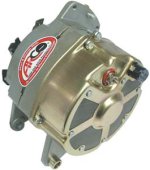
While it's labeled ARCO, this one looks like a version of the Delco 10Si.... (the rear 10Si style cover gives it away).
360 Chrysler Marine alternator.jpg

The Chrysler boys will hopefully chime in here, but I'd say that your twin mounting arms/ears are your main concern if that's what you now have.

The one that you show above is referred to as the "one-wire" or "single-wire" self-exciting alternator.
If you use this, the existing external requlator wires become capped off.
Pos and Neg are still used as you would normally.

These require an initial rpm bump to excite the field... once excited, they remain excited at idle rpm and up....., and until shut down.
No issues with this at all. .... but some misunderstand this and/or don't care for it.

.
 
Last edited:
Thanks for the reply, Rick. I'll have to take a look at the way it's mounted. Is there a preference of a single wire or external regulator?
 
Thanks for the reply, Rick. I'll have to take a look at the way it's mounted. Is there a preference of a single wire or external regulator?
If there is, it would be a personal preference.
The 1 wire is simple.... no external regulator to have issues with.
The externally regulated style becomes excited without the rpm bump.

Either produces the same charge rate for a given amp rating.

If you need high output..... none of these OEM or OEM replacement types will cut it.
You'd need to go with Balmar or one of the more expensive and heavier duty alternators.... and also increase the size of the Pos/Neg charging circuits.
 
I think that's a generic photo of an ARCO alternator. As long as you get the ARCO 40112, it will fit your Chrysler 360 without modification aside from tying back the old field wire. I have one on each engine. The website you show states that this alternator is remanufactured. For that price, you can easily find a 40112 that isn't, although I'm not sure that there is much difference between new and remanufactured if ARCO did the remanufacturing.

When you install the new alternator, consider replacing that crusty old wire that runs from the alternator to the starter solenoid with a length of 12-gauge tinned wire and new connectors at each end. You might as well get all the charging power that you new alternator offers.

Bill

 
................When you install the new alternator, consider replacing that crusty old wire that runs from the alternator to the starter solenoid with a length of 12-gauge tinned wire and new connectors at each end. You might as well get all the charging power that you new alternator offers.

Bill

Bill, I certainly agree with that, but would suggest that the OEM circuit is probably 12 ga. as it is!
He may as well replace it with 10 ga. and also replace the little Negative lead that joins the alternator chassis to the engine block.

Just a thought!

.
 
Rick,

I think the OEM wire is 12-gauge and it sure could be good idea to make that 10-gauge if he has the right terminals on hand. Given the age and the heat in that area, the old wire and especially the old terminals really should be replaced. It only takes a few minutes. The same is true for that little negative lead although all of the current flow that completes the alternator circuit is probably coming back through the alternator body itself.

But that brings up another good idea when upgrading the charging system. Check the ground cables between the battery bank and the engine block. That connection carries all the DC return current for the entire boat. If the connector at either end of that cable is not bright and clean and the mounting points free of rust (they sure weren't on my boat) it's a great time to fix that too.

Bill
 
Rick, The same is true for that little negative lead although all of the current flow that completes the alternator circuit is probably coming back through the alternator body itself.
Bill, intuatively that makes sense.... and I don't completely disagree.
I'm certainly no engineer, but I'd bet that they would prefer that we use the chasiss negative cable.
 
Last edited:
Back
Top