Logo

Alpha 1 gen 2 not going into reverse

Vaisär

New member
Hello there.
My alpha 1 gen 2 is not going into reverse every time. Some times it does, sometimes it does not. Cables all good. Upper shift shaft seems good. Lower shift shaft turns further anti-clockwise than what we think is normal, pretty close to 90°. Has anyone encountered this before, and do you think this could be the reason for the erratic behaviour? Other proposals?
Thank you.
 
how do you know if cables are adjusted correctly?

Have you removed short shift cable from shift bracket and can you get reverse every time when pulling cable? Pull for reverse and push for forward.

If that works then maybe cable adjustment might be needed. I would try his first! If cable needs adjustment post back and I can post how.

Also pay close attention to the bell crank (as I call it) the wheel. make sure it is all there and it spins, Item 22.

Also look closely at the "shift fork" on the end of the short cable which moves the bell crank. pull it out as far as you can, gently (with engine side of cable disconnected from shift bracket) and see if there is a lot of muck deposited behind it. If too much muck is there the shift fork will not go deep enough to engage reverse every time. If this is the case it must be cleaned as the muck is inside the hole of the shift fork which you cant see unless you disassemble the shift cable. This might be tough to figure out so it may be a last place to look. But if there is a lot of muck around the cable nut behind shift fork that is a good sign this may be the issue.

Other area of concern if everything else is good is explained below.

Look at link of parts break down, I have seen this a couple of times on the Gen II's

The bushing Item 5 has moved UP in the bell housing about 1/8 inch. If this happens the vertical shift shaft also moves up and reverse does not get made every time you shift. You can see if you look closely, there will be a slight color change in the bushing outside diameter. It will be lighter in color as it has not been exposed to the exhaust as long as the rest of the bushing.

If this is the case the shift shaft item 25 must be removed and the bushing gently tapped back down. BUT NOT TO FAR!! It has to be at the right height or it will cause an interference fit with the outdrive shift shaft.

then reassemble the shift shaft. Make note of the orientation of the (item 25) U shaped bottom so you assemble it back oriented correctly. You can do it 180* out.


http://www.marineengine.com/parts/m...11995/0d469859-thru-0f679999-usa/bell-housing

 
Last edited:
how do you know if cables are adjusted correctly?

Have you removed short shift cable from shift bracket and can you get reverse every time when pulling cable? Pull for reverse and push for forward.

If that works then maybe cable adjustment might be needed. I would try his first! If cable needs adjustment post back and I can post how.

Also pay close attention to the bell crank (as I call it) the wheel. make sure it is all there and it spins, Item 22.

Also look closely at the "shift fork" on the end of the short cable which moves the bell crank. pull it out as far as you can, gently (with engine side of cable disconnected from shift bracket) and see if there is a lot of muck deposited behind it. If too much muck is there the shift fork will not go deep enough to engage reverse every time. If this is the case it must be cleaned as the muck is inside the hole of the shift fork which you cant see unless you disassemble the shift cable. This might be tough to figure out so it may be a last place to look. But if there is a lot of muck around the cable nut behind shift fork that is a good sign this may be the issue.

Other area of concern if everything else is good is explained below.

Look at link of parts break down, I have seen this a couple of times on the Gen II's

The bushing Item 5 has moved UP in the bell housing about 1/8 inch. If this happens the vertical shift shaft also moves up and reverse does not get made every time you shift. You can see if you look closely, there will be a slight color change in the bushing outside diameter. It will be lighter in color as it has not been exposed to the exhaust as long as the rest of the bushing.

If this is the case the shift shaft item 25 must be removed and the bushing gently tapped back down. BUT NOT TO FAR!! It has to be at the right height or it will cause an interference fit with the outdrive shift shaft.

then reassemble the shift shaft. Make note of the orientation of the (item 25) U shaped bottom so you assemble it back oriented correctly. You can do it 180* out.


http://www.marineengine.com/parts/m...11995/0d469859-thru-0f679999-usa/bell-housing

Thank you for your swift reply. It will be early next week before I get time to check all of this out. Will keep you posted!
 
Is the lower shaft straight when if Fwd gear? Has to be in a straight line 12:00 looking down from the top, neutral about 11:00 and rev about 10:30
 
Lower shaft is straight when in forward, pointing to 6 o'clock.
When turning lower shift shaft mine turns anti-clockvwise, and does so almost all the way to 3 o'clock. This seems further around than I have seen on other outdrives. Any explanation to why the turncircle goes so far? Upper shaft ends upp driving the shift fork to the bottom and reverse can't be reached?
 
Last edited:
It is hard to fully grasp the " time " explanation.

Lets start with this.

The lower shift shaft, when in forward it is
12:00 looking towards bow of boat.

So when in reverse we say it will be almost 9:00

That being said,

The shift shaft drives a C shaped piece in the lower which drives a shift spool.
The shift spool is connected to a clutch dog which engages forward/reverse gears.

Do not jump the gun until you confirm the first post aswering your first post.

Shift spools in Gen II's rarely have issues.

So respond to original suggestions and then we can move forward.
 
Hi there.
All cable work checked with mercruiser measuring tools, and all correct.Bell crank present and correct. The sterndrive has less than 100 hours on it, and the only thing behind shift fork is some grease. Bushing (item5) is in place, checked by authorised mercruiser mechanic.
 
Lower shaft is straight when in gear. When in reverse, it turns to almost 9:00. At this stage the `shift fork`hits the inside of the bell house and can not go further. The only way to engage reverse is to turn the lower shift shaft by hand a little further from this position, we are talking 1-2 degrees, and reverse slots into place???
 
Shiftshaft.jpg
This is my reverse?
 
The pictures are from left to right,

Neutral ~ 11:00
Reverse ~ 10:00
Forward ~12:00

I agree if your move lower shift shaft to 9:00 you either have a shift spool issue, the C piece that drives/moves the shift spool (attached to lower shift shaft in lower cone area) or reverse gear/carrier is out of spec/location .

Has this always been this way or did it happen over time or after a recent service?
 
If the fork is straight in F , then you do have some type of drive issue . Reverse is WAY to far. Do you have the merc manual and do you feel capable of doing the repairs?
 
Hi.
Thank you for sending the manual. I think this is beyond my capacity, and will have to take the lower to a shop for inspection.
 
10.40 is GMT +2. I live in Finland where the boating season has just begun and lasts for 3-4 months, hence the rush! Thank you all for your contributions!
 
Hello all.
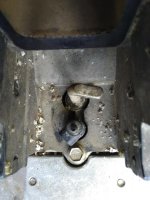
Lower opened and this is what we found on the reverse gear. It looks the same through the entire circle. I take it the wear on the gear is a result of something else, and not the issue that has caused the problem to occur? The rest of the lower looks pristine.
When turning the lower shift shaft, it moves 5-10(?) degrees from straight before the sliding clutch starts to move. Is this normal?
I would like to understand the excess turn circle of the shift shaft before I put in a new reverse, otherwise it stands to reason that the new reverse is going to wear out just the same?

reverse.jpg
 
What you are looking at is the engagement teeth for the clutch dog that you think is worn.

Yes it is worn but not your problem.

http://www.marineengine.com/parts/m...ear-housing-propeller-shaft-standard-rotation


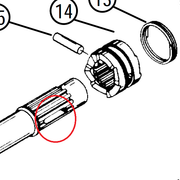
The sliding clutch is called a "clutch dog". item 45

That is moved by way of the shift shaft and Item 39 "shift crank" which moves the shift spool item 40


So you need to remove the prop shaft with forward gear and that will have the clutch dog and shift spool attached when removed. What will be lift in gear case is shift crank.


Pull up shift shaft and remove shift crank.


Before disassembly of prop shaft and shift spool/clutch dog,

NOTE clutch dog has two grooves and note which way they point on the shaft.
It has to be reassembled the same way!!

remove wound spring wire from clutch dog, push pin out of clutch dog/shaft and now shift spool will slide out.


attached is the shift spool spec and some notes.

If shift spool looks bronze it is old style, New style looks steel grey in color.

If all these parts are in good condition and no excessive slop or wear are seen then the only other possibility would be the CARRIER with REVERSE gear is not seated deep enough in housing which would cause reverse gear back lash to be way to high and could be due to wrong shim stack being used. (Too many shims).

See attached for more info
 

Attachments

  • shift.jpg
    shift.jpg
    59.1 KB · Views: 609
Thank you for this, will look into it.
Like I have said, the drive has approx 100 hours on it - so its practically new.
Looking at the wear on the engagement teeth for the clutch dog - your proposal of the reverse gear not sitting deep enough in the housing would make sense? Is this what you mean that the clutch dog does not get hold of it properly, but sits on the very `lip`of the engagement teeth and can hence slide off it and cause it to wear? The wrong shim stack would in that case have been put in at the time of factory assembly???
 
Basically yes.


Worn clutch dog teeth only would cause the dog and the gear not to STAY engaged. The dog can "pop" out.

Also wear on the corners of the dog/gear engagement teeth shows shifting into gear to slowly. Shifting must be quick and firm.


Unfortunately the only way to check reverse gear engagement is by checking gear lash. If you down loaded the manual it shows how to do so and shows the spec for reverse gear lash.

For now I would focus on the shift crank, shift spool and also double check that the clutch dog is facing the correct direction as shown in the pic.
There are two grooves cut into it and they should be facing the prop.

There is one other possibility,

Remove the shift shaft bushing and pull the shaft out.

It simply could be bent.

If someone tried to remove the drive without the shift control being in forward and forward gear engaged, the the shaft could have been bent in doing so.
 
Last edited:
I post the full manual if needed but if you look at the prop shaft this slot regulates the total travel of the shift dog
The shift dog is moved by the shiftspool shaft and locking pin. the shift shaft turns the C selector moving the spool in or out. If the gears were not set correctly the drive would be making some terrible grinding sounds .
 
Back
Top