Logo

88 omc 4.3l v6 starter removal tips?

DavidBall

Member
Trying to remove starter, to have it tested, replaced or rebuilt. Two 9/16' vertical bolts from the bottom won't budge! The Starter Gear cover is in the way of one bolt and wont allow me to get a socket on there. AND the gear cover is bolted to the block from the stern side, and I cant get to it. Not even sure if this needs to be removed. Trying to keep from pulling the engine. Any tips? I have read some threads about this but not sure if they apply to my engine/starter. The Manual gives very little info on removal. Thanks!
 
its a pita for sure, I think when I did one i may have used either a regular boxed end wrench or an off-set boxed end wrench. Disconnect Battery, disconnect wires, no need to take the gear cover off.
 
Glad to hear the gear cover doesn't have to be removed. It looks like an even bigger PITA. I've invented some new cuss words this week and I'm sore from head to toe from all the contorted positions I've been in, trying to get this bolt off! Tried the box-end last night. Can't get enough leverage, and the wrench started to strip the bolt head, so I stopped. I swear unless my wrench is off, the bolt head seems smaller than 9/16. Gonna go to sears and look for an extra-thin wall socket. If this keeps up, a pull-rope starter may be in order. :confused: I appreciate the tip. I'll follow up soon.
 
Finally got the starter off. Took it to my local starter repair guy, who said it seems fine. Now I'm not sure what the problem is. I can turn the flywheel by hand, so I don't believe the engine is seized. I did notice that the red wire from battery to Solenoid was a tad loose. When I turn the key, the starter clicks and acts like it is trying to turn. I even heard a faint squeal coming from the starter motor. I jumpered the solenoid and got same result. GOnna put the starter back on tonight and tighten up the wires better.

Last question: When the engine failed to start, my dashboard Volts gauge was reading around 11.5 volts, and when I turned the ignition, it dropped down to around 5 volts. Does anyone know roughly what the voltage needs to be to start? I heard nominal is around 12.5 volts. With Engine running, i get around 14 volts from the alternator.
 
David, everything that you have described sounds like an engine that is seized up..... in particular the growl or squeal coming from the starter motor, and the very low voltage.
Under normal conditions, you will see a voltage drop from a normal 12.5 or so, down to approx 10 volts or so.
If you saw only 5 volts, that indicates a very heavy amp draw..... such as a starter motor that cannot spin the flywheel.


Try turning the engine over with a strap wrench wrapped around the harmonic balancer.
DO NOT use the center balancer bolt for this.
The torque value for this bolt is 60 ft lb.
If you were to exceed this, and if this bolt snaps off, you'll not only be pulling the engine, but you'll be taking it to a machine shop for proper bolt extraction.


In the future (and not with a seized engine), try to warm the engine up prior to loosening the starter motor bolts. This will help with any rust or corrosion.
Use a six point wrench on these bolt heads, and perhaps a thin wall wrench on the one outer bolt that is in conflict with the flywheel cover.
 
Last edited:
Take the plugs out and see if there is any water/rust on the plugs?
Then try turning the motor over when the plugs are out?
 
Finally got the starter off. Took it to my local starter repair guy, who said it seems fine. Now I'm not sure what the problem is. I can turn the flywheel by hand, so I don't believe the engine is seized. I did notice that the red wire from battery to Solenoid was a tad loose. When I turn the key, the starter clicks and acts like it is trying to turn. I even heard a faint squeal coming from the starter motor. I jumpered the solenoid and got same result. GOnna put the starter back on tonight and tighten up the wires better.

Last question: When the engine failed to start, my dashboard Volts gauge was reading around 11.5 volts, and when I turned the ignition, it dropped down to around 5 volts. Does anyone know roughly what the voltage needs to be to start? I heard nominal is around 12.5 volts. With Engine running, i get around 14 volts from the alternator.

Ayuh,.... Considerin' the Positive wires were fallin' off their connections,...

Maybe ya oughta go through the Ground connections to clean off the crud, 'n corrosion, then tighten 'em up,...

A Bad ground could cause those sorta Issues,...
 
Thanks all for sharing your experience. This my first boat, so I really appreciate it. As I mentioned in an earlier post, I can turn it over by hand, with the plugs out, and I can't see any water in there. I need to mention, when this boat first failed to start, I was on the lake, testing a new impeller kit, and was having overheating issues only at low rpm and idle. I had stopped the boat, to let it cool. Sat there for 30 mins and then tried to start. I had left the radio on too, so the battery could have been slightly drained. Turned key and got the click and squeal. Jumpered the solenoid... same thing. I tried to turn over by hand, with belts and a ratchet on bolt, but could not budge it. After 4 hours and being towed in, I removed plugs to check for water, and WAS able to spin it by hand. I have not tried since. (This was 7 days ago). Is it possible that a hot engine could be temporarily seized, and then frees up after cooling down? I sure hope so.

AS to the cooling issue, This weekend, I am replacing impeller again, and removing the drive to check for cracked grommets and/or water tube issues in the lower unit.

Bondo, I hope you are right. I had wirebrushed and cleaned most of the electrical. I HAD NOT cleaned (or found) the ground connection to the block. Any idea where it is? I've looked but wires disappear.
 
........................

This my first boat,
There will be a learning curve that comes along with new boat ownership. Be patient.

As I mentioned in an earlier post, I can turn it over by hand, with the plugs out, and I can't see any water in there.
this is a good sign.

I had left the radio on too, so the battery could have been slightly drained.
As a new boat owner, you'll soon learn that we should have two battery banks.
One deep cycle battery for while at anchor, and one cranking battery that will be held in "reserve".


I removed plugs to check for water, and WAS able to spin it by hand. I have not tried since. (This was 7 days ago).
Is it possible that a hot engine could be temporarily seized, and then frees up after cooling down? I sure hope so.
Whether or not cooling down helps...... you need to get this engine running ASAP as to evaporate any residual water.
Water laying around the piston rings is a recipe for rust and piston ring siesure.

AS to the cooling issue, This weekend, I am replacing impeller again, and removing the drive to check for cracked grommets and/or water tube issues in the lower unit.
Get your hands on an OEM cooling system schematic, and study the hell out of it.
There is much more to your cooling system than an impeller alone.

Bondo, I hope you are right. I had wirebrushed and cleaned most of the electrical. I HAD NOT cleaned (or found) the ground connection to the block. Any idea where it is? I've looked but wires disappear.
Follow the Negative cable from your battery bank to the engine block. This will be a heavy cable.
This must be a very good and solid engine block connection..... as well as a good cable and cable fittings, and of the correct cable gauge.

BTW..... and just a suggestion...... if you end up replacing this starter motor, rid yourself of the old Delco non-gear reduction motor.


Instead, purchase a HTGR/PMGR starter motor.


The armature spins approx 3 X's that of the OEM, and is then gear reduced for more torque to the flywheel.
These will kick A$$ over the non-reduction motors..... and will do it on fewer amps.


.
 
Last edited:
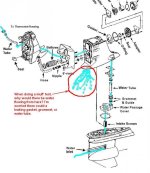
Rick, Thanks again! I agree with all of the above. I have studied the hell out of the cooling system. The original owner left an OEM manual in the dash, Thank God. I have been troubleshooting this for a while. I have a separate post pertaining to the overheating issue. I have large amounts of water exiting through the joint between the upper and lower units, near the anode. Based on the water flow schematics and diagrams, water should only exit through the holes in the exhaust bellows and some through the prop. I'm taking the drive off tomorrow to see if the grommets are cracked. I have bought the gasket set for the upper unit/transom union and also the 2 new grommets and inlet screen. I'm really anxious to see whats going on in there. I have read other posts from cobra owners saying water from this joint was normal. I still don't see how. Here is a pic from my other post.
88 omc outdrive flow.jpg
 
David, while on the garden hose, and at idle RPM (or in the water), you will see exhaust water exit via the low speed exhaust relief ports.
This is very normal.
These ports are near the water surface, apposed the prop exhaust of which is deeper in the water.
These relief ports are to prevent engine fuel loading from back pressure, while at idle speeds.

You may not see exhaust water through the prop hub until at the higher rpm.

However, your over-heating focus should be aimed towards the supply and where the water goes from that point, and/or finding any restrictions in the system.

When these systems are new, everything works as planned. Engine and exhaust all run at the correct temperature.
But as these systems age, things change due to rust scale, corrosion, restrictions, etc.
The goal is to find out what changed and to correct it.


.
 
Last edited:
In addition to the muff test shown in the pic, I have since removed the impeller housing and forced garden hose water through the intake hole (toward the inlet screen). In that situation, most of the water should have been coming out of the inlet screen, right? More was coming out around the joint of upper and lower units.

Maybe I need to study it more, but I don't see another path.
 
Bad news. Before, when I checked plugs for water, I had only removed 1 on each side. Took them all out today, water poured out of the back two on each side. Now can't spin the harmonic balancer. Looking at oil through cap, it looks slightly milky. Blown head gasket from overheat? Or manifold seals? Damn. Guess I need a real marine mechanic now. This is over my head.
 
sorry to hear, the V6 Block can Crack on the inside of the V at the tops of the cylinders, allowing water to pour into the engine.
 
Yep, thanks. I've heard that. Gonna do a pressure test later this week, If I can get it to spin. I Put penetrene in the cylinders yesterday. I have the old batwing one piece manifolds/risers. It's a long shot, but I hope it's just the manifolds. Kinda unlikely they both leaked/failed at same time. Regardless, may do a 2 piece conversion. There's always next season. :-(
 
Back
Top