Logo

454 Crusaders-Twin Perko battery switch settings?

nightstalker

Regular Contributor
My 1990 454's have two of the Perko battery switches (1/all/2). The previous owner said that he kept both switches on "all". Is that the correct thing to do? Why are there two switches? Couldn't both batteries be connected to just one?
Nightstalker
 
My boat is set up so that normally the left engine battery switch is connected to the left battery (#1)which is connected to the buss that powers left row of breakers. Turn the switch off you kill power to the left engine & left row of accessory breakers.The right switch handles its side the same way & is normally set to battery #2 the right battery. Each engine/battery normally supplies power to half the electrical load. The idea is you keep any failure confined to half the system. You can use the switches to connect the batteries any way you want once you know you have a problem. Keeping the switches on both connects everything together keeping all your eggs in one basket.
 
Interesting question. Since we have an inverter on our boat, we use LOTS of batteries, with everyone of them on the starboard 'house' bank. The only thing the port battery does is fire the engine. If we were to run the house batteries down too low, we can fire the port engine then parallel the battery switch to get the other one going. (Marinettes came with a solenoid deal that combines the battery banks with the push of a button.)

What counts most here is bilge pump power. If--heaven forbid--your boat springs a major leak, you want your all of your batteries keeping the pump(s) going. With the battery switch on "ALL" that keeps them ready to go. But, if you're overnighting, you might want to isolate one of those batteries separate, just in case you run the other ones down too low to fire the engine.

Six of one, a half dozen of the rest....

Jeff
 
Last edited:
No matter what the set up is you need to know what options you have for configuring your batteries. Try the system different ways at the dock. Find out how your pumps are wired. Find out how your radio is wired. Many times they are connected directly to a battery on their own fuse, maybe no fuse at all. You don't want to try to figure this stuff out at sea with smoke coming out from under the dash. Many years ago a boat was run down by a barge at night because the captain lost power to his electronics & running lights,became disoriented & ran between the tug & barge. He was the only survivor. The boat was recovered & found to have a broken alternator belt on one engine. All he had to do was switch to "both"
 
I prefer not to have these 1-2-all switches. They are, at best, confusing to operate. For twin inboards, a port starting battery, and a starboard starting battery should be used. The "emergency" momentary switch and solenoid is very good. For all other loads, get a house battery, a deep cycle.
In my boat, I use a couple of group 27's gels for the house. AGM would be even better. Or, if room permits a 4D, or a 8D, or some golf cart batteries. Isolators from the alternators to the batteries. You still need ON-OFF switches from the batteries, but these are easy to use. Once aboard, turn them all on! All bilge pumps avoid the main panel; they get a fused connection to various batteries, directly.
I know manufacturers rarely do it this way; many will use the starboard engine battery to power the panel, or the panel is split between the two starting batteries. It's a cost and space saving technique. My group 24 starting batteries last me for about 6 to 7 years, the gel house batteries about 10 to 12. THey have different jobs, and should use a different construction battery.
 
Interesting question. Since we have an inverter on our boat, we use LOTS of batteries, with everyone of them on the starboard 'house' bank. The only thing the port battery does is fire the engine. If we were to run the house batteries down too low, we can fire the port engine then parallel the battery switch to get the other one going. (Marinettes came with a solenoid deal that combines the battery banks with the push of a button.)

What counts most here is bilge pump power. If--heaven forbid--your boat springs a major leak, you want your all of your batteries keeping the pump(s) going. With the battery switch on "ALL" that keeps them ready to go. But, if you're overnighting, you might want to isolate one of those batteries separate, just in case you run the other ones down too low to fire the engine.

Six of one, a half dozen of the rest...


Jeff[/QUOTE

My three bilge pumps are wired directly to each battery. I also have the parallel start switch at the helm. If I had a dead starting battery, I would start the other engine, engage the parallel start switch (putting starting power to the other engine) and fire her up?
Nightstalker
 
Long as one battery is UP and can be isolated from the others (the dead ones), you can get an engine going. It then acts as a battery charger for the other batteries.

Jeff
 
A couple of thoughts (you may already have all this covered but maybe someone doesn't):

1. Connecting batteries in parallel--- particularly ones that are not now identical--- can lead to one battery pushing charge into the other due to differences in internal resistance. Generally, the effects are slow. My preference in these setups is to run with one or the other and not both for normal operation. often you see folks running one battery-one engine with the ability to switch around if a battery is defective or accidentally run down.

2. Pumps--- if it springs a leak at the dock, it may not matter what or how many batteries you connect it to. It's surprising how much water can come through how small a hole and how much power pumps can take during the week you are not there. In my mind, as important an issue is to make sure pumps work while I'm on board and will buy me some time to solve the problem. Some manufacturers wire pumps through a float switch or equivalent sensor with a separate fuse and direct connection to a battery. Therefore, if all switches are off, the pump(s) will still run off the float switch and that single battery. It's worth knowing what this setup is on your particular boat. I frequenty reach down and manually activate every float switch to assure I have protections.

3. If I have more batteries than engines, I systematically use one battery for a trip or two and then switch.

4. You can switch underway with most battery switches but be really careful never to end up with any engine's alternator running without connection to a battery. You will fry stuff. Most battery switches are make-before-break as long as you do not switch through the OFF position.

5. There are several more automatic alternatives which are nice but not generally necessary is you understand your setup and don't mind throwing a switch or two sometimes.

Good voyaging,
Bruce Clarkson
 
A couple of GP 27 for the start and a 4-D for the house is great. But what about the battery charger? In a three bank charger, most manufactures prefer three like battries.
 
That is correct...If you have gels, you should not add lead batteries to the charging link, for example. When my batteries need replacement, I think I will need to plan in advance $$$$$$$ (7) group 31 AGM's. The inverter / charger we use is fantastic for recharging and completly automatic.
 
I think 'lou hit it on the head; you need to figure out what you have and how it works.....just like the fuel line routing....and it would be a good idea to figure it out at the dock.

I'd discourage moving any battery switch with an energized alternator connected to it (unless you know how its wired and what the risks are). I don't think I've ever seen more than six switches wired to make use of the field disconnects.
 
My Mainship with twin 270 crusaders is set up similarly with a group 31 battery for each engine to its own "1-2-all-off" perko switch and with each starting one engine and supplying half the house load. The genset has its own battery with is not tied in except that it does stay charged from the 3 bank Newmar charger. This arrangement works fine for me except for when I need to use the 12v fridge which draws down a single battery too quickly. If I switch both perkos to "all' will juice from both 31s be available equally to service the house load? There are no wires coming off either battery other than the big thick leads up to the switches. Thanks
 
I have learned this lesson (painfully): Each bank of a charger needs to charge ONE battery ONLY. You MUST isolate each battery during the charging and--even more important--the maintaining (float) periods.

Now, when you are underway, especially if you plan to overnight on the hook, the situation is different. The next day (after running 12 volt accessories and inverters) you need to recharge those batteries, and leaving the Perkos on 'ALL' helps get that done. I even leave the battery parallel switch (that connects port and house banks) ON to allow both alternators to recharge the 5 batteries I use.

Jeff
 
Last edited:
It depends upon how the connections are made between the battery switches and your "house load"...either way, this setup is usually suboptimal for many owners...there have been many posts regarding battery wiring options...suggest you use the Search Function to explore that wealth of data...it would also be very beneficial to understand exactly how your batteries may be connected to your "house load" (breaker panel)...
 
My 1990 Silverton 34C was set up the same way. The left switch controlled one battery to the port engine and the electrical input to the left side of the power distribution panel and the right switch controlled the other battery to the STBD engine and the right side of the power distribution panel. Following cabels from the switches is difficult at best. Discovering exactly what each switch controls can take some time but by slowly and methodically working through the process will serve a great benefit by you gaining explicit knowledge of your electrical system.
What I did was disconnect one battery at the battery and place both switches in position 1 and see what works and what does not. Now change both switches to position 2 and check what works and what does not. Now re-connect the disconnected battery and disconnect the other battery and repeat the process. Now, get a label gun or some peel and stick labels and label one battery Port and the Other STBD based on you findings. On the power distribution panel place a lanel at top based on which position controls which side if that is the way it works out.
The other ting you may want to do is to pull the power distribution to view the back side and use a digital camera and take a few pictures from differnt angles and if you are not an electrically skilled person take the pictures to a person that is and examine the pictures for what may look like unconventional wiring. I did this and found a few items wired directly t the HOT side of breakers. This ment that turning the breaker off only de-energized properly wired items but not the HOT wired items.
Also, another useful idea is to take multiple pictures at periodic intervals of your engine room and examine them on your computer to assist in spotting trouble before it becomes critical.
 
When I got my boat, it had three batteries, one for port engine, one for starboard, and one for the genny. I had three on-off battery switches, one for the windless which was wired to the starboard battery, also wired to this battery was the house bank. The port switch and battery for for only the port engine and there is a parallel switch.

I rewired the setup. Not sure how well it works but after a year, never had a problem, or dead batteries. I now have 5 batteries, one just for the genny wired only to the genny because the genny had it's own charger.

I added two batteries for the house bank and tied the windless to this bank, in addition to moving the wiring for the house bank to the third battery switch which was for the windless. The other two batteries are for each engine. I then added two Yardina combiners, one house bank battery is parallel with the starboard engine battery via combiner, and the same for the port side. As I mentioned, I am not sure this is the best method, but it has been working very well so far.

I upgraded the 20 amp 3 bank charger to a 50amp 3 bank charger. The alternators are standard 60 or 65 amp I think. I did not want to replace the switches or the position - location. I am now thinking of changing to the Blue Seas "Triple Battery Bank Management Panel" which would require adding two ACR's, but still thinking about that change.

Hope I did not confuse anyone as I tried to explain this quickly.
 
Narw! The important thing is for EACH battery to be isolated from the others during charging and have its own, dedicated charger (or bank of a charger).

Jeff
 
Hi all, Dan here (new-to-me 1987 Mainship 36 with twin crusaders, two 31 batteries, twin perkos) Jumping back on this thread as I am still hoping for help on my setup. I followed process suggested by Silverton 34 as our setup sound identical - one battery powering each powering one engine and 1/2 the house load. After running all combinations of the switches (1,2, all, off) and even switching the batteries I've found I'm getting no power from the number 2 battery into the system, everything is running off number one with both perkos set to all. I notice both perkos feed some sort of solenoid. Is this a combiner possibly related to the parellel start up on the helm? Any thoughs would be appreciated. Thanks
 
That's the battery paralleling switch that allows you to jump the weak battery.

Sounds like something is wired wrong on the Perko switch.

Jeff
 
I didn't take the perko apart but everything going into it looks original and well secured etc. I tried rotating the dial a few times as suggested on the perko site but didn't help. Are those perkos prone to failure?
 
This thread is from August 2010. Perhaps begin a new thread in the Electrical Section of the forum.
But, long as we're here........

IMO, the Perko MBSS (main battery selector switch) has the lightest contacts and spring tension of all MBSS's.... and in particular, the 90* sweep switches. I've broken these apart to compare and show the contacts.

No offense to you Perko guys, but I'd avoid these if possible.
If you are concerned, give one the BlueSea, Guest or old school Cole Hersee swithes a try.
(see image below)

Keep in mind that both engines can crank from a single cranking bank, if you desire. This often frees up space for a larger House Load Battery Bank.
Through your MBSS switching, you can always bring in the HL bank, or Generator bank in, should you need to.
Or keep a dedicated cranking bank for each engine.... either way works well.


BlueSea offers an array of ACR's for combining alternator charging for our HL Banks.
Here's their 120 amp version.


The Blue Sea 7620 ML-Series Automatic Charging Relay (Magnetic Latch) 12v DC is 300 amp capable.

The Blue Sea 7622 ML-Series Heavy Duty Automatic Charging Relay is 500 amp capable (shown at the right) and offers a cranking combine mode. This one also offers a remote switch.
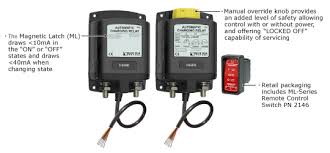


In many cases, these solve alternator charging and combining concerns.


Food for thought! :D


Here is a 90* sweep Perko shown next to an old 360* sweep Cole Hersee MBSS.
Look at the difference in size between the Perko contacts -vs- the C/H contacts.
What you cannot see, is the difference is spring tension. The Perko has considerably lighter spring tension.

BTW, the rear cover on the C/H is removable for service, and is O-ring sealed.
While the C/H looks "old school", it is by far superior to the Perko, IMO.

 

Attachments

  • MBSS Perko 90 d sweep  vs Cole Hersee.jpg
    MBSS Perko 90 d sweep vs Cole Hersee.jpg
    62 KB · Views: 802
Last edited:
Great info - thanks and sorry to have jumped on such an old string. One last question tho - the previous owner installed an electric windlass and ran his power line off the combiner solenoid terminal up to the 50amp breaker. At first I thought this was probably not an optimal place to draw power but having a better understanding of the parallel switch I can now see that perhaps this is by design to help operate the winlass from the flybridge (no parallel switch on lower helm) by flipping the parallel switch joining the batteries if they have run down while on the hook? Does that sound right or is this an abuse of the solenoid?
 
Back
Top
