Logo

40hp Johnson RKL-25D No Spark

I just bought a 60's era glastron boat with a 40hp Johnson (RKL-25D) outboard. I have voltage at the magneto, but still no spark. What could be the problem? Let me know if you need any more information.
Thanks in advance,
Adam
 
The magneto generates spark on it's own,----I hope there is no battery voltage applied to the coils !--------Do you know if this motor sat for a long time ??---------Pull the flywheel off and inspect the dual ignition in there.
 
I turned over the motor just with the starter and measured voltage coming from the magneto.

Yes it sat for a long time, it was a barn find and I know very little about its history.
Do I need a puller to remove the flywheel?
 
A puller is needed to remove the flywheel.--------Use the 3 holes with 1/4-20 threads.---------------Both coils are likely due for replacement.-----------The motor is the electric shift model and the generator must be in good working condition.--------------Water pump impeller must be replaced as well.
 
Check everything before spending $$$$$$------Check shift clutches, compression , ignition coils , pressure test lower unit, remove bypass covers to inspect pistons and rings.----A good / simple motor if it was properly maintained
 
Good Advice. I just ordered a service manual from this site, so assume the procedures will be in there. Anything else I should inspect while I have it apart?
 
Very simple system.---12 volts is applied to electromagnets and that pulls on the clutch spring.----That drag makes the spring wrap around the clutch hub and it tightens to drive the propshaft.----Very simple system !!----Some would argue.
 
Thanks for the reply,
I replaced the coils. They were completely shot. I also had to replace a condenser, so I now have spark. I rebuilt/cleaned the carb, it fires and idles great.

I put earmuffs on what I think is the intake. (grate on the side of the motor) What alarmed me was I did not see water spitting out for the cooling system, like I have seen with my 1986 yammaha 150hp. I noticed the intake scoop just above the prop so I then submerged the entire lower half in a garbage can full of water, but I still did not see water spitting out anywhere.

So where is hot water exhausted?

And how do I know if the impeller is working?
 
We did that test. Water shoots up the Tstat side. Where does it go from there? I'm concerned I might have a clogged hot water exhaust. Does it even shoot out anywhere visible?
 
Thanks for the reply,
I launched it yesterday, and it started right up, but I now have some tuning problems.

It developed a bad miss, and after a short trip on the water it wouldn't like more than 1/8 throttle.

Also there was a problem with the shift system. It felt like it was slipping out of gear. It would lug and shoot up the RPM, then catch back into gear. This only happened when we got it in the higher range of RPM. Mind you, it would go into drive, neutral, and reverse with no problem at low/zero speed.

I'm going to study the manual a bit, but any advice is greatly appreciated
 
I am also a bit new to these engines, so hardly an expert, but have the same model that had slipping gears...with regards to the slipping out of gear, sounds like the gear springs slipping on the hubs. These lower units need the correct gearcase oil or they will not shift properly/will slip (you need type C gearcase oil - it will usually specify it is for use in electric shift on the bottle). Also, if the gearcase oil looks like a milkshake/there is water intrusion in the gearcase and it will need to be resealed. I would check that first / change the lower unit oil and be sure to fill with Type C. If oil is like milkshake, you will likely need to replace the seals otherwise you will end up back in the same place (but it could also be something as simple as the PO not installing the washer under the fill screws).

Another potential issue on the slipping could be that the electric current to the shift magnets is being disrupted, causing the magnet to disengage. This could be happening at higher rpms due to vibration or perhaps there is fault in the throttle controller (there is an electric switch in the throttle controller that is toggled when the throttle/shift lever is moved out of neutral.

Your post mentioned that it sounded like it would 'lug' and then shoot up in RPM...not sure what would cause it to 'lug' at prior to slipping. Could be you have more than one issue such as a propshaft bearing that is locking up/binding at higher rpm's enough to cause spring to losing grip on the hub. In anycase, I would check to see if your lower unit oil is clean first and go from there. In my case I had a leaky lower unit and bad bearings (completely seized, one in the lower gearcase around propshaft and one around driveshaft, in the upper gearcase).
 
Ok thanks, this all makes sense,
I changed the gear-case oil before starting and I did NOT use type-C. The oil I drained out was a little milky.

I definitely could have a better connection on the battery too. I also don't know if my generator is working properly.

I should've used different diction when describing the "slip", that's all it was... a "slip"
 
Regarding the lube, OMC/Bombardier it is called "Premium Blend" gearcase lube and will specify on the bottle that it is for electric shift. Sierra also sells substitute and bottle specifies Type C - be sure to get the right one. If you have any contamination in the gearcase, it may make sense to flush gearcase a couple of times (sacrifice a bottle of lube in the process), and refill with fresh (any grit between the spring and hub will cause slipping). If it was only slightly milkshake, perhaps it is a minor leak, and a fluid replacement will get you through to the winter months for a more thorough review/proper fix (if you go down that route, suggest looking up my thread as I have gotten a lot of good advice from several members including kimcrwbr1 & racerone, very knowledgeable and generous with assistance, definitely experts).

In the for what it is worth category, I have been running without my generator connected this season as I haven't sorted that system yet (I think my regulator is fried and replacement is $100), but I have been running fine simply by putting battery on charger every couple few days (I am usually out on the water running for 3-5 hours before pulling battery for charging and the charger only runs for 30min before indicating full charge, vs 12 hours required to charge a fully depleted battery, so seems magnets arent drawing much power).

 
Thanks for the info vandenburg, I've been busy the last couple of months but am now focusing back on the boat. I have looked at your thread regarding the lower unit repair and am crossing my fingers that I don't have to go down that road. But if I do, your thread is there thankfully.

Along the lines of the lower unit and proper gear case oil....When I pulled the boat in the fall, I noticed a small pin hole on the bottom surface of lower gear case cover (see arrow in picture below). A liquid of milkshake consistency drained out of this hole. Is this hole suppose to be there or do I have a problem? (I'll try to post a real picture when I get a chance)
fin.jpg
Also, how do I properly pressure test the lower unit?
Thanks
 
Last edited:
The lower unit does have drain holes where I think combustion byproducts/unburnt fuel exit. The gear case where the gearcase oil is should be sealed though (I think). What does the leaking liquid smell like - if like gas, then I think that is normal.

You can check pressure by putting air into gearcase via oil drain hole and seeing where it leaks out. I did this with a bicycle tire pump and home built adapter to attach tire pump to oil drain hole and pumping to 5-10 lbs pressure. Not sure if this is an acceptable method, but it worked ok for me.

Mine leaked air out the prop seal, also between the upper and lower gearcase and the gearcase oil fill holes. After rebuilding, LU would hold the pressure.
 
Here is a picture to better understand what I'm trying to explain. That hole seems to have gear oil draining out of it. I noticed it on the ground as well. Seems that isn't good.......
Am I due for a lower unit rebuild?
photo(1).JPG
 
There is no point guessing on this !---Pressure test or have your local shop pressure test this gearcase.----That is the only way to determine if it is drainage from exhaust or a gearcase leak.
 
Ok. I finally performed a pressure test on my lower end. I applied 8 psi to the upper vent/fill hole and did not hear a thing. No air escaped the unit from the any of the seals that I could tell. I am pretty confident that the unit is tight because when I removed the air gun, the pressurized air escaped the same hole.
So am I good??? That's a really good sign right??

This leads me back to my question of why there is oil dripping down the lower unit. (pic posted above)

Note: I did not use the correct "type C" oil when I first tested the boat this summer. Is this most likely my problem?
 
Yep ok I'll take it as drainage then. I guess I'm a little ignorant as to fully understanding 2-stroke outboards and their characteristics but that's good news then. All I can do is test it again when the weather gets warmer. Thanks again for the help.
 
I have a re-sealed gearcase on pressure test at the moment.----Put an adapter on the gearcase and use 5 PSI ( 35 Kpa ) and let sit overnight. ---That usually tells the story.
 
Another question.

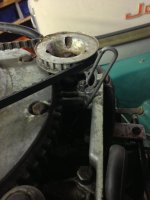
What does this rod connect to? I have the hand starter but it was not mounted when I bought the boat. I take it that I'm missing some pieces which connect to this rod. Somewhere in the manual I found that it could be a compression release. Is this correct? That seems to make sense since the rod is connected to the butterfly inside the carb. Can anyone confirm this or have a picture of a full assembly. What is the proper procedure for operation? Push down while pulling the rope??

photo 4.JPG
 
"There is a spring that pulls it up when the throttle is at slow you can pull start it if the throttle open it keeps you from pull starting."

Excellent picture!! Thanks. So basically this is a lock to prevent you from operating the pull starter while the engine is running? Does it affect engine performance at all from the spring forces acting on the butterfly? Or can I run without it?
 
Started the boat today to prep it for the first major test ride this weekend. The motor started up without any major issues and seemed to run just fine. When we were done I noticed there was a large amount of grey sludge all over the lower unit of the motor. It seemed to be coming from the drainage hole that I posted about earlier. Is this normal? How much drainage should I expect? What does it come from? Unburnt oil mixing with the water?..
It doesn't seem to be lower gear oil because that was a transparent redish color and this was grey/brown.
 
Back
Top