Logo

280 Engine to outdrive grounds/bonds

Windy Bay

Contributing Member
I am re-doing the Wiring on my boat, and as I have inspect the stern area I find that there are several ground/bonding wires that go from the stern drive to the bolts on the flywheel cover. None of the wires are marine, none have marine connectors, and some are broken. When I pulled the engine last year I found myself having to remove several wires from the flywheel cover/engine bolts to remove the engine. Is this Normal? should there be an easy way to disconnect these wires? All other wires going to the engine are in a wiring harness that is just un-plugged. Should the grounds be the same way. I believe these wires that bond the outdrive componets to the engine are very important to reduce electrolysis. Is this correct? Any input would be appreciated.
 
You should see a 10 ga bonding wire going from one of the lift out mechanism fasteners, then to the spindle arm pinch bolt, and then to a flywheel cover mounting bolt.

All major system Negatives will also connect to a flywheel cover bolt.
 
Use marine grade tinned wire and solder the lugs on then shrink tube the ends. You can never have too many grounds. Electricity flows from neg to pos and the water or neg earth has a small voltage charge that gets arrested at the first neg ground point. You can even bond the shield to the drive to arrest the current flowing up through the exhaust water.
 
Soldering wire fittings alone is not a preferred method.
Always crimp your wire fittings.
I prefer to do both..... start with a crimp and then finish with soldering, and then apply your shrink wrap if desired.


FYI..... the term "Ground" refers to Earth Ground as found used with A/C current in both commercial and residential electricity.
There is no ground in a 12 vdc system..... only Positive and Negative.
 
Thanks for the replies. I agree with Rick, that crimping is the best method. I also use shrink wrap, as it helps with strain relief. Thanks Rick for the location and number of bonds between the outdrive and the engine. the one on the tilt is there but not the other one. This boat has all the wiring a real mess. I have all new wires, and gauges coming for it. I still need to figure out where the main ground from the dash to the engine should be landed. Right now it is landed at the Alternator. Thanks for all the input.
 
.............
Thanks for the replies. I agree with Rick, that crimping is the best method. I also use shrink wrap, as it helps with strain relief. Thanks Rick for the location and number of bonds between the outdrive and the engine. the one on the tilt is there but not the other one. This boat has all the wiring a real mess. I have all new wires, and gauges coming for it.

I still need to figure out where the main Negative from the dash to the engine should be landed. Right now it is landed at the Alternator. Thanks for all the input.
Think of the engine cylinder block as the "System Negative Common". Your battery bank Negatives should make a direct connection to the system negative common.

All other Negatives can connect to a common Negative terminal block, or directly to the cylinder block..... your call!

The Negative for the helm and instruments is taken forward via a 10 ga black circuit that will be in the Engine harness/Helm harness.
There will be an OEM white plastic connector near the transom. This joins the Engine harness to the Helm harness.
The connector should be pulled apart so that the fittings can be inspected.
These fittings are often corroded.
You can replace each fitting if need be.
 
Hi Rick,
Thanks for the reply. I have the white connector at the stern of the boat that goes from the wiring harness to the engine harness. This connector had bad connectors that had corroded of burned off. My pictures seem to be too large to upload here. One of the previous owners has run a #10 red automotive wire around that connector. I have searched the net for the connectors that go in that plug and have been unable to find new ones, or any connector that is similar. Having not been able to find something to replace that connector, I found a 9 terminal trailer connector that I am considering using, although I would prefer to use that type of connector. I am completely re-wiring the main harness from the helm to the harness on the engine. pieces of automotive wire have been spliced to almost all wires. and or wires like the key switch to the starter solenoid were abandoned in place. As I have replaced wires like the one going to the Engine coolant temp, where I found 3 splices between the white connector and the sending unit. The original harness had a connector in the stern, and one at the helm, that are similar to a flat 4 trailer connector (except it has 8 wires. In the stern this connector was so corroded that 3 of the bayonets were completely corroded apart. The three were the main Positive (Red), the Main Negative (Black) and the alternate Positive (orange) Automotive wire were run in place of the red and black. To make thing worse someone had use an automotive tester (the one with a sharp tip) to test these and other wires) causing corrosion in the wire. I am using this link for my guide to re-wiring. https://www.westmarine.com/WestAdvisor/Marine-Wire-Terminal-Tech-Specs
 
This file shows the connectors. Not the best way but I hope it shows well enough.
 

Attachments

  • pics of wiring.pdf
    146.8 KB · Views: 172
Last edited:
Pull two heavy guage wires directly from the house battery to a fuse blpck and grounding bar under the dash. Fuse and switch the pos with a indicator light.
 
The male and female flat blade type wire fittings (found in the OEM white plastic connector) should be available.
Using a small pin-point probe, come in from the contact side to release the holding clip. Once the clip is released, the wire and fitting will pull out.
A good automotive electrical supply company can identify these and should be able to set you up with what you need.

These will easily carry the current for the data circuits, but.... IMO, they are a bit too light for the main hull harness Positive and Negative loads.

** You could also use a multi-pole terminal block in place of the OEM connector.


Hi Rick,
Thanks for the reply. I have the white connector at the stern of the boat that goes from the wiring harness to the engine harness. This connector had bad connectors that had corroded of burned off.
I am not surprised. I have seen this many times.

One of the previous owners has run a #10 red automotive wire around that connector. I have searched the net for the connectors that go in that plug and have been unable to find new ones, or any connector that is similar. Having not been able to find something to replace that connector, I found a 9 terminal trailer connector that I am considering using, although I would prefer to use that type of connector.
See my above ** suggestion.

I am completely re-wiring the main harness from the helm to the harness on the engine. pieces of automotive wire have been spliced to almost all wires. and or wires like the key switch to the starter solenoid were abandoned in place. As I have replaced wires like the one going to the Engine coolant temp, where I found 3 splices between the white connector and the sending unit. The original harness had a connector in the stern, and one at the helm, that are similar to a flat 4 trailer connector (except it has 8 wires. In the stern this connector was so corroded that 3 of the bayonets were completely corroded apart. The three were the main Positive (Red), the Main Negative (Black) and the alternate Positive (orange)
If you have an Ammeter at the helm, consider replacing it with a Volt Meter. A volt meter can sense voltage from an instrument circuit.
Doing so will eliminate unnecessary resistancecaused by the looooooong orange run to the helm and back to the engine bay area.


Also, I will suggest that you run both your SLBB and HLBB Positive cables to your MBSS terminals #1 and #2 respectively.
Run the MBSS "Common" cable to the engine starter motor connection.

Take both battery bank Negatives to your System Negative Common. DO NOT piggy-back from one battery to the other...... take both Negs independently to the System Neg Common.


SLBB = start load batt bank
HLBB = house load batt bank
MBSS = Main Battery Selector Switch
 
So as of right now this is my plan. I have ordered wire from a marine supply. All UL 1426 boat cable, tinned marine grade wire. #14 for the instruments, #12 for the orange, #10 for the red (+) #10 for the black (-), #14 for the blower, #12 for the key to solenoid, and I already have the #10 red on hand. I also got new wire for the bilge pump. three wire and am placing a new automatic/manual bilge pump in the bilge. instrument colors are Blue. Gray, Tan, purple, white, yellow with red stripe, and brown with yellow stripe. I am planning a terminal block near the engine compartment, and one at the helm. Each of the switches for blower, bilge pump, nav lights/anchor lights, wiper , and horn each have a switch and circuit breaker. I also have spare switches for future use. I am placing a 2nd breaker panel for accessories, power port, radar, depth finder ect. (oh and a new Ignition switch). The bilge pump will be wired directly via some sort of circuit protection to the battery.

Rick, I will try a big NAPA for the connectors in the stern. Although like you I feel that the connectors are a little small for the red, black and orange wires.

As a side note, I am not replacing the Wiring to the 280 drive. It is all in gray jacketed wiring type loom, and is working properly. I am also not replacing the nav light wiring. I am replacing the tilt switch, and the drive warning light. The new one is a rocker switch, and a red warning light.

Thanks
Larry
 
Last edited:
Yea i just eliminated the breakers and fused the lights and all accys under the dash. The only thing on the ignition switch is the guages that isolates the engine circuit from the house circuit. Be sure and put a inline fuse on the hot for accys at the battery. Fuse everything i dont trust the breakers much fuses are easier to replace on the fly!
 
Re: "and am placing a new automatic/manual bilge pump in the bilge".... every bilge pump I've installed in my boats and in others over the last 10 years has had an early failure of the "automatic" feature. I no longer use those with built in auto. I see a high rate of returns from customers at my P/T job in a big box marine store. I purchase an external float switch, the one with the protective "Cage" and the test lever feature. These can be wired as auto/manual easily.

The last boat i totally rewired, I hanged over the fuse system to the blade type, and installed a multiple fuse distribution block (BlueSea) near the helm. This gave a nice neat all in one fuse location and an easy way to have a neat wire layout. All terminals even if they are no where near the bilge are the ones with the heat shrink insulators. I also installed a small, blade fuse type distribution water resistant block at the stern at the batteries to handle fusing to the bilge pumps and the battery charger. No more dangling fuses.

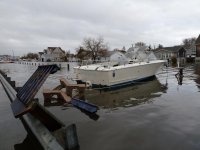
FWIW... my personal boat is not self bailing. I installed two bilge pumps, with caged switches. One pump is rated @ 500 gph and has it's switch is mounted as low as possible in the bilge and is wired to my "house" battery as dual purpose battery. The other pump. mounted right next to the first one is a 2000gph pump. It has the same type switch but it is mounted 1 inch higher than the switch for my 500 gph pump. This pump is wired to my start battery. Lancer Post SANDY.jpg


Does this system work???? The photo below is the photo taken of my boat 4 days after Hurricane Sandy ( the earliest I could get to it). This boat was located in a lagoon off of Barnegat Bay, about one mile south of the track for "ground zero" and about 2 miles east of Sandy's landfall. If you note carefully, there is a kid's roller hockey net draped over my Starboard bow piling, indicating how high the water was at that location. Those are someone's steps and table in my stern lines. My "house" battery was flat and my start battery was low but easily started my engine.
 
Last edited:
......................
So as of right now this is my plan. I have ordered wire from a marine supply. All UL 1426 boat cable, tinned marine grade wire. #14 for the instruments, #12 for the orange, #10 for the red (+) #10 for the black (-), #14 for the blower, #12 for the key to solenoid, and I already have the #10 red on hand.
Question: is the orange circuit for an Ammeter?
If so, please note that ammeters are rarely used these days in lieu of volt meters.
The long heavy ammeter circuit (to the helm and back) creates unnecessary resistance.
I would use a volt meter instead of an Ammeter, and I would eliminate the Ammeter circuit.


I also got new wire for the bilge pump. three wire and am placing a new automatic/manual bilge pump in the bilge. instrument colors are Blue. Gray, Tan, purple, white, yellow with red stripe, and brown with yellow stripe. I am planning a terminal block near the engine compartment, and one at the helm. Each of the switches for blower, bilge pump, nav lights/anchor lights, wiper , and horn each have a switch and circuit breaker. I also have spare switches for future use. I am placing a 2nd breaker panel for accessories, power port, radar, depth finder ect. (oh and a new Ignition switch). The bilge pump will be wired directly via some sort of circuit protection to the battery.
Suggestion: DO NOT make any direct battery bank connections other than Battery Cables themselves.
You have a perfect location right at the rear of the MBSS (#1 and #2 terminals) for any "Un-Interrupted" power source. This will be schematically identical to a direct battery bank connection. (direct battery bank connections lead to small terminal corrosion and confusion when doing battery R&R)

If you need an "Interruptible" power source, then use the "common" terminal!
The "common" terminal becomes excited when the MBSS is making a battery bank selection.


Rick, I will try a big NAPA for the connectors in the stern. Although like you I feel that the connectors are a little small for the red, black and orange wires.
I doubt that NAPA will have the correct fittings. You'll need to visit an automotive electrical supply company.

As a side note, I am not replacing the Wiring to the 280 drive. It is all in gray jacketed wiring type loom, and is working properly. I am also not replacing the nav light wiring. I am replacing the tilt switch, and the drive warning light. The new one is a rocker switch, and a red warning light.

NOTE: the standard 280 uses a Lift-Out unit only (no power trim).
When the Lift-Out unit "vice rod" becomes extended, the Amber light warns the operator that the drive is not fully down and against the set pin.
The vice rod can become damaged if the operator powers up while the drive is being lifted.


Thanks
Larry
 
Rick,
the orange wire in my case is distribution panel to accessory switches. I have batt voltage and plan to keep that. I am aware that the 280 is lift only and that there is no trim. On my original 280 gauge like instrument, there is a switch, and an amber light. I will be replacing the switch, Which does say (Tilt/Trim) but that is the only way I could get it without a custom switch plate. The light will be wired the same as it is now. You were right NAPA did not have it. I'm going to try on-line one more time. There are no supply houses near elkton. Thanks for the heads up on the connection on the MBSS.
 
On mine the trim control is in its own loop all the wires are shielded in a grey harness. The indicator light goes out when the ram is fully contracted. The lift motor is run directly from the battery through the relays and the control circuit i connected to the fuse block with a 20 amp fuse.
 
Larry, my first image below shows a simple yet very usable 2 Batt Bank wiring schematic that allows manual battery bank selection.
My second image shows a slight deviation re; the MBSS and the addition of an ACR.

Not shown would be the engine harness and the engine harness-to-helm harness connection.
Note that battery cables only connect to the each batt bank. (an exception may be the Lift-Out unit power supply)
Note how each bank connects to either #1 or #2 MBSS terminals....... (typically the Start Bank to #1 and the House Bank to #2)
Note how the "common" cable supplies power to the starter motor/engine harness and eventually the helm harness.
The engine alternator sends it's charge rate through the "common" cable and on to the batt bank that is currently being selected.
The 2-bank O/B Charger sends it's charge rate directly to both #1 and #2 MBSS terminals, allowing the Charger to sense each batt bank individually.
The bilge pump's float switch receives power from an Un-Interruptible power source..... typically the #2 and largest batt bank. (NO direct batt bank connection!)

Select Batt Bank #1 for start-up. Warm engine while re-charging Batt Bank #1.
Switch to Batt Bank #2 while on the hook or while docked.

At any time an ACR or VSR can be added.

Most MBSS contacts are "make-before-break" and can be safely switched between batt banks with engine running.
However, DO NOT switch to "Off" or pass through "Off" with the engine running! (doing so interrupts the alternator field and may cause damage)

The MBSS should NEVER be mounted within the engine bay.
Instead, mount the MBSS in a location that is easily accessible yet not in the way.


Larry, this is just one suggestion.... do as you wish! :D
 

Attachments

  • MBSS Single engine w float switch.jpg
    MBSS Single engine w float switch.jpg
    43.5 KB · Views: 117
  • Alarm with MBSS Single engine w float switch.jpg
    Alarm with MBSS Single engine w float switch.jpg
    53.6 KB · Views: 111
Last edited:
Rick, Please don't stop making suggestions! I have already incorporated one of your suggestions, That I really liked. Any boat I have ever had, or for that matter that my dad or friends have had, have wires coming directly off the Battery. I am taking your suggestion and placing those wires to the batt switch, and the negative to a grounding block. This boat is a 24' runabout, so the house load is very minor (2 lights in the cabin). Since having this boat, I have not trusted the wiring. I leave the boat running from the time I leave the dock till I return to the dock. My fear has been that electrically it won't start. I go off shore (30+ miles) and I need to trust it! After removing the old loom that runs from the stern to the helm, I found that i could have re used most of the wire. Only the main red positive wire, and the solenoid to key switch were bad. This boat is 37 years old. Not a youngster but a very solid boat. I have had 2 problems, the electrical and the lift mechanism on the 280. I delayed fixing both, and have learned lessons with both. I fixed the lift last year, and as you can tell I am fixing the second issue now. I should have all wiring removed today, and then I am awaiting parts to come in to complete the re wiring job. Thanks for what you do here. I hope that not only do you help me, but hopefully someone will be able to read this thread, and learn from our conversation.
 
............................
Rick, Please don't stop making suggestions! I have already incorporated one of your suggestions, That I really liked. Any boat I have ever had, or for that matter that my dad or friends have had, have wires coming directly off the Battery. I am taking your suggestion and placing those wires to the batt switch, and the negative to a grounding block.
I think that you will like having done that.

This boat is a 24' runabout, so the house load is very minor (2 lights in the cabin).
As you know, even a small current draw (for long periods) can take down a starting battery. You will be glad that you have a house load batt bank!

Since having this boat, I have not trusted the wiring. I leave the boat running from the time I leave the dock till I return to the dock. My fear has been that electrically it won't start. I go off shore (30+ miles) and I need to trust it!
Yes you do!

After removing the old loom that runs from the stern to the helm, I found that i could have re used most of the wire. Only the main red positive wire, and the solenoid to key switch were bad. This boat is 37 years old. Not a youngster but a very solid boat. I have had 2 problems, the electrical and the lift mechanism on the 280. I delayed fixing both, and have learned lessons with both. I fixed the lift last year, and as you can tell I am fixing the second issue now. I should have all wiring removed today, and then I am awaiting parts to come in to complete the re wiring job. Thanks for what you do here. I hope that not only do you help me, but hopefully someone will be able to read this thread, and learn from our conversation.
You are very welcome.
And yes..... hopefully others will benefit from your thread.

Side note...... during the years that I did Marine repair work, I have seen some of the worst wiring jobs.
Twisted and taped joints, house type wire nuts, mis-matched color codes, circuits not being fused, and so on.
 
Back
Top