Logo

280 drive kickup

sandkicker

Outstanding Contributor
It's been an annoying problem for years and upon haulout yesterday, it rose to painful. For years, my drive kicks up when I shift into neutral while the boat is moving. Eventually, the drive "drops" (usually with a clunk) back into engagement with the transom shield. If I'm distracted or in a hurry ( like trying to dock in reverse in a cross wind) and shift in reverse, the drive kickes up, and then of course when I shift into neutral again, really "clunks". Once late this summer, I "overshot" the reverse to neutral shift and got a bit of throttle in FWD and it REALLY clunked. Admittedly, the shifter ( a circa 1969 MORSE single lever) is a bit "sloppy" and requires concentration. Since the drive does lock properly in REVERSE and not kick up if I engage REVERSE while the drive is down, I discounted wear on the "hooks" and weakness on the "springs" for the kickup @ the FWD to N shift while the boat it moving. The current prop ( soon to be changed to a 15x17) is a 15x19. I noticed in comparing the props that the difference in the "pitch" is no so much the blade angle (which I had assumed), but the "depth" of the blades, i.e., how far back the blades expend from the leading edge and also the amount of "overlap". For example, when viewed from astern, the 19" pitch prop shows "no daylight", while the "17" shows a gap between the blades, i.e., the trailing edge of one blade does not sweep back to "meet" the leading edge of the next blade. I realize that this effect directly relates to the drag that the prop induces on the end of the drive when I shift into neutral and hence the amount of upward rotational force on the leg if the boat is moving. So, my question... will my FWD into NEUT kickup resolve itself when I change to the 17 pitch prop or do I need to just replace the "springs and hooks" on the drive as well?

Also... It's been a few years since I took this area apart ( and I always did it while the drive was off the boat). Can the "hooks and springs" be replaced while the drive is on the boat?

OH.... the reason it went to annoying to painful???? I found the cross pin on the transom shield that the drive latches to... sheared almost dead center in the middle! Interestingly, the face of the sheared cross pin does not look "sheared", i.e. flow marks, but very rough, i.e., more like it was brittle. Will get a photo when next I'm @ the boat. Going to inspect the thru holes the pin sits in to make sure there isn't any damage to the transom shield itself.
 
Bob, this is truly one the most misunderstood aspects of the early AQ series drives.

Here's a list of criteria that must be in order.

A fully functioning set pin. No breaks, no bends, etc.
All four set pin "bores" must be near pristine. (center trim position works best)
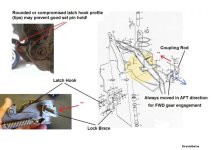
Latch hooks tips must be crisp and sharp and in near pristine condition. (tips cannot be rounded)
Latch hook lift spring value must be good.
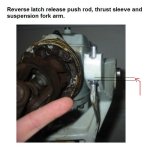
Push rod thrust sleeve must be free to move Up/Down in suspension fork.
Mechanical Lift-Out unit's "Vice Rod" must be capable of fully retracting. (vice rod pressure plate cannot be contacting thrust sleeve)

Side plates must be free of corrosion and must freely pivot in the bearing sleeve hinge points.
Lock brace must be free of corrosion and must move freely.


In order to pull it apart and examine and clean all parts..... it is best to remove the transmission and lower unit and then do a full pivot tube removal.

NOTE:

these pivot tubes are rather soft.
both the upper and lower end profiles are involved in creating delicate sealing areas.
use caution when pressing or driving these down-ward and out.
DO NOT damage these areas!
if need be, use mild heat to lightly expand the Intermediate housing.


.
 
Last edited:
Bob, this is truly one the most misunderstood aspects of the early AQ series drives.

Here's a list of criteria that must be in order.

A fully functioning set pin. No breaks, no bends, etc.
Will be replacing pin, of course. Fairly sure I have a spare
All four set pin "bores" must be near pristine. (center trim position works best)
Am in center position, hull runs beautifully with trim tabs only needed for "lots of company"
Latch hooks tips must be crisp and sharp and in near pristine condition. (tips cannot be rounded)
As best I can recall, this may be the issue... Will recheck this afternoon... thanks for the "tip"... :)

Latch hook lift spring value must be good.
Push rod thrust sleeve must be free to move Up/Down in suspension fork.
Mechanical Lift-Out unit's "Vice Rod" must be capable of fully retracting. (vice rod pressure plate cannot be contacting thrust sleeve)

Side plates must be free of corrosion and must freely pivot in the bearing sleeve hinge points.
Lock brace must be free of corrosion and must move freely.
These get checked annually in the spring


In order to pull it apart and examine and clean all parts..... it is best to remove the transmission and lower unit and then do a full pivot tube removal.

NOTE:

these pivot tubes are rather soft.
both the upper and lower end profiles are involved in creating delicate sealing areas.
use caution when pressing or driving these down-ward and out.
DO NOT damage these areas!
if need be, use mild heat to lightly expand the Intermediate housing.

GROAN....


.


Thanks for response.. Thinking it over earlier, I realized that full latchup in reverse does not prove springs are OK as they aren't involved. Will be replacing these as the ones in there are original i.e., circa mid 80s... as are the latch hooks.
 
Last edited:
Do you let the lift motor stop when you lower the drive? Just hold the switch down until the ram hits its limit switch.

FIRST make sure the limit switch actually works or you'll break something.
Does your boat have the indicating light for leg full down position?

My boat has the ight which is lit RED unless the tilt electric drive is fully retracted.
 
The drive should lock down when the drive is all the way down. The two spring hooks are the break away type until it is shifted into reverse and then the lock brace will give the hooks a mechanical lock. It could be the shift cable needs to be adjusted so it fully enguages the reverse lock pawls in reverse and then adjust the shift rod to the upper gearbox in neutral.
 
...............................
Thanks for response.. Thinking it over earlier, I realized that full latchup in reverse does not prove springs are OK as they aren't involved.
Correct.
The 2 over-centering springs are not involved. However, the single center lift/return spring is involved.

Will be replacing these as the ones in there are original i.e., circa mid 80s... as are the latch hooks.
I have seen near perfect 30 year old latch hooks...... and I have seen severely damaged 10 year old hooks.
It all depends on how the operator cares for his/her stern drive!
High engine idle speeds during reversing, frequent impacts, etc.

Do you let the lift motor stop when you lower the drive? Just hold the switch down until the ram hits its limit switch.
Yes.... allow the "Vice Rod" to fully retract.


The drive should lock down when the drive is all the way down.
Only if/when the vice rod pressure plate is fully retracted creating space between the pressure plate and thrust sleeve.

The two spring hooks are the break away type
Yes..... these are the "over-centering" springs that protect the drive against an impact!

until it is shifted into reverse and then the lock brace will give the hooks a mechanical lock.
This is actually a misnomer. Look closely at the lock brace while in the REVERSE gear position during coupling rod contact.
The entire latch system is free to disengauge.
The lock brace function is to prevent "over-centering" action.


http://www.ebay.com/itm/852046-Push...ash=item5d39e34905:g:NcEAAOxy3lFRCZjE&vxp=mtr
http://www.ebay.com/itm/Volvo-Penta...ash=item46568777d0:g:vlAAAOxyTMdTPcAx&vxp=mtr
The nut on the push rod adjusts how tight the spring locks fit on the tilt bar and the thrust sleeve fits on top of the push rod.
Kim, that nut is actually a jam or lock nut. It stops the internally threaded thrust sleeve from spinning after an adjustment has been made.

Pull the thrust sleeve and see if it is sticking it could be keeping the lock from fully enguaging as well

I fully agree. If the push rod/thrust sleeve assembly cannot fully return to the "Full UP" position, the push rod itself can prevent good latch hook hold.

Also...... and on a different note......... check the depth of the thrust sleeve Jam Nut/Lock Nut "bore" within the suspension fork arm (the depth from bottom up).
Often the bore is not high enough to allow enough thrust sleeve protrusion for good pressure plate operation.


.
 
Last edited:
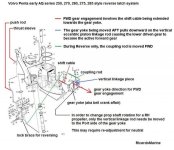
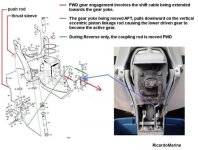
See attached images
 

Attachments

  • Rev Latch unit schematic 2.jpg
    Rev Latch unit schematic 2.jpg
    82.6 KB · Views: 223
  • Rev Latch unit schematic.jpg
    Rev Latch unit schematic.jpg
    72.9 KB · Views: 359
  • Rev Latch unit for Nick.jpg
    Rev Latch unit for Nick.jpg
    61.8 KB · Views: 218
  • Rev Latch unit 2 .jpg
    Rev Latch unit 2 .jpg
    56.1 KB · Views: 175
  • Rev Latch unit.jpg
    Rev Latch unit.jpg
    58.6 KB · Views: 178
  • Rev latch push rod.jpg
    Rev latch push rod.jpg
    34.3 KB · Views: 197
Pulled it apart yesterday... the broken cross pin failed at an corrosion inclusion point. This pin is the original 1969 pin. The latch hooks are circa mid 80s, i.e. on a 280 drive not the original to the boat 250. The ends of the hooks show some wear and will be replaced along with the springs. To reiterate, drive latches correctly in reverse, but kicks up partially when I shift into N., i.e. enough to prevent latchup if I subsequently shift into REV... without waiting for the drive to drop back "into battery". With a 650 RPM idle, the boat moves at just under 4ks @ idle.
 
Bob, is your shift cable linkage connected correctly?

As always with the AQ series drives...... a shift into FWD gear must be a result of shift cable extension at the gear yoke...... not cable retraction!
(see my first image in post #10)


.
 
Bob, is your shift cable linkage connected correctly?

As always with the AQ series drives...... a shift into FWD gear must be a result of shift cable extension at the gear yoke...... not cable retraction!
(see my first image in post #10)


.

Yes, expends for FWD. A bit of background on this subject. When I had the boat reengined 10 years ago by a "Volvo expert", I got the boat back ( 3 months late!!!) and REV always kicked up. When I complained to the "mechanic" who did the job, I got a long story about worn parts that were NO LONGER AVAILABLE (as you know total BS) and the need to buy a whole used mid section on eBay, have it rebuilt and installed to the tune of $900+. A month later time and tides allowed me to remove the drive's back cover witohut hauling the boat or getting wet and check the position of the "link". It was backwards! (extended for REV). 5 mins and $0.35 ( dropped cotter pin in the water) and another hour to dismount the helm shifter and reverse the cable sense and then all was OK... I replaced that 250 drive (wrong reduction ratio!) several seasons later with the current (used) 280 with a 1.6:1 reduction and that's when the current problem started. I lived with it, grudgingly, until I found the broken pin. BTW there appears to be some wear on the pin that broke (new one on order) as well.
 
Follow up... last fall ordered new latches, over center springs and cross pin. The other day went to the yard to replace the parts... findings..

1) old latch ends rounded compared to new.
2) Holes in transom shield "worn" slightly overside ( about .030/040 slop). thinking of putting o-ring dams on the crosspin and epoxying the crosspins in place to eliminate slop ( Drill one 0.0625 hole at an angle up into each hole as injection points). replacing the transom shield is not on my schedule.

and...

3) was wonder just how "bad" my old springs were so I ran the following test...
a)attach an old spring to a new spring, end to end by using hooks and loops on the springs/
b) insert screwdriver into end of each spring.
c) Pull springs apart....

I expected to see that the old spring would elongate before the "new" one...WRONG!!!
New one(s) elongated first!
Compared new and old springs side by side ( very easy to not get them mixed up...old ones had residue of antifouling paint on them)
NEW springs are 1 and a half coils shorter!!! Diameter of material appeared to be the same ( did not have a micrometer with me at the time) so ????

What gives? Did Volvo rethink the spring force??? Thinking of just cleaning the old ones and reinstalling them.
 
Back
Top