Logo

2007 Mercruiser 5.0 MPI - water only in 2 cylinders on opposite bank

Navigator1978

New member
The engine is salt water
I have water in 2 cylinders (Second on the right and second on the left, oposite banks .oil was good but after some time driving the boat (10 hours) got little milky.

Engine starts and run good on idle, but can't reach more than 4100 rpms and planes slower. Also it shuts off when I stop the boat after 10-20 min drive, than I need to start it with lever froward.Also when I drive the boat and stop the rpm plays (400-1200) for a few times and than I gets steady.

I did a compression test on all cylinders and it shows good

I changed both risers and exhaust manifolds with new one since they were anyway for replacing (a lot of corosion) but still have same issue.Water ( only in this 2 cylinders) usually after driving the boat or seating few a few days in the marina.I have also replaced the head, manifold and intake gasket as cheaper option before diving deeper.same issue continues.....


How likely is that i have crack in the block or heads or intake manifold ? The manifolds and risers had a lot of corosion when i changed them. The engine has 350 hours. The crack should be probably werry small if that is the case from corossion.Could there be a small crack in the intake manifold that opens only on hot engine?I have done a compress test on intake and looks good but im not sure how realible this test is.There is signs of corrosion on the intake manifolds as well but not visible signs of crack.Other thing that is strange is that those cylinders filling with water are the ones under the thermostat and thermostat was rusted together with the housing and not working.I just replaced it.
 

Attachments
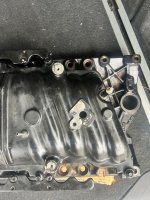
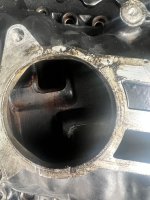
  • IMG_6942-min.jpeg
    IMG_6942-min.jpeg
    1,013.3 KB · Views: 81
  • IMG_6943-min.jpeg
    IMG_6943-min.jpeg
    866.9 KB · Views: 49
Last edited:
Water in cyls normally does not come from a rusted out intake but that I’m basing on the design of the older carb style manifolds. If those rot out in the water passage it puts water in the oil vis the cam valley. Elbow/manifolds are a prime cause. If the engine is all put back together you can air pressure test the cooling passages to see if it holds pressure.
 
I might remove the manifolds/elbows as a unit if possible and prop em up level. Hook up a water hose to the inlet and turn on the water. Watch for water seeping down in the exhaust ports that match up to the cylinder head.
I had a similar problem (water in 2 cyls) about 9 years ago and first tested the manifolds, they were not leaking. Other tests pointed to the head gaskets. Took it apart and that was it. I had the heads magnafluxed and both had cracks from a previous overheat. Replaced the heads with reman units and put it back together with new gaskets & head bolts. After that no water in the cyls or oil….
 
I might remove the manifolds/elbows as a unit if possible and prop em up level. Hook up a water hose to the inlet and turn on the water. Watch for water seeping down in the exhaust ports that match up to the cylinder head.
I had a similar problem (water in 2 cyls) about 9 years ago and first tested the manifolds, they were not leaking. Other tests pointed to the head gaskets. Took it apart and that was it. I had the heads magnafluxed and both had cracks from a previous overheat. Replaced the heads with reman units and put it back together with new gaskets & head bolts. After that no water in the cyls or oil….
I changed the manifolds and risers becouse they were rusted.I also did a pressure test for the heads.It checks good.Im not sure if they can do a proper pressure test on the heads or the intake as there are a lot of passages that might open up when the engine opens up.And I did have a significant corosion on the manifolds and thermostat....
The water caming in my cylinders its not a lot.So im suspecting that corossion has done something maybe to the heads or intake.
You did also have water in opposite cylinders?So it came out that the both heads had cracks?
 
Both head gaskets had leaks and each cyl head had cracks in the exhaust valve seat area of the center cylinder (V-6). I had some water in #2 and just a mist of water in #1. #2 is the first one on the starboard side and #1 is the first one on the port side.
Keep in mind even new elbows/manifolds can leak. Especially on the wet joint system. Yours should be the dry joint so it should be less likely.
 
Both head gaskets had leaks and each cyl head had cracks in the exhaust valve seat area of the center cylinder (V-6). I had some water in #2 and just a mist of water in #1. #2 is the first one on the starboard side and #1 is the first one on the port side.
Keep in mind even new elbows/manifolds can leak. Especially on the wet joint system. Yours should be the dry joint so it should be less likely.
your engine was salt water?
 
Yep, salt water since even before I bought it.
Probably at least 25 years.
The main thing is to get the salt water OUT of the cyls and motor oil ASAP. Before I actually fixed it, I changed the oil 4 times, drained the water after each change, and coated the cyls with fogging oil. When I took it apart the next spring, there was very little rust evident, just in the combustion chambers of the affected cyls, the cyls themselves were in good shape, as was the valve train etc.
4.3 manifold removal.jpg

Removing the intake manifold....
4.3 starboard cyl head removal.jpg

starboard cyl head removal, cyl with water in it was #2, all the way to the right, the cyl head is flipped round the other way, so you can see some corrosion in the combustion chamber all the way to the left....
 
Yep, salt water since even before I bought it.
Probably at least 25 years.
The main thing is to get the salt water OUT of the cyls and motor oil ASAP. Before I actually fixed it, I changed the oil 4 times, drained the water after each change, and coated the cyls with fogging oil. When I took it apart the next spring, there was very little rust evident, just in the combustion chambers of the affected cyls, the cyls themselves were in good shape, as was the valve train etc.
View attachment 36524
Removing the intake manifold....
View attachment 36525
starboard cyl head removal, cyl with water in it was #2, all the way to the right, the cyl head is flipped round the other way, so you can see some corrosion in the combustion chamber all the way to the left....
So was there visible cracks on the heads or your took them to a shop for a pressure test?There is no visible cracks on mine and took them to a shop for a pressure test and they told me they a re fine....
 
Also what they found was that due to salt water use the cooling passages were getting eroded to the point where the head gasket wouldn't reliably seal. And I know from the experience of others that after 15-20 years of salt water use the heads can rust through behind the valve seats which would hydrolock the engine. Based on my experience if I had another raw water cooled inboard engine in the salt at 15 years I’d replace the heads preemptively to avoid trashing the engine.
IMHO all cast iron inboards in salt shouid have closed cooling. Worth the cost over the long term..you could literally double the engine life….
 
Also what they found was that due to salt water use the cooling passages were getting eroded to the point where the head gasket wouldn't reliably seal. And I know from the experience of others that after 15-20 years of salt water use the heads can rust through behind the valve seats which would hydrolock the engine. Based on my experience if I had another raw water cooled inboard engine in the salt at 15 years I’d replace the heads preemptively to avoid trashing the engine.
IMHO all cast iron inboards in salt shouid have closed cooling. Worth the cost over the long term..you could literally double the engine life….
yeah, probably that's my case.But the shop could not determine the problem in the heads, maybe because they are pressure testing them on cold and they have same small cracks that open when the engine is hot....
 
There are other tests that can be done, a dye test and magnafluxing.
But if you had an overheat, on the Chevy small block the engine block itself usually survives, but the heads often crack.
The good news is reman heads are available and not too costly. I think I paid $550 for a pair of 4.3 reman heads.


4.3 reman cyl head 2 small.jpg


4.3 with re-man heads installed..jpg
 
yeah, probably that's my case.But the shop could not determine the problem in the heads, maybe because they are pressure testing them on cold and they have same small cracks that open when the engine is hot....
4.3 liter engines used in boats are notorious for cracked heads, Warped block decks and head surfaces when over heating has occurred.

you said compression was good, How good. You should post specifics of the testing you have done so we all can see the data
 
Mine had a real bad overheat in 2013 and still ran well for 2.5 more seasons then got the water in one cyl. Took it apart ans checked the block deck, was fine not out of spec when measured with straight edge & feeler gauges. Heads were replaced & still running fine all this time later; no water in cyls or oil, even did oil analyses to verify. On the V8 you have the 2 inner cyls with exhaust valves right next to each other so to me that’s even worse than the V6 heads because on the 4.3 V6 none of the exhaust valves are right next to each other. Most cases of blown HGs are overheating and boat isn’t propped right RPM @ WOT is too low or not using high enough octane fuel. OMC had a sticker on the flame arrestor to use at least 89, I usually buy 93 at the fuel dock.
 
Back
Top