Logo

1996 Evinrude outboard - Possilbe Wiring or Starter problem!!

fisherwoman

New member
Hi All

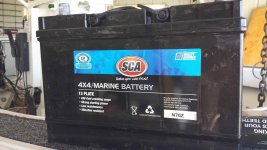
Ok so i have recently brought this boat, on first inspection, it has not been maintained very well. I replaced the Fuel and the Battery, and the spark plugs as a first. When i first tried to start the boat, the Starter motor, lifted up and engaged and cranked the motor but very slowly. Next i attached the battery directly to the Starter motor and it did the same, engaged but cranked very slowly, next i removed starter and took it apart and cleaned it all out. I then attached it too the battery in a vice and the starter motor fired up good, spun like a dream, i then attached it to the motor, and did the same, connecting the battery directly to it, this time it jumped up engaged and spun the motor over and at normal speed. I took the battery back to the centre console and hooked it up to see if the key start would work now, but we are back to square one, the starter jumped up and cranks but very slowly. I am thinking now that its a wiring problem. Would i be correct in saying that? If it is, where would i get my hands on a basic wiring system for this type of motor, i lift up the centre console and there is a pool of wires in there, connecting GPS and all other things, and i dont wont to short anything out.

All help is appreciated - I plan on going to the Inland Fishing comp in a couple of weeks hoping i can get this sorted before then.

As a side note, i see that some of the main wires going from the motor to the console are white and look like house wiring?? is this usual?

Cheers guys
 
Last edited:
Try cleaning the solenoid connections to a shiny bright; may be bad connections or you could have a solenoid with bad internal connections and need to replace. Others should chime in with more suggestions. Good luck.
 
Try cleaning the solenoid connections to a shiny bright; may be bad connections or you could have a solenoid with bad internal connections and need to replace. Others should chime in with more suggestions. Good luck.

Thanks i will give that a go tommorrow!!! - I know it must not be something too technical, but not sure where to go from here, without paying someone to rewire the whole thing.... sounds like $$$$$ to me :)
 
OK, your wiring seems to be a mess, according to your own description. However, since it at least tries to crank, you know that the connections are correct as far as what goes where.

Problems with the starter at least trying, but not enough torque to spin the engine generally fall within three catagories

1. The motor is too hard to turn. Could be partially seized. Needless to say, the starter can't crank it if it is.

2. There is a defective part within the starter circuit. No need to examine the whole dad-blamed boat, zero in on the high amperage starting circuit. That is the battery, battery cables, solenoid and starter. In this case you have already tried bypassing the solenoid and it didn't work. You more or less have checked the starter. Don't ignore the battery. Have it load tested. Many places like Auto Zone will do it for free.

3. There is a poor connection in the high amperage starting circuit. This is by far the most common problem. Battery cables must be free of corrosion and tight. Both ends. Don't forget the negative cable is half of the circuit.

A simple check of those three points will usually find the problem quicker than it took me to type all this. If not, it is time to get out the multimeter and do some voltage drop tests. That means you need a multimeter and know how to do voltage drop tests. It is simple, but another long typing session. Come back if you need it.
 
OK, your wiring seems to be a mess, according to your own description. However, since it at least tries to crank, you know that the connections are correct as far as what goes where.

Problems with the starter at least trying, but not enough torque to spin the engine generally fall within three catagories

1. The motor is too hard to turn. Could be partially seized. Needless to say, the starter can't crank it if it is.f
thanks for your time, much appreciated, ok so as far as the motor, if i hook the starter directly to the battery (which i brought brand new yesterday) the starter works, engages and turns the engine over fine - So starter motor is good.... as far as i can tell.

2. There is a defective part within the starter circuit. No need to examine the whole dad-blamed boat, zero in on the high amperage starting circuit. That is the battery, battery cables, solenoid and starter. In this case you have already tried bypassing the solenoid and it didn't work. You more or less have checked the starter. Don't ignore the battery. Have it load tested. Many places like Auto Zone will do it for free
As for the solenoid, it has not been checked, i havent got a multi reader is there anyway of hooking the battery directly up to the solenoid, and if so, the result of a good solenoid vs a bad one, and how i would go about that would be great, everything i have searched for tells me i need a meter tester... i havent got one. Some sites have said use a screw driver, but im still confused.

3. There is a poor connection in the high amperage starting circuit. This is by far the most common problem. Battery cables must be free of corrosion and tight. Both ends. Don't forget the negative cable is half of the circuit.
ok so by high amperage starting circuit your referring to the wiring from the battery to the motor directly or from the ignition switch to the motor - or is that the same thing. We hooked the battery up to the ignition switch cables and this is when the problem occured, when batter is hooked directly to starter it all works perfectly. - wiring or solenoid might be the problem, do i just replace both and hold my tongue right?

A simple check of those three points will usually find the problem quicker than it took me to type all this. If not, it is time to get out the multimeter and do some voltage drop tests. That means you need a multimeter and know how to do voltage drop tests. It is simple, but another long typing session. Come back if you need it.[/QUOTE
Once i find out if i can do a direct solenoid test using jumper leads, i will try that - seems like the less complicated starting point, and then failing that should i go wiring directly from the ignition to motor. I agree it seems to be loosing amps somewhere from there to battery, but i still cant rule out solenoid....

Thanks sooooo much for your help much appreciated... !! x
 
Can i just hook the solenoid to jumper leads - Red to a large bolt on the solenoid, and black ground on something - would i be right thinking if the starter motor cranks well that my solenoid is good and if it doesnt its bad?? working back wards.... god boats are complicated!!
 
Excuse me while I calm down and try to regain some composure. I just got back from a block party where a neighbor said her kindergarden grandchild is doing her schoolwork on a computer. We think we are so high tech, yet the average American knows virtually nothing about electricity.

OK, I've vented now.

fisherwoman, electricity flows from your battery + terminal through the cable, to the starter solenoid. The solenoid is nothing but a heavy duty switch, normally in the off position. When you turn the key to start the motor, that turns the solenoid on. Being turned on, the electricity can flow through it to the starter. After going through the starter, goes to engine ground, then the negative battery cable and finally returns back to the battery (-) terminal. (Actually it goes the opposite direction, but we aren't going to get into that here.)

So, the fact that the motor tries to crank when you turn the key tells us that the key switch is turning the solenoid on. Now that we know that, we can eliminate all that wiring mess from that point forward. It may not be pretty, but at least we know it is working.

So, what do we have left? We have the battery, positive battery cable, solenoid, starter, engine ground, and negative battery cable. THAT is what I am referring to as the high amperage starting circuit. "Circuit" means exactly what the word implies. The electricity flows from the battery, through the named parts, and back to the battery. Anything that interrupts that circuit can cause trouble.

"Resistance" is anything that gets in the way of (resists) that flow of electricity.

It is a known fact that as electricity flows through a resistance, a voltage drop exists across that resistance.

Not wanting to get any more complicated than necessary, that voltage drop can be measured with a voltmeter (multimeter)

OK. On to practical use of the laws. If you set your meter to a meaningful function and range, and touch the meter's red probe to the large stud on the battery cable side of the solenoid and the black probe to the large stud on the starter cable side of the solenoid there will be a high voltage shown (actually about 12V, same as the battery. That is because there is a very high resistance (remember, it is turned "off" and is obstructing all electrical flow through it. Now, keeping the probes in place, have a helper turn the key to start position. The solenoid will click as it turns on and your voltage drop measurement will go to zero (hopefully). That is because there is no resistance to flow and no voltage drop developed.

That describes a good solenoid. If there is a voltage drop indicated when the solenoid is turned on, that indicates a bad solenoid. Let me hasten to add that the AMOUNT of voltage drop is an indicator of how bad it is. Nothing is perfect, so a few tenths of a volt is not cause for alarm. But a volt or more, indicates trouble. That is a volt or more that is not being applied to the starter.

Any other section of the circuit can be tested the same way. Simply move the meter probes to both ends of the suspected part (such as a battery cable).

You can get a cheap multimeter at most any hardware store, or Wal-Mart or Home Depot. An investment that will save you money that you didn't spend buying un-needed parts.

A couple more lessons and you will be ready for your electricity 101 final exam.
 
20131104_080954 copy.jpg20131104_080641 copy.jpg20131104_080832 copy copy.jpg20131104_080823 copy copy.jpg20131104_080649 copy.jpgView attachment 801820131104_080729 copy.jpg
Thank you for all answering, i will have to buy a multimeter to test the voltage, some one did suggest putting a screw driver over the two nuts on the solenoid and hook it up to test it. I have cleaned all connections on the motor itself, but have not cleaned the connections that go to the battery, so my problem might be in that, i will give them a clean this afternoon and keep you updated. thanks again, watch this space..... Oh and i feel like although i only know a fraction that there is to know about electronics, i feel i already know too much for my liking... hahaha...
 
Also resistance creates heat if wires or connectors get hot it is because your pulling too many amps or corrosion has developed in a wire or a connection. Cleaning grounds, connections and connectors and inspecting wires is the first step in troubleshooting. Before you start buying any parts.[/QUOTE
Nothing seems to be getting hot - that i have noticed so far. :)
 
Yes, placing a screwdriver across the two big nuts on the solenoid will bypass the solenoid and take it out of the circuit........AFTER you bend the screwdriver into a U shape so you can do that. AND assuming you get a good connection, knowing that sparks are going to be flying everywhere and you will be melting some metal off the area..

Beware of people that know everything.
 
Yes, placing a screwdriver across the two big nuts on the solenoid will bypass the solenoid and take it out of the circuit........AFTER you bend the screwdriver into a U shape so you can do that. AND assuming you get a good connection, knowing that sparks are going to be flying everywhere and you will be melting some metal off the area..

Beware of people that know everything.
ok so an update - we placed the battery back into the centre console and this time connected the red jumper lead to the starter and the other red jumper lead to the solenoid to diagnose the solenoid, the engine cranked in exactly the same way as it did when we have not bypassed the solenoid, so im thinking that the solenoid is fine and its the wiring.

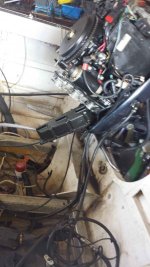
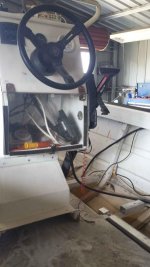
Ok the wiring....... As you can see its a massive mess - when we first purchased the boat it had 2 batteries, i assumed one battery was just for the lights on deck and to fuel the piluge pumps etc, when we looked at the wiring from the ignition we found the wire that went directly to the motor and found that there where alot of wires coming off that wire, one that had a black termal on it that went to the other battery. Anyway we undone all the wires and connected the main power line from centre console to the motor, so the wires where direct and turned the key - same slow crank!!!!

So now im just thinking its the wiring from the centre console and ignition switch to the motor.... how wrong am I? So i think the best bet for me is to maybe pull all the wiring out and start again... Does anyone know what a basic wiring system for this machine is, so i can start again, or does someone have an idea...
 
we are somewhat handicapped on helping you unless you have a multimeter and know how to use it....to rip out all the wiring and start over is not the option i would take..from what i read you have a voltage drop from the battery to the motor when the battery is placed and wired in from its normal position under the console...this could be in either the hot positive or it could be on the ground side..so i have a few questions...is the battery fully charged and in good shape...if you have a voltage gauge in the boat then it should read 12.7 with no load....what does it read....what does it read when you are trying to crank the engine?...what wires are on the battery to feed the engine?..there should be a heavy red one on positive and a black one on negative....i am talking about wires that come from the engine wiring harness it self...if they are not directly wired to the battery then you have a terminal block or some spices somewhere...you mentioned the presence of something like house wire....if romex is used to start the engine thats a no-no.....
the proper way to shoot the problem is with a meter...depending on the distance from the battery located under the console there may be a problem with meter lead length but we could work around that...the cheap meters have leads that are too short and meter leads of any length are not cheap..
having said all that here is the problem in a nutshell...in a working system you want a good battery and have it fully charged....then when you hit the key you do not want any voltage drop between the positive on the starter solenoid(the heavy wire that will feed through the solenoid to the starter) and the positive on the battery...same way on the ground side..no drop between the negative post on the battery and the grounding on the starter..keep in mind you will not read any drop unless you are pulling current...if you get a meter and just probe around you will read battery output and things will look fine if you are not trying to crank the engine....
if you want to get a meter we will help you shoot the problem the right way....
 
reread your initial post again....that battery output with no load should be 12.7...or damn close to it with no load...12 volts wont cut it....make sure you have a good battery before even getting started on trouble shooting....
 
I've just read all of the posts/replies on your problem. It appears that you are overthinking a simple problem.

If you have a good known battery and good known jumper cables attached directly to the electric starter, and this results in having the starter crank the engine at the normal (fast) cranking speed (which you state it does)... the electric starter is okay. Disregard any further temptation to include the starter with this problem.

The starter solenoid simply transfers available incoming voltage thru it to the electric starter. It either makes a connection or it doesn't..... It does make a connection, so disregard further temptation to include this component in your trouble shooting as it is functioning.

What does that leave? ..... The simple starter circuit (cables/wires). You have either a loose connection, a tight but dirty connection, or a internally corroded cable/wire which in any case would become quite hot within a short amount of time. Any of this results in a voltage drop!

Disregard the possible corroded cable/wire scenario for now and do the following.

Remove all cables/wires related to the electric starter circuit.... one by one so as not to possibly confused as to what goes where. This would be the cable/wire terminal ends and also the components they attach to so as to have a perfectly clean connection.

When retightening, use a wrench or pliers... not your fingers if wing nuts are encountered.

Actual bettery terminal (Pos & Neg), all connections at these points, all cable terminal ends and also the components they attach to.

Black negative battery cable (ground) that is attached to the powerhead.

Red positive battery cable that is attached to the starter solenoid.

Red positive cable that is attached to the electric starter and also the other end that is attached to the starter solenoid.

The small black ground wire that leads from the small 3/8" nut terminal of the solenoid to a ground on the powerhead.

Now.... with all of the above cable/wire terminal ends and the components they attach to being perfecty clean and absolutely tight... and the battery being in tip top fully charged condition... the electric starter should crank that engine over at a normal fast rpm. If it does not... start feeling for a hot or overly warm cable that is failing internally.
 
Last edited:
As I said before, the jumble of wires may be a mess, but at least you know it is working as evidenced by the fact that the solenoid clicks and at least tries to crank the motor. And as I said before that rules out the key switch and mess of wiring going to it.

However, you bring up another good thought. Did you say the battery is under the console?? How far away from the motor is that? Did they have to lengthen the battery cables to do that? Therein may be your problem. Simply adding to the length will increase the total resistance through them (and therefor the voltage drop). Also, if the extensions are too skinny, same result. Finally there is the actual connections where the extensions were added. Sorry to keep harping on the subject, but a voltage drop test on the cables is the magic word.
 
ok all im going to get that multimeter today and start testing my connections - I will post results once I have them - A MASSIVE THANK YOU to everyone who has commented muchly appreciated and ill be back!!!
 
PROBLEM SOLVED:

ok so this afternoon with my multimeter, I hooked up the battery to the middle console and put the measures voltage at solenoid, read 12v - started it but voltage went down straight away. I continued testing all wiring to see where the problem lied. I ended up removing the long connections from motor to battery and bringing the battery up and sitting it under the boat motor, hooked it directly to the wiring that came out of the motor -(thick starter wiring) and she fired up. So ALL ALONG it was that stupid wiring, obviously wasn't good enough to carry the current. So i will be getting some good wiring and replacing it and BOBS YA UNCLE!!!

I want to say a BIG THANKYOU to everyone that has contributed, and i will be using the diagram above to reconnect and clean up the wiring at the console - thanks again for everything - much love!!!!
:)
 
Back
Top