Logo

1996 150 Johnson J150ELEDB

Fishin4specks

New member
I'm having fuel delivery issues. Is there any reason why the VRO would not be working at except a bad VRO. the last thing I want to do is pay for a new VRO without addressing the problem.

I'm getting 0 in Hg of vacuum regardless of rpm. The motor will eventually die but start back up after pumping the bulb.

This vacuum guage is plumbed in line with the fuel line. 0 vacuum regardless of rpms. I also used another vacuum guage connected to the manual choke and it was also reading 0 also.

This video shows 0 vacuum with rpm up to 3000. I never touched the throttle after I got it up to 3k and it died on its own.

https://youtu.be/jyT5FzShonU
 
Vacuum?...... The VRO diaphragms are spring loaded. The downstroke of the related piston creates a pressure to force/move the diaphragms.

Remove the spark plugs and the hose that leads from the VRO to the crankcase. With every cranking revolution of the engine, you should get a hellava blast out of the crankcase fitting.

If you get that blast of power and the VRO does not function.... that sounds like a faulty VRO.

If you do not get that blast of power.... look for a blown piston, a hole in the crankcase/block, or a faulty reed/leaf valve plate.
 
Vacuum?...... The VRO diaphragms are spring loaded. The downstroke of the related piston creates a pressure to force/move the diaphragms.

Remove the spark plugs and the hose that leads from the VRO to the crankcase. With every cranking revolution of the engine, you should get a hellava blast out of the crankcase fitting.

If you get that blast of power and the VRO does not function.... that sounds like a faulty VRO.

If you do not get that blast of power.... look for a blown piston, a hole in the crankcase/block, or a faulty reed/leaf valve plate.


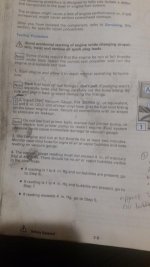
Thanks for the reply. I followed the steps in the service manual and here's what I did and what I observed

Installed vacuum gauge and clear vinyl hose at fuel inlet fitting on the lower engine cover. --> observed less than 1 to 4 inches of mercury on vacuum gauge and no bubbles in clear hose. Went to step 8.

No bubbles. Went to step 9

Observed no bubbles on fuel distribution manifold. Went to step 10

Installed fuel pressure gauge at fitting between VRO and carbs. Went to step 11

Observed less than 3 psi and strong pulse coming out of crankcase at pulse limiter. Manual suggests to change VRO.
manual pg 1.jpgmanual pg 2.jpg
[FONT=arial, sans-serif]My question is am I missing anything? It just seems odd to get absolutely zero pressure or vacuum on each side of the VRO while the pulse limiter is working. I guess maybe the air piston is seized? If the diaphragms were punctured or torn, it would still produce enough vacuum for the gauge to wiggle a little. But i wasn't getting any feedback on the guages on either side of the VRO and the pulse limiter is putting out bursts of air. [/FONT]
 
Back
Top