

Ok, so I have a 1991 Johnson 225 Ocean Runner (E225PXEIC) on a 22' CC bay boat. This thing use to run great! I had about 5500 RPM and 45 knots out of this thing regularly on bays and lakes (calm water, of course). I then has a foot failure, a year of back and forth fiddling with rebuilt feet and adjusting the engine shift control system. Turns out I had a broken clamp that connects ****ing assymbly to shift rod, which wouldn't let me shift.  I guess the good news is that I now have two extra lower units. Anyway, during that time, something happened to my engine. Now, as the picture shows, I am getting grease or oil sludge coming up out of the lower unit around where the shift rod tube comes out of it. Also, I am burning about 20 gal of feul in less than 45 minutes and am only getting 4200-4300 RPM at full throttle and only 32 knots. Then, when they motor gets turned back on, it sputters slightly (maybe too much feul??). Anyway, I am ready to sink the whole damn boat and make a new fishing spot. Any suggestions as to what might be causing this horrific problem?
Quick info: I have recently replaced all spark plugs with proper gap check and all spark plug wires with performance marine wires. The foot is now beautiful and shifts like a dream.
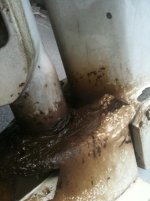

I guess the good news is that I now have two extra lower units. Anyway, during that time, something happened to my engine. Now, as the picture shows, I am getting grease or oil sludge coming up out of the lower unit around where the shift rod tube comes out of it. Also, I am burning about 20 gal of feul in less than 45 minutes and am only getting 4200-4300 RPM at full throttle and only 32 knots. Then, when they motor gets turned back on, it sputters slightly (maybe too much feul??). Anyway, I am ready to sink the whole damn boat and make a new fishing spot. Any suggestions as to what might be causing this horrific problem?Quick info: I have recently replaced all spark plugs with proper gap check and all spark plug wires with performance marine wires. The foot is now beautiful and shifts like a dream.
