Logo

1989 Johnson 100 Tune-up questions

Hello,
Haven't had much luck in a few other forums. Thought I try here :)
My engine model is J100STLCEM.
I guess basically Going in steps but don't quite understand the Cam Follower Pickup adjustment.
I'm also getting or appears to be worse gph/ increased fuel consumption.

Here's the full post, any help is much appreciated.

*A few pictures included below.

Just a few things to mention:

Engine runs great mid to WOT, getting 5000rpm.
Some reason I seem to be using more gas or getting a bit higher gph then before.
I was getting a bit of fluctuations in idle speed.
I did a compression check a while back and results are good.
New spark plugs gapped at .030"
Removed both Throttle lever and shift lever, cleaned them thoroughly and installed new bushings and greased all parts, then reinstalled.
Installed new nylon retainers for the throttle linkage.
Installed new Cam roller that rides inside the Throttle lever.
Checked all of the gas recirculating connections for clogs. Replacing all hoses(hoses with 1/16" I.D.)
Put reccommended amount of Johnson/Evinrude Carbon Guard in gas tank.
Decarbed engine using SeaFoam. *Helped with the idle fluctuations (no more fluctuations).
*All adjustments below done with throttle cable detached.

Doing the first few tune-up steps for my engine in order.
1)Throttle Valve Synchronization- I noticed the carb throttle plates were slightly out of phase. Following the manual, I loosened the top cam follower screw and the bottom adjust lever screw making sure cam follower wasn't touching the throttle cam. Then opening both throttle plates and releasing them to snap closed, I put slight downward pressure on the throttle linkage (to remove any backlash). Then tightened the bottom adjusting lever screw and then the top cam follower screw.
Checked that both throttle plates were synchronized (which they were). DONE

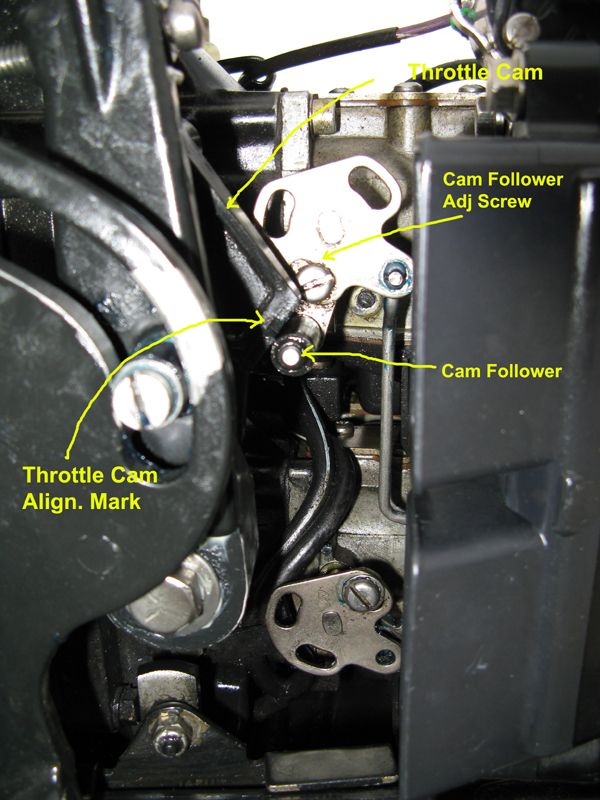
2)Cam Follower Pickup Adjustment
-This one was a bit hard to follow in the manual.
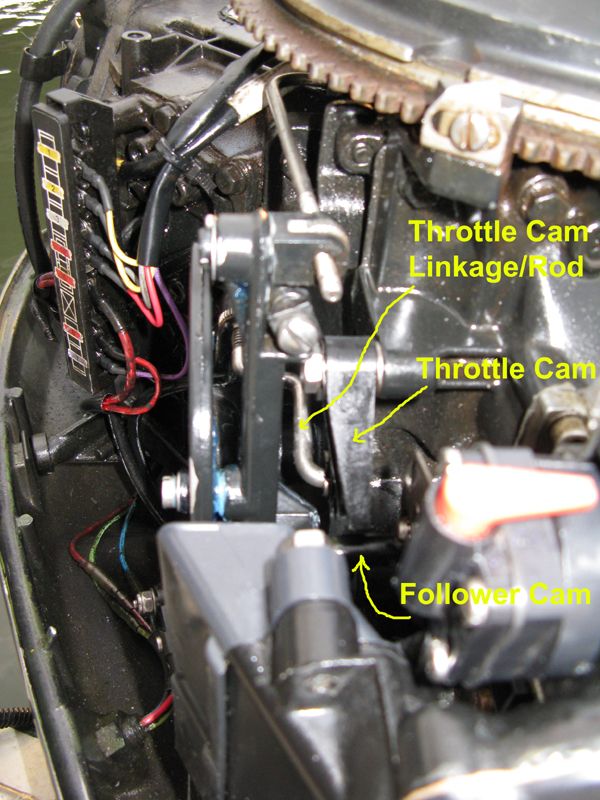
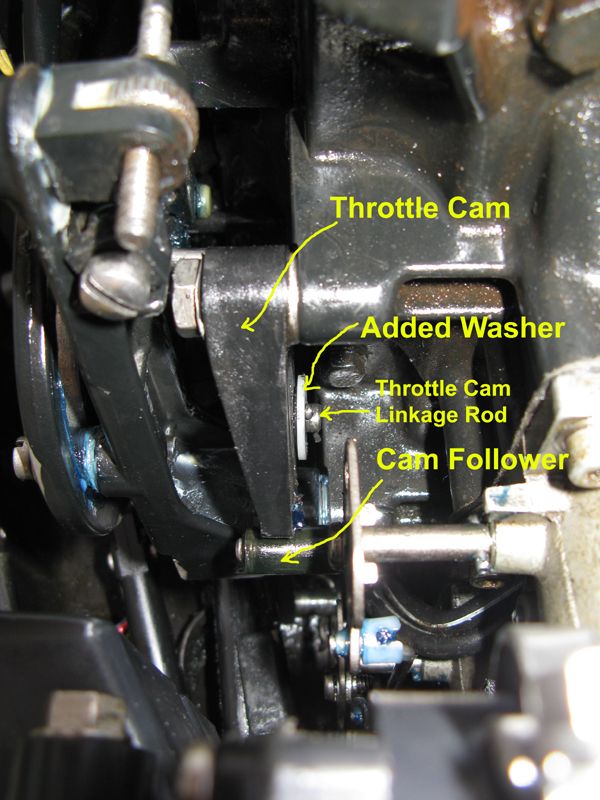
One problem I had was the Throttle Cam link would pop in and out if you slightly pushed in on the throttle cam. There was some play on the rod that goes into the throttle cam. I removed the inner cotter pin and installed an additional washer, reinstalled the cotter pin and seem to fix the loose rod popping in and out the throttle cam.

I'm guessing this is done in neutral and using a 'throttle shaft amplifier tool'. Start rotating the throttle cam and just as the end of the tool starts to move, check cam and follower alignment.

I see where the 'pointer' is on the throttle cam, and this needs to align with the center of the follower cam, correct?
Should the Cam follower and throttle cam be touching (no gap)?
When I start to rotate the throttle cam my amplifying tool end moves almost at the same time, notch lines up with center of follower cam, is this correct?


I'm kind of at this point but I noticed my idle speed is a bit too low and the idle adjustment screw is bottomed out/all the way in.


3)Maximum Spark Advance Adjustment- I have a timing light but I can't do this one will have to bring it in the shop, since you have to run engine at 5000rpm and using a test wheel/test prop in a tank.

Some pics:
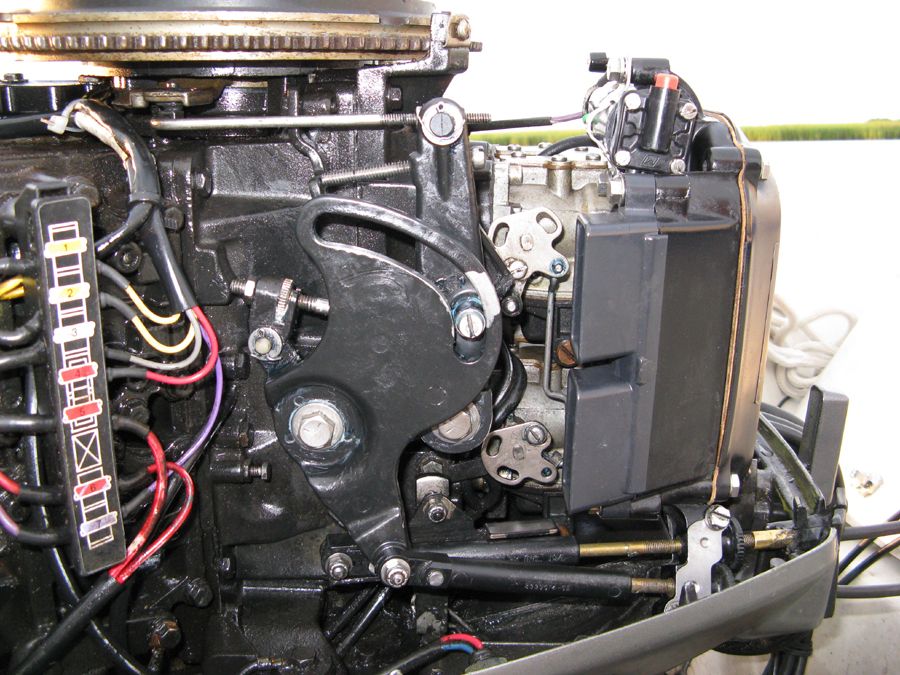
SideView_zpsd2968fdd.jpg


ThrottleCam_Follower_Adj_zps6a300196.jpg


ThrottleCam_ThrottleCamLinkage_Rod_zps69c00c19.jpg


ThrottleCam_AddedWasher_zps79a9dfaa.jpg
 
Last edited:
Sounds like you've pretty well covered all the bases as the saying goes.

Throttle cam roller "not" touching cam... All throttle butterflies open and close securely at the same time.

Check the throttle/idle timing setting to make sure that nobody has moved the thumbwheel/locknut setting.

If you disengage the "Fast Start" feature of the engine, you can check/set the full spark advance setting as follows:

(Timing At Cranking Speed 4°)
(J. Reeves)


NOTE: If your engine has the "Fast Start" feature", you must disconnect/eliminate that feature in order to use the following method. The "Fast Start" automatically advances the spark electronically when the engine first starts, dropping it to normal when the engine reaches a certain temperature.

The full spark advance can be adjusted at cranking speed,"without" have the engine running as follows.


To set the timing on that engine, have the s/plugs out, and have the throttle at full, set that timer base under the flywheel tight against the rubber stop on the end of the full spark timer advance stop screw (wire it against that stop if necessary).


Rig up a spark tester on the #1 cylinder plug wire. Hook up the timing light to the #1 plug wire. Crank the engine over and set the spark advance to 4° less than what the engine calls for.


It's a good idea to ground the other plug wires to avoid sparks that could ignite fuel that may shoot out of the plug holes. I've personally never grounded them out and have never encountered a problem but it could happen.


I don't know the full spark advance setting your engine calls for, but to pick a figure, say your engine calls for 28°, set the timing at 24°. The reasoning for the 4° difference is that when the engine is actually running, due to the nature of the solid state ignition components, the engine gains the extra 4°.


If you set the engine to its true setting at cranking speed, when running it will advance beyond its limit by 4° which will set up pre-ignition causing guaranteed piston damage! You don't want that to take place.


No need to be concerned about the idle timing as that will take care of itself. The main concern is the full advance setting.

A fellow member from one of the various marine forums suggested having water supplied to the water pump (flushette or barrel) simply to provide lubrication to impeller. A worthwhile suggestion I thought, and entered here.


Be sure to use your own engines spark advance settings, not the one I picked out of the air here in my notes.

Thousands of parts in my remaining stock. Not able to list them all. Let me know what you need and I'll look it up for you. Visit my eBay auction at:

http://shop.ebay.com/Joe_OMC32/m.html?_dmd=1&_ipg=50&_sop=12&_rdc=1

The variation in the idle setting could simply be that the mechanical idle stop screw is not touching it's stop plus a slight bit of play in the throttle cable that needs to be removed via the adjustable cable trunion at the engine clamp. This slight bit of play would allow the cable to return a higher rpm occasionally.
 
Thanks for the reply...really help out. Didn't know this other way of doing this.
I don't believe I have the 'Fast Start' feature, just the choke solenoid.
I understood everything you said except or rather location of:
set that timer base under the flywheel tight against the rubber stop on the end of the full spark timer advance stop screw
Couldn't find the rubber stop.
Here's a diagram showing the Spark advance Rod, which is right under the flywheel. Hopefully what you were describing is also shown:
cd630528-863c-4b6c-bd6c-d39656614ba9_zps28ba417e.gif


If you have a chance, tell me the number, etc..

Again, appreciate the reply and great info!

Thomas
 
Last edited:
Your model uses two (2) of the standard heat sensors in the cylinder heads which indicates that your engine does not incorporate the "Fast Start" setup as you suspect.

Also, the rubber stop mention is not used on that model either... simply set the timing with the thumb wheel/lock nut on the (101) advance rod.

The "timing" notice has been sitting in my data base for a long time obviously. I shall have to modify it somewhat as the full spark advance "rubber stop" has been eliminated from many models. My apologies for the confusion.
 
Your model uses two (2) of the standard heat sensors in the cylinder heads which indicates that your engine does not incorporate the "Fast Start" setup as you suspect.

Also, the rubber stop mention is not used on that model either... simply set the timing with the thumb wheel/lock nut on the (101) advance rod.

The "timing" notice has been sitting in my data base for a long time obviously. I shall have to modify it somewhat as the full spark advance "rubber stop" has been eliminated from many models. My apologies for the confusion.

No problem Joe,
You've been a huge help! :)
Will give it a try this weekend.

Thanks again,

Thomas
 
One last thing...
I ground all wires Including cyl. #1, the one I have my timing light hooked up to?
Can I also disconnect my kill switch at the remote control?

t
 
Rather than disconnecting the kill switch, simply unplug the large RED electrical plug at th engine, then crank the engine via a jumper wire (or mechanics push button tool) from the battery terminal of the starter solenoid to the solenoid's small 3/8" nut that energizes the solenoid.

I have never gounded spark plug wires but rather use a spark tester. Here's one easy to build:

(Spark Tester - Home Made)
(J. Reeves)

You can use a medium size philips screwdriver (#2 I believe) inserted into the spark plug boot spring connector, then hold the screwdriver shank approximately 7/16" away from the block to check the spark or build the following:

A spark tester can be made with a piece of 1x4 or 1x6, drive a few finishing nails through it, then bend the pointed ends at a right angle. You can then adjust the gap by simply twisting the nail(s). Solder a spark plug wire to one which you can connect to the spark plug boots, and a ground wire of some kind to the other to connect to the powerhead somewhere. Use small alligator clips on the other end of the wires to connect to ground and to the spark plug connector that exists inside of the rubber plug boot.


Using the above, one could easily build a spark tester whereas they could connect 2, 4, 6, or 8 cylinders all at one time. The ground nail being straight up, the others being bent, aimed at the ground nail. A typical 4 cylinder tester follows:


..........X1..........X2


.................X..(grd)


..........X3..........X4

Thousands of parts in my remaining stock. Not able to list them all. Let me know what you need and I'll look it up for you. Visit my eBay auction at:

http://shop.ebay.com/Joe_OMC32/m.html?_dmd=1&_ipg=50&_sop=12&_rdc=1
 
Hey Joe,
Just one last thing I forgot to ask.

Rig up a spark tester on the #1 cylinder plug wire. Hook up the timing light to the #1 plug wire. Crank the engine over and set the spark advance to 4° less than what the engine calls for.

My engine calls for 28° BTDC then I subtract the 4° doing the timing J. Reeves method to 24°. So using his method I would be advancing the timing 4° (or retarding the timing)?

Thanks again,

thomas
 
Hey Joe, Just one last thing I forgot to ask. My engine calls for 28° BTDC then I subtract the 4° doing the timing J. Reeves method to 24°. So using his method I would be advancing the timing 4° (or retarding the timing)? Thanks again, thomas

Thomas.... Since your engine's full spark advance timing is 28 degrees... using my method, you would set the timing at 24 degrees.

When the engine is actually running in the water at full throttle... if you happened to hook up a timing light to check the setting, it would register 28 degrees as it should.

You are actually neither retarding or advancing the timing using my method... it is just that there is a registered difference of 4 degrees between setting the timing at cranking speed and at the actual full throttle while underway.
 
Thomas.... Since your engine's full spark advance timing is 28 degrees... using my method, you would set the timing at 24 degrees.

When the engine is actually running in the water at full throttle... if you happened to hook up a timing light to check the setting, it would register 28 degrees as it should.

You are actually neither retarding or advancing the timing using my method... it is just that there is a registered difference of 4 degrees between setting the timing at cranking speed and at the actual full throttle while underway.

Thanks Joe,
Understand what you're saying.

I had a chance and did the Max. spark advance. Had to rotate the adjustment wheel a bit but got it right at 24°.
Adjusting the timing allowed me to back off the idle speed adjustment screw, which before was bottomed out/all the way in.

Just checking the Cam Follower Pickup Timing or Idle Timing at idle speed in water fully tilted down, I'm getting 10° instead of 4-6° (recommended in manual).
I know you said not to worry about the idle timing but any suggestions on this or why it's on the high side?

Btw, My idle speed is 800rpm and my "in forward gear" speed is 600rpm.
Thomas
 
Last edited:
Looking at the instructions for the Cam Follower Pickup Timing.

1) Attach timing light to No. 1 cylinder.
2) Start engine and check timing mark on flywheel.
3) *Move the Spark Advance Lever until specified mark (for me 4-6 degrees BTDC) on flywheel aligns with pointer.
4) At this point the Throttle Cam mark should align with center of Cam Follower Roller.
5) If it doesn't, loosen the Throttle Cam link locknut and rotate thumbwheel (away from engine to advance and toward engine to retard) as required to bring pickup timing within specs.
6) If within specs. tighten locknut securely.


So mine at the moment is about 10 degrees..and need to get to 4-6 degrees. Does moving the Spark advance lever also mean re-adjusting the idle screw to get closer to the 4-6 degree range?

Spark Advance Lever:
SparkAdvanceLever_zps9d64542d.jpg


t
 
Last edited:
See if you can get that recommended idle timing of either 4 or 6 degrees via the nylon clevis, rod, and lever, part #15-89-78...... Dropping the throttle setting to the 4 or 6 degree setting then adjusting 15-89-78 to have the scribe mark align with the center of the roller.

Note that the 4 degree diference only comes into effect at the higher rpm.
 
See if you can get that recommended idle timing of either 4 or 6 degrees via the nylon clevis, rod, and lever, part #15-89-78...... Dropping the throttle setting to the 4 or 6 degree setting then adjusting 15-89-78 to have the scribe mark align with the center of the roller.

Note that the 4 degree diference only comes into effect at the higher rpm.

Thanks again Joe,
I did check that idle timing in neutral idle not forward gear idle. Should this be done in forward gear idle?

t
 
Basically there is only one timing adjustment.--That is maximum timing advance at full throttle.-----The idle timing is the throttle pick-up timing.------What that means is with the timing light at 4 or 6 degrees you need to make a throttle linkage adjustment to have throttle plates open at that time.---If engine idles nice with ignition further retarded it is a bonus.
 
Basically there is only one timing adjustment.--That is maximum timing advance at full throttle.-----The idle timing is the throttle pick-up timing.------What that means is with the timing light at 4 or 6 degrees you need to make a throttle linkage adjustment to have throttle plates open at that time.---If engine idles nice with ignition further retarded it is a bonus.

So (forgive my ignorance), my 10° BTDC Throttle pickup timing would be considered retarded from the recommended 4-6° BTDC?
It runs great, reaches 5000rpm, and idles very nice in neutral (800rpm) and in forward gear (600rpm).

If this is the case, should I just let the throttle pickup timing be?
 
Pertaining to any timing setting, the higher number is considered the higher "advanced" setting.

As long as there's no hesitation when appling throttle (10 degree), you could do that.

When you drop the throttle slightly so that the timing light sits on either 6 or 4 degrees, does the engine still idle smooth or does it tend to die, miss, whatever?
 
Pertaining to any timing setting, the higher number is considered the higher "advanced" setting.

As long as there's no hesitation when appling throttle (10 degree), you could do that.

When you drop the throttle slightly so that the timing light sits on either 6 or 4 degrees, does the engine still idle smooth or does it tend to die, miss, whatever?

When I'm in the hole and throttling up at the lower end there is some very slight hesitation/bogging only through 1000 rpms though. I'm guessing the 10 degree throttle pickup timing is causing that?

Ahh, forgot to ask you in a previous post... If I run the engine in forward gear idle which runs lower rpms that neutral idle (600rpm vs 800rpm), would'nt that decrease the throttle pickup degrees a bit?

See if you can get that recommended idle timing of either 4 or 6 degrees via the nylon clevis, rod, and lever, part #15-89-78

I tried adjusting that a little but didn't seem to alter the degrees by that much...may try again tonight.

Also, should I go ahead and disconnect the throttle cable since it says to "rotate the Spark advance lever"? (be easier without the throttle cable hooked up).

When I did your cranking maximum spark advance (24°), I got it right on the mark, and checked it again later that day. Btw, I also checked the Timing Pointer Alignment and turned out spot on as well.

Any other info suggestions welcome.

thomas
 
Last edited:
***Just an update :)
I disconnected my throttle cable, engine tilted down all the way in water, hooked up my timing light and got 6° woohoo :D
Did a bit of adjusting the thumbwheel #15 connected to rod #89 on diagram below:

SparkAdvanceLever_zps9d64542d.jpg


and got it right between 4
° and 6°. Idling good maybe a bit low.
Now adjusting the throttle cam mark with cam follower...

Ahh...I did back out my idle speed screw quite a bit, this could've helped...

t
 
Last edited:
One more question,
I have everything timed just about perfect, follower cam on mark, idle speed...but occasionally when driving around 3000+ or so rpms and then backing down to neutral (slowly), while in neutral sometimes the rpms rev up a couple hundred rpm (200 or so). If I pull up the warm up lever and back down, it settles at the right rpms (or putting it in gear then back to neutral).
Would this be something to do with the throttle cable? ... to loose, to tight, etc... or something else?

t
 
Bump,
I'm soo close... If it's the throttle cable I can order a new one.
Before I order the cable (which I hope it just needs a new one or better yet, adjusting the existing one) just wanting to make sure.

Any other suggestions on what could be causing the occasional slight increase in rpm in neutral and then back to spec rpms would be greatly appreciated.

thomas
 
Back
Top