Logo

1986 Johnson 70 HP - fuel leak problem

Naxas

New member
Hello all,

I have a 1986 Johnson outboard 70 HP VRO. I have just recently bought it. The VRO oil injection has been disconnected years ago. I took it out the ocean a couple of times and I did notice that it takes a LOT of fuel which it shouldn't really. Apart from that it ran fine.

Now 2 weeks after my last trip I tried to start it in the garage it it didn't start and instead it leaked a lot of fuel.

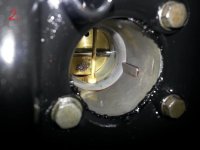
I have figured out the fuel leaks pretty much in between the metal and plastic part (see photos) at the back of the engine (facing the boat). I can see the fuel drops where I drew the red arrows.

I have attached photos, first from the left (facing boat), second from the right and the third just to show runs the fuel runs off and down the motor.

Does anyone have an idea what this could be and if yes is it expensive to fix?

Thanks
 

Attachments

  • 20131106_150007.jpg
    20131106_150007.jpg
    70.4 KB · Views: 883
  • 20131106_150025.jpg
    20131106_150025.jpg
    56.7 KB · Views: 503
  • 20131106_145940.jpg
    20131106_145940.jpg
    44.6 KB · Views: 509
I believe you may have a float valve problem in one or more carburetors.-------Remove cover in front of carburetors.----Put motor in normal running position.-----Squeeze primer bulb and look to see where leaks are.------------Repairing carburetors is not hard to do and usually involves little expense.
 
First thing you do is look at the carburetors.--Take some pictures as well.--Tell yourself " i can do this" and have a go at it.----- Taking that work to some service shops will be a $400 touch.-Work on one carburetor at a time.
 
First thing you do is look at the carburetors.--Take some pictures as well.--Tell yourself " i can do this" and have a go at it.----- Taking that work to some service shops will be a $400 touch.-Work on one carburetor at a time.

Hi Racerone,

I did exactly what you told me. Put the motor in normal position, took the cover off and squeezed primer bulb.
The problem is the primer bulb gets hard and I can't see any fuel leaking. The only carburetor that looked a bit more wet is the second one and I have attached a few photos of all three (1. from top to bottom carburetor) . Maybe you are able to see more.

However if I try to start the motor the fuel starts leaking out again.

Any suggestions what to do?

Thanks

20131108_171339.jpg20131108_171346.jpg20131108_171703.jpg20131108_171708.jpg20131108_171403.jpg
 
If primer bulb goes hard that would be a good indication that floats are ok.----But you say there is leakage when you start the motor ?---------Does the motor run properly ?-------Motor " new to you " by chance.-------If leakage is from a carburetor throat , then I would take that carburetor apart, not hard to do and hard for you to go wrong.---Do not like the looks of those clear hoses as they may not be alcohol resistant.
 
In addition... and with no intention of insulting your intelligence... standing in back of the boat and facing the back of the engine... your left would be the "Port" side, your right would be the "Starboard" side. It's best to use the proper wording to eliminate confusion to some.

From what you've said, and there was no mention of the engine even trying to start/fire... I'm wondering if you have lost ignition and in cranking the engine over in an attempt to start it, you have a excess of fuel loading the crankcase up.

Check the spark by removing all of the spark plugs, and rigging up a tester whereas you can set a gap of 7/16" for the spark to jump. The spark should jump that gap with a strong blue lightning like flame... a real SNAP! A adjustable gap tester can be found in most auto part stores. Here's one you could build cheaply............. note the hint about the screwdriver shortcut.

(Spark Tester - Home Made)
(J. Reeves)

You can use a medium size philips screwdriver (#2 I believe) inserted into the spark plug boot spring connector, then hold the screwdriver shank approximately 7/16" away from the block to check the spark or build the following:

A spark tester can be made with a piece of 1x4 or 1x6, drive a few finishing nails through it, then bend the pointed ends at a right angle. You can then adjust the gap by simply twisting the nail(s). Solder a spark plug wire to one which you can connect to the spark plug boots, and a ground wire of some kind to the other to connect to the powerhead somewhere. Use small alligator clips on the other end of the wires to connect to ground and to the spark plug connector that exists inside of the rubber plug boot.


Using the above, one could easily build a spark tester whereas they could connect 2, 4, 6, or 8 cylinders all at one time. The ground nail being straight up, the others being bent, aimed at the ground nail. A typical 4 cylinder tester follows:


..........X1..........X2


.................X..(grd)


..........X3..........X4

The thought has crossed my mind that possibly the lanyard has been knocked or pulled off of the kill switch assembly which would eliminate the ignition.

However, at any rate, fuel shouldn't be leaking down the exhaust housing (Long section between the powerhead and lower unit) so do your best to see where that leak is originating from.
 
Thanks for all answers.

I did check all cables, spark plugs and kill switch and the engine starts fine without any problems now.
It must have been one of these things.

Joereeves was obviously right and there must have been an excess petrol in the system. I let it run for 10 minutes and there was not a single drop of petrol leaking.

I will happily take the boat up to Kalbarri for a fishing trip in 2 weeks.

Thanks again for all answers
 
Back
Top