

Logo

1982 Johnson 150 excessive fuel usage

Frank D Davis

New member
I have a 1982 Johnson 150hp outboard. It is using an enormous amount of fuel. Like 6 gallons for 5 miles at 20mph on bass boat. It runs fine and Idles OK. Can see fuel on water and leaking from some exhaust areas but is not visibly leaking inside the motor cover area. Can this be a fuel pump issue. It appears the fuel has to be leaking into the crankcase because you don't see the fuel around the carburetors or fuel lines. Started out I just chalked it up to motor getting older but it has been getting worse and worse. any help appreciated
 
I have a 2000 johnson 225 doing the same thing!..still runs the same but fuel use almost doubled!!!...always had fuel or oil sheen in the water so i cant figure it out...but the performance is the same.
 
Thanks racerone I thought that possibly could be the issue so Tomorrow I will pull both fuel pumps and check and post back what I find. Thank you again for your help Frank
 
Ok more info; Today I pulled both fuel pumps off the engine and took them apart and inspected the diaphragms and gaskets and all was in good shape. They both showed no sign of any leaks. I reassembled and connected motor to hose and cranked it and it ran smooth. Just to check I pulled each plug wire 1 at a time and each one made a difference in that you could hear a miss each time one was disconnected and it would smooth out when reconnected. I then just for grins pulled each plug and visually inspected them they all looked very similar had a small amount of black deposit and were each a little oily on the surface. I then cleaned each one reassembled and cranked again on the hose and engine ran smooth. There was a small amount of fuel mixture in the cover on the manifold and the carburetors. I did notice when I tilted the motor up a drop or two of fuel would accumulate on the front of each carburetor There is a small hose connected from the intake manifold going to the crankcase. Is this a place for the fuel to run when the carburetors are leaking. If not does anyone know the purpose of this hose. What would be the next suggested step. Should I rebuild each of the carburetors? Thanks again for the help Frank
 
That wee hose is there to get rid of any leakage from the carburetors.-------Leakage is drawn into the engine.------------Does the manual fuel pump go hard when you operate it ??
 
The leakage appears to be just below the power-head where there is a collar around the main engine shaft it is very black and wet with fuel and oil mixture. When you are on the water anyone following me says they smell raw fuel and there will be a fuel oil sheen on the water around the engine when just setting idling. or just after you stop.
 
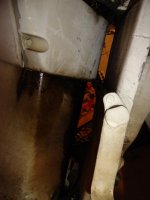
Ok here goes I think I may have the pics. I Think this is what you wanted. & Thanks again Frank

J150-1982 leak2.jpgJ150-1982 Leak1.jpg
 
I'm interested in this tread, I have an 87 110 that has seepage identical to yours. Mine even has some dripping out the prop exhaust, I unbolted my fuel pump and pumped the bulb but no fuel came out the pulse side of the pump so I'm assuming the pump is good. I suppose one of the carbs is flooding or the primer system is flooding the engine and the exhaust housing gasket needs replacing. I'll check it out more when this storm is over.
 
From the pictures it appears that the gasket between the block and the exhaust housing is leaking.---------Might want to change that and inspect lower crankshaft seal at the same time.
 
To change the gasket between the block and exhaust housing I am assuming I will have to pull the power head is that correct? Also would this cause the excessive fuel use?
I was wondering if this could be from the carburetors leaking and it being sucked into the block through the hose connected from the manifold to the block? I plan to pull the carburetors off and clean and inspect them and put kits in them if they look as though they need them, but I haven't had time and the weather has been nasty. Will post back when I have accomplished this.
 
My 120 evinrude 1998 looper was also using alot of fuel and surging.Thought it was ignition but the final cure was a stuck float in one of the carbs.I invertly put in a washer under the needle valve "according to the parts diagram"These parts instructions are often faulty and have caused me alot of grief.Had the same problem on my VRO.One set of instructions said to use two pulse limiters.The other and latest had no mention of two being used.Probably caused by parts being made overseas and the manufactur not checking it.
 
I Pulled top Carburetor off and did the test for the float. I first blew through fuel line with the carburetor upright and was able to blow air through it. I then turned the carburetor upside down and blew through fuel line and was not able to blow air through. I went ahead and dissembled the carburetor. Using a magnifying glass you could see a wear ring on the needle valve. Also when I removed the plugs on the jets the plug for the high speed orifice on the left side was loose also all the o-rings on these plugs appeared to need replacing. Everything else was clean and showed no signs of damage or wear. The float appeared ok and it was adjusted correctly. I decided to go ahead and put kits in all three carburetors and ordered #0439076 - Carburetor Kit with Float for all 3 carburetors from MarineEngines.com. I will install kits and test engine when I get the kits and repost with results. Thanks to everyone for their help and advice.
 
Sorry for the long post;


I received the carburetor kits yesterday Tues 9/4. I thoroughly cleaned the carburetor and blew air through all the orifices any hole on the carburetor I made sure there was no blockages. I replaced the float and needle valve and needle valve seat on the top carburetor. I also replaced the o-rings on all 4 Jet plugs 2 for the high speed orifice and 2 for the Low speed. Replaced all the gaskets.
I then did the same cleaning and replacements for the other 2 carburetors as I did for the 1st. I tested the needle valves for each as before by blowing thru them in the upright position and could not blow through when they were upside down. There was no visible sign of any issues. The carburetors were clean and there was no blockages. I replaced some of the fuel lines that were hard and put new clamps on them. I installed the carburetors back on the engine in the same position as they were originally.
I cleaned all the old buildup on the motor shaft. Then connected the water hose to engine pumped bulb up it got tight checked for leaks and found none. I then started the engine. Pushed in the key several times to prime engine lifted the fast idle control and it started right away and ran smooth on hose. No visible leaks no fuel sheen on grass where engine was idled.


Today Wed 9/5 Took boat out to river to run. When we arrived at the landing I checked the motor-toter for oil & gas residue. There was none. Before working on the carburetors it would be covered when you arrive at the boat landing. Unloaded boat it crank normally and ran smooth. We ran it up the river 2 or 3 miles ran at idle some and mid speed some and at fairly high speed some. When we stopped we did not notice any oil gas sheen on the water as we had before and also did not smell raw gas when standing near motor. We made several runs back and forth stopping and idling some and killing the engine and just setting there. We did not use a noticeable amount of fuel and in the end we ran several miles. We loaded the boat and came home and when we arrived home I checked the motor-toter and it was still clean. It appears to be quiet a bit better but I still can’t put my finger on what fixed it if indeed it is truly fixed.
Thanks for all the advice and help. Frank
 
Back
Top