Logo

1979 Johnson 150HP V6 150TL79C Starting Issue

Hello. I am hoping someone could provide me with some insight. I have a 1979 Johnson 150HP V6 150TL79C. I purchased it with a pontoon on 28 Dec 2015. The day I bought it I brought it out on the water. It ran great. I brought it home and started changing things on the boat to fit my likes and dislikes. I ended up rewiring the power lines and replacing the batteries with Marine approved batteries.

I tested the motor about 3 months ago. It started and ran for about 10 minutes and I turned it off. The following weekend a buddy and I took a trip to the lake, but it in the water and I ended up killing the batteries trying to start it. It turned out both Marine batteries I had were dead.

I replaced the batteries under the warranty. This time when I attempted to start it I couldn't get the motor to turn over. I ordered a service manual for the motor and began reading up on the process or repairing it.

I looked at the fuel but didn't appear there was water in it. It would stutter try to turn over, pop some exhaust, etc...
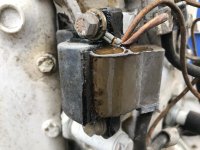
I looked at the Coil Packs and noticed they were cracked really bad and looked like there was some sort of sticky liquid coming out of them. I read many different forums that said they may be repaired if not too bad but it was best to replace them regardless.

I ordered 6 Sierra 18-5176 replacement coil packs. I removed the original coil packs using the information in the service manual.

After finishing the install I started the engine but it had a different sound to it when starting. There wasn't any exhaust this time either.

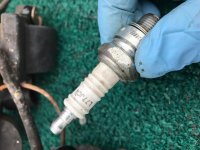
I checked the spark plugs with a newly purchased gap tester but the tester kept falling apart on the ground clip and I had to reset the spring every couple of times. I couldn't get it to spark. I ended up doing a resistance test on the coil packs and spark plug wires and all of them registered between 274-280. I didn't see information in my service manual about where the resistance should be.

The thing that confuses me about this is I didn't bother to test the spark prior to changing the coil packs but based on how it is responding I am guessing that I did get power and now the plugs do not.

I tested the resistance on the Power Pack as well and the manual states there should be a higher resistance number on the D ports in the plug and a lower number on A,B, and C ports. When I tested it I got .001 for A,B,C and 1 for D. I wondered if I tested it wrong. I also did not see information in the service manual about where the resistance should be.

I started to wonder if the plugs on the coil pack are not making a connection with the plugs on the Power Pack. I did not use Dielectric Grease. Should I use it on the plugs? Is that safe? I also did not put any on the wires or spark plugs.

Side Note: I did notice a very small fuel leak on my Fuel Pump/Filter. I ordered a gasket kit for it.

Does anyone have any suggestions about what may be the issue or if I am doing something wrong? I was debating on just purchasing some used power packs to test with but didnt want to waste money.

I attached some photos of the coil packs and spark plugs. IMG_0513.jpgIMG_0514.jpgIMG_0515.jpgIMG_0615.jpg
 
I would first take the starter apart for inspection.----------Do an ohm check from shaft to commutator.---------And did you make sure the orange wires did not get mixed up doing the coil swap ?
 
When I turn the key the starter rotates the flywheel. Would that mean the starter works or do I still need to test it?

Here is the motor attempting to start before I changed the coil packs. It does the same thing after minus the exhaust portion. I forgot to record it after I changed them.
https://youtu.be/JRzZtwZuGlA


I did mark the yellow wire and numbered the cylinders before taking them out. This was what I essentially did.
https://youtu.be/JdXtuBdkDzs
 
I fully charged the battery over night. I attempted to start it but it seemed like it was doing nothing. I let it sit for about 20 minutes as I read the service manual and was checking a starter testing video. I didn't see a voltage range in my book on the starter but was reading in other areas that it should be 9.5 volts or higher. I went back out and hooked up the voltmeter. When I turned the motor over it read 9.8 - 12v. Then it tried to turn over.

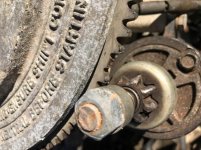
After playing with with it for a while I noticed that the spindle on the starter is not coming back down every now and then. Then as I tried it again the nut dropped and and slid back up and the engine tried to start.

I am am wondering if my starter is bad and either needs to be replaced or rebuilt.

Here is a photo of the spindle and gas.
 

Attachments

  • Gas.jpg
    Gas.jpg
    49.3 KB · Views: 125
  • Spindle.jpg
    Spindle.jpg
    53.7 KB · Views: 150
Last edited:
Inspection of the starter and brushes is very easy.----------Just take it apart.--------Take an ohm reading from commutator to the shaft.--------Should read infinity.---------Not sure why folks are reluctant to do this simple work.
 
I started to take off the starter to look at it and clean it. Then I noticed a tooth missing on my flywheel and a knarled tooth on the spindle...

I am guessing I should just replace the flywheel and starter. Thoughts?
 

Attachments

  • flywheel.jpg
    flywheel.jpg
    59.9 KB · Views: 106
Best to do a total evaluation of this motor before spending any money.---Your opinion may vary but in my area used parts are easy to find.
 
I don't know if I have the right ability to evaluate it. I just spent $150 on the coil packs. I found a starter for $47 new and a used flywheel for $75.

I bought it on 28 Dec 2015. We brought it out on the water for about 30 minutes so I could see how it runs but since then I haven't even put it on the water.

I don't even know what the oil looks like. I haven't tested the compression. I am trying to locate a tester under $50 locally. Seems like they all need to be ordered.

I spent $16 on the fuel filter/pump gaskets but they haven't arrived yet.

It it worked when on bought it. I was told the motor just overhauled and that it was put together with good used parts.

I really want to believe it's worth fixing.
 
Is your ignition switch push to choke? Exactly what is your start procedure? Pull the drain plugs off of the float bowls and see if the same amount of fuel drains out and the fuel is water free. Install the plugs and then pump the carbs full of fuel until the primer bulb gets hard. Push the choke in and then crank on the starter and let off both as soon as she starts. ththose older motors can be real cold blooded so keep your finger on the choke and quickly push the choke before it stalls and quickly let off (feather the choke) a few times until it will idle on its own usually three or four times until the heads heat up. Around here you can borrow a compression tester at any auto parts store just leave a deposit. Get back with the compression numbers that will determine the next step, without good compression nothing else matters at this point.
 
Port Cylinder 2 - 90, Cylinder 4 - 74, Cylinder 6 - 80.
Starboard Cylinder 1 - 90, Cylinder 3 - 90, Cylinder 5 - 90.

My warm fuzzy has disappeared. I read this may not be a good thing?
 
Check the spark gap on all the plug wires it should jump a gap of at least 7/16 open air gap on all the wires. I wouldnt freak out just yet your numbers are not that bad for a 38 year old cross flow engine. get it running good and give it a good decarb and see if the numbers come up.
 
Ok...
I found a flywheel on eBay for $50. That has been replaced. The timing has been completed. It tries to start still. It was recommended I clean and rebuild the carbs. I cleaned those and replaced the fuel filter.

This time when we turned it over it didn't want to start until my buddy held down the throttle on the side. Then it started and he ran it for about 30 seconds. Each time he took his hand off that throttle the engine would cut off.

I am am going through the service manual to see what the issue may be. Any more suggestions would be great.

i noticed I have a small fuel leak at the fuel pump. I ordered a rebuild kit for them and also noticed I have a gassy oil coming out of my exhaust port.
 
Did you replace/remove your fuel line at all? Usually the primer ball is closer to the tank not the motor. Yours looks like it's closer to the motor, look at the arrow on it and make sure it pointing towards the motor. The fuel line on backwards will cause that exact problem.
 
No the fuel line is the same when I bought the boat. I never paid attention to the direction it was installed. I will check. I was looking in my service manual and it said that there is not supposed to be any additional fuel filter on it but I has one there and replaced it with a new one. It says the filter is in my fuel pump.
I have to check my fuel pump to see if the filters are in it too. I am wondering if they were removed and the external one was added.
 
I pulled and charged one of the batteries. I rebuilt both of the fuel pumps. I replaced the fuel line and removed the external fuel filter. I also replaced the starter.

Then my buddy and I proceeded to adjust all the linkage, the throttle, etc.
After about an hour of messing with it and trying over and over to start it he asked me about the remote control.

I explained the last time I messed with the neutral setting and told him about the button on the side and wondered if the last time was related to a fail safe in the remote. As I was showing him what I was talking about (moving the throttle forward and back and pressing the hidden button the side that moved the lever) I attempted to start it and appeared my engine was now attempting to turn over. It sputtered but would not start. Then I noticed the new starter spindle was jammed under the nut on itself. I put the old one back on and attempted to start but it too sputtered. Then the battery died. I have a BRP Remote Control.

I am curious if the Remote Control is causing these problems. I downloaded the manually and reading through it to make sure I'm using it correctly. The service manual goes over the original remote control but not this after market.

When my remote was installed, it was mounted on the left of the captains area and the steering wheel to the right. My buddy discussed taking a look at the connections of the remote control and moving it to the right.

Does anyone have any suggestions? I am pulling both batteries to charge for the next time so we have more time to troubleshoot.
 
Wow. I was really hoping you guys would get back to me. I did want to give anyone who is reading this an update.
I returned the starter and found a replacement spindle for it for about $6 on ebay.

We charged both batteries. I also looked at the service manual at the OEM remote control. It noted the start position on the side of the controls. Mine does not notate a start position but when I pressed the hidden button the side we discoverd it moved the controls into the start position.

We attempted to start it and it turned over. I guess I should have mentioned to everyone. I am rather new to boats. This is my second boat. My prior boat was a 2009 21' Party Barge(new). I don't recall having any of these issues starting it but then again I only had it for about 8 months before I sold it.

This boat is a 1986 24' Party Barge. If you are new to boating... I would recommend checking that first. That may have been the issue the entire time. If that was the case I may have spent money rebuilding and replacing parts for nothing. However, my motor sounds great with all these new parts on it.

The last thing I have to do is verify the timing at 4800 RPMs. I had to order a tachometer for the boat because it doesn't have one. The timing at idle is great. I am positive it will be fine in use but I think that is a different forum post.

I will say that this is my last entry for this issue.

I am planning on opening a few other threads that will cover these issues. I haven't really see too much on these:

1. How to add Power Trim/Tilt to an Outboard motor on a Pontoon without one installed (Includes gauge, sender unit, and switches).
2. How to modify a fiberglass console (Includes moving steering and controls and adding gauges).
3. How to wire a Pontoon boat with a new fuse panel, and ground distribution block. Including a wiring diagram.
 
Sounds like the neutral safety switch is stopping it from starting. You should not have to move the throttle/shift lever for it to start. That button is to disconnect the shifter from the throttle so you can use throttle for cold starting. Look at the joe reeves timing method to time the motor, much safer because the motor needs to be timed in gear. Unless you have a test wheel it is not the safest thing timing a motor flying across the lake
 
Be advised that I have the same engine that has been removed from my boat after breaking a ring on #1 cylinder. I had replaced the power T&T a while back and replaced some major parts before it died. If you need any particular parts, both electrical or mechanical, let me know and I'll try to help as cheaply as possible. I also have extra spark plugs, spare electrical components, etc. that I would get rid of "cheap".
 
Easy way to test the neutral safety switch is to disconnect the wire to it. If it starts with the wire disconnected you know the switch is bad. The switch is located inside the controls.
 
My apologies. It has been a long time since I updated. I about gave up. I rebuilt the carbs after it still would not start. I replaced the batteries. I came across a video that talked about cold start. I messed with my remote control and found a rubber cover that I thought was just part of the remote that when pressed in dropped the controls into cold start.I put my Remote Control on cold start and was able to start it. I noticed after it runs for a while I can start it in nuetral.I honestly have not had the boat now since 2015 and have not once taken it out since the day that I bought it. I pulled the boat out a few months ago thinking maybe I should sell it since I haven't had time to mess with it. I forgot to tender the batteries so I had to jump the batteries from my truck. It started right up but discovered one of the carbs is leaking. It has a stuck float.I have had a couple low ball offers for it so I decided to fix the float and replace the battery in a few weeks and take the family out on the waters.
 
Hello. I am hoping someone could provide me with some insight. I have a 1979 Johnson 150HP V6 150TL79C. I purchased it with a pontoon on 28 Dec 2015. The day I bought it I brought it out on the water. It ran great. I brought it home and started changing things on the boat to fit my likes and dislikes. I ended up rewiring the power lines and replacing the batteries with Marine approved batteries.

I tested the motor about 3 months ago. It started and ran for about 10 minutes and I turned it off. The following weekend a buddy and I took a trip to the lake, but it in the water and I ended up killing the batteries trying to start it. It turned out both Marine batteries I had were dead.

I replaced the batteries under the warranty. This time when I attempted to start it I couldn't get the motor to turn over. I ordered a service manual for the motor and began reading up on the process or repairing it.

I looked at the fuel but didn't appear there was water in it. It would stutter try to turn over, pop some exhaust, etc...
I looked at the Coil Packs and noticed they were cracked really bad and looked like there was some sort of sticky liquid coming out of them. I read many different forums that said they may be repaired if not too bad but it was best to replace them regardless.

I ordered 6 Sierra 18-5176 replacement coil packs. I removed the original coil packs using the information in the service manual.

After finishing the install I started the engine but it had a different sound to it when starting. There wasn't any exhaust this time either.

I checked the spark plugs with a newly purchased gap tester but the tester kept falling apart on the ground clip and I had to reset the spring every couple of times. I couldn't get it to spark. I ended up doing a resistance test on the coil packs and spark plug wires and all of them registered between 274-280. I didn't see information in my service manual about where the resistance should be.

The thing that confuses me about this is I didn't bother to test the spark prior to changing the coil packs but based on how it is responding I am guessing that I did get power and now the plugs do not.

I tested the resistance on the Power Pack as well and the manual states there should be a higher resistance number on the D ports in the plug and a lower number on A,B, and C ports. When I tested it I got .001 for A,B,C and 1 for D. I wondered if I tested it wrong. I also did not see information in the service manual about where the resistance should be.

I started to wonder if the plugs on the coil pack are not making a connection with the plugs on the Power Pack. I did not use Dielectric Grease. Should I use it on the plugs? Is that safe? I also did not put any on the wires or spark plugs.

Side Note: I did notice a very small fuel leak on my Fuel Pump/Filter. I ordered a gasket kit for it.

Does anyone have any suggestions about what may be the issue or if I am doing something wrong? I was debating on just purchasing some used power packs to test with but didnt want to waste money.

I attached some photos of the coil packs and spark plugs.View attachment 14670View attachment 14671View attachment 14672View attachment 14673
Take a look at battery cables of they haven't been replaced in 5-6 years that could be the issue with not turning over those cables get alot of wear ND tear in those years 4AWG WIRE IS PREFERRED , if you have to run more than ten foot consider using 2 AWG TO HANDLE load requirements
 
Take a look at battery cables of they haven't been replaced in 5-6 years that could be the issue with not turning over those cables get alot of wear ND tear in those years 4AWG WIRE IS PREFERRED , if you have to run more than ten foot consider using 2 AWG TO HANDLE load requirements
That's if the battery cables your replaced aren't at least 4AWG
 
Back
Top