Logo

1976 Ford 302 Lower Re-build

Neal Franson

Regular Contributor
My fuel filter came in, so I took the old one out and made an adjustable bracket for the new filter out of the old bracket, as it is a tight fit and I wanted a little wiggle room.
I also figured out my tilt problem. My wiring was just fine, but I forgot that I had put in a 50-amp in-line fuse, and it was blown - I must have crossed some wire.
 
I finally got the pinion nut off! It wasn't going to twist out, so with a Dremel tool and a lot of cut-off blades I sliced it off cutting into the pinion gear, that was already toast. I pulled out the driveshaft and then the main gear, and as suspected, the clutch spring was broken about 3/4s of the way down. The clutch hub, which holds the snap ring holding the forward drive gear and the clutch spring assembly in place has a very worn groove, so needs to be replaced, with all the other parts, and is probably the reason the snap ring fell off and caused my catastrophe. I didn't notice it when I did the last rebuild - should have checked.
Also, I got my fuel filter base installed, having to weld a strap to the bracket to move it out where it had room, and changed some fuel fittings in the fuel pump that were 5/16 ID to 3/8" ID fittings.
I did change-out the 2-barrel Holley carb to my Chinese knock-off of an Edelbrock 1409 four-barrel. I know this is not a favored move, but it is pretty! See picture - the fuel filter base is in the lower right-hand corner, without the element, which is coming in this week.
1976 Ford 302 -4barrel.jpg
 
The complete used lower drive is on the way and delivery is supposed to be July 1st. It also has a stainless 14x17 prop. Hopefully will be back out mid-July.
I have found the expensive parts for the re-build pretty cheaply on Ebay and may not have ordered the used drive if I would have known it would be so inexpensive. But it adds equity having a back-up re-built lower.
 
17P stainless is cupped & will give RPM similar to 18 aluminum.
Just bought this last night - fits my 90HP Fossil Drive. Really don't need it as I already have 1 used & 1 NOS lower drive.
 

Attachments

  • 20250625_233727.jpg
    20250625_233727.jpg
    418.6 KB · Views: 23
I still need to pull the forward coil and the front bearing, etc. I will be depending on you, Droid, for help with the shimming.
The higher pitched prop will give me more efficiency, lowering the rpms for speed.
 
I spent the afternoon cleaning lower unit parts and reassembling the reverse hub/needle bearings and gear and the seals in the swivel bearing assembly and contemplating removing the forward coil. There are three tools that I don't have that are unavailable on this website to take out and put back together these parts: one is the slide hammer with a special connection #680658, which I could probably fake; there is a tool to take out the roller bearing assembly, which the pictures in the manual are very poor, so am not sure what this tool is or what it looks like, #380657 called puller jaws, wide: and has a Johnson/Evinrude # of 391012, both unavailable with no picture, so, I don't even know if I can fake one. Plus, what I am seeing looking into the gear housing, looks different than the exploded views that are on this website and in the manual. Maybe it is a newer version of the coil that extends out more than anything that I can find. And then to put it back together there is a shimming tool. That is why I refrained from taking it out the last time, and why I am still debating if I can do it this time, being somewhat blindfolded. To clean it out, I just blew water through front part of the gear case from all angles that I could, top and bottom, but it is not really clean until you take it out and take it all apart and clean everything.
The new, used complete lower that I ordered will be here in a day or two, so I will probably shift gears into putting that together with my upper and getting it mounted and ocean ready; and putting my rebuild on hold.
 
My new used lower came in today and it is a perfect fit! I checked the oil, and it looks good - clear and clean.
The bottom fin was damaged in shipping, bent and cracked about halfway through. I put some marine JB Weld epoxy in the crack and pounded it straight and let it dry. Then, I got some fiberglass cloth and cut a triangle for each side and mixed the rest of the JB Weld and built up the whole area of the crack with fiber-glassed JB Weld on each side. Next, I will sand it smooth, prime, and paint it.
The 17-pitch stainless steel prop looks really great! I also mounted my whale tail stabilizer to the new unit from my old and started painting it.
I also ordered the parts I need to put it all together - some new seals, etc.
 
I was curious what the actual horsepower of my Ford 302 with each of the upgrades that I have installed. He estimated it at 239 to 270 hp! (from 190 hp). It is an interesting read for us motor heads. Check it out.
 

Attachments

  • Groks estimate of the horsepower of my Ford 302.pdf
    155.8 KB · Views: 101
Well now, OMC never went past 235hp except for a year or 2 @245hp (with thru hull exhaust) on an electric shift.

If you destroy the drive you'll know why. I'd avoid W.O.T. hole shots.
 
I was curious what the actual horsepower of my Ford 302 with each of the upgrades that I have installed. He estimated it at 239 to 270 hp! (from 190 hp). It is an interesting read for us motor heads. Check it out.
I think "he" is very generous with the estimates provided...my gut says the one that will make the biggest improvement is the exhaust...and what you may see from the other changes will never get to the estimate offered...

Going on memory, didn't the camshaft get changed as well...?? I didn't see that is the writeup...
 
Yes, well I do take his advice with a grain of salt - I don't think it has 270 hp. He does give references to others who have made changes and tested them, which I did not include in the write-up. The electronic ignition should also give it a few, and our favorite 4-barrel carb with the bigger manifold and the fuel line upgrades should count for something at the top end. I would go with his low end of 239, or at least 225. In any case, it is a hot rod! Meaning it is hopped up a good deal from the standard.
The camshaft was replaced to the standard 302, instead of the 351 that it had, which mainly just changed the firing order, and had us in confusion for some time as to what was wrong, till someone recognized the problem.
 
My seals came in today, so this evening I mated the upper to the new lower with a lot of grease and mounted it to my boat with the new stainless steel 17 pitch prop.

Outdrive.jpg
 
I finished the install and hooked it up to the water, had to pump the bulb about 60 times to fill the new large fuel filter, and it started right up - like immediately! Just had to adjust the carb and the linkage to get it to idle. I had the carb pretty well adjusted from before and it has the smallest jets in it, which are bigger than the Holley's. I am about ready to take it out this weekend.
 
Well, I got it down to the ocean, and I didn't pass my sea trials, but it was not a total disaster. The good thing is it always started right away at idle. Before it was like it was fuel starved, and I would have to pump the throttle like crazy to get it going.
So, I started out at 1000 rpm and would check the speed and the temp at 500 rpm intervals. I worked up to 4000 rpm and blew an iridium plug on #2! I brought a spare standard spark plug, so moved to an area that I could safely drift for a while and changed the plug. I worked up again to 3500 rpm and the motor started cutting out, similar to before, as if it was fuel starved (but not sure). The motor didn't stall, so I started out again and it did the same thing at 3000 rpm. Again, didn't die, I just cut the throttle, and it kept running. I limped back to the launch at 2500 rpm and tied to the dock to do a few diagnostics.
First, I noticed there were two puddles of oil, one in front of my intake manifold, and one in back of it. I brought my vacuum tester, and the vacuum was good, about 19 in/hg at idle and 23 or so with throttle. I didn't have any other diagnostic tools, so I put my toy on the trailer and went home.
I guess I have to reinstall my intake manifold again - this time I am going to uses those cork strips on the front and back.
A plug blowing out seems like it would be from a lean mixture. I could check the flow from the fuel pump, but this is my third fuel pump. Everything else on the fuel line is 3/8 and I even eliminated all the L's, so the fuel flow is smooth. The new fuel filter is at least four times the size of my old one. There is also a 3/8" anti-siphon valve and a new vent. I have been all though the fuel supply, including cleaning the tank. The gas is fairly recent. and has marine Stabil in it.
The iridium plugs are pre-gapped to .051 instead of the standard .030, so could change back to the standard plugs and maybe tone things down a bit.
My Chinese knock-off of an Edelbrock 1409 4-barrel carb says it only needs 5-6 psi, and I believe I have that from my fuel pump, but I will check. The Holley was not any better and was worse at idle. I couldn't tell if the secondaries of the 4-barrel carb came on or not.
I am not sure what I have to do to get more fuel to the cylinders, if that is my problem. I would change it to fuel injection, if that were feasible, but that is just my "hot rod" mentality. I probably don't want to bump up the horsepower any more than it is. Or I could be satisfied with staying under 3000 rpm, but that is not likely. I am more likely to put a supercharger on it, but I will restrain myself.
Any ideas?

 
Last edited:
Some more data:
I tried to get an accurate reading on my fuel pump pressure, but it was hard to tell, as my gauge zeros out at minus 2 1/2 or so. I bought a new one at harbor freight and it was exactly the same. I took the old one apart to try to straighten the needle, but I just screwed it up. It looks like the pressure is 5 lbs, or just under. The manual says it should be between 3 1/2 and 5 1/2lbs. My carb instructions say between 4 and 5 lbs, and not over 6 1/2 lbs. I did a volume test, and the manual says a V8 should fill a pint in 20 seconds, and it took about 35, with a paltry trickle of a flow. I remember checking it early on and fuel gushed out.
I was checking marine fuel pumps, and they don't advertise their pressure or fitting size.
I raced the engine to 4000 rpm momentarily while looking into the carburetor and didn't see any movement from the secondary throttle plates, and no gas from the jets in the venturi on the secondaries - maybe they are just ornamental! Or maybe it has to be under some load, FOT, or more prolonged use to get a rise from them.
 
I went back out and messed with the carb, and without the engine on, the throttle plates will activate at full open throttle. I never got to full open throttle on my sea trial. There may be a linkage adjustment that can help activate the secondaries earlier.
 
very normal for the secondaries to stay closed when reving the engine with no load...

Have you checked the vacuum on the suction side of the fuel pump yet????

If you have access to an outboard can, that can be used to eliminate built in tank issues...what material is the built in tank made of??
 
The tank is 55-gallon stainless steel. I have not checked the suction side of the fuel pump. What would be a good reading?
I do have an outboard can, which is 5/16ths, but I would have to check it under load with a trip to the Pacific. All is normal under 2500 rpm.
 
i trust the tank is baffled

on the suction side, less than 2" Hg would be decent...if the vacuum exceeds 5" Hg, its too much...i would also what for drops to zero...
 
I remember seeing a kind of wall in the tank. The boat was built by Cruisers, who now build Bayliners, I believe. I can take another look in there. What is your concern?
So, you want little vacuum on the back side. I would think you would want a lot. Could you explain?
It will probably be this weekend until I do more work on it.
 
just wanted to make sure what you had was solid and not a contributor.

You need to see a little bit - no vacuum means no pressure difference means no flow.

too much vacuum indicates a restriction and will severely impact the output of the pump...reduce the vacuum even more and the fuel will vaporize which means no output from the pump...
 
Neal,
I got around to investigating the tool question.

1st, 680658 should read 380658 & that is replaced by 391008.

2nd, 380657 is replaced by 391012

Its been over 15 years since I was in 1 that far. I may have used some combination of OMC, Mercury Marine &/or over the counter slide hammers. I just don't know.

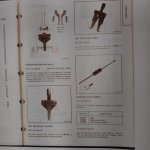
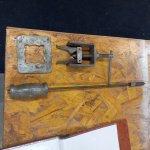
Here are a few images of similar tools & a page from a 1983 tool catalog.
 

Attachments

  • 20250715_203435.jpg
    20250715_203435.jpg
    724.3 KB · Views: 21
  • 20250715_203535.jpg
    20250715_203535.jpg
    565.3 KB · Views: 23
Back
Top