Logo

1970 Johnson Starter just spins

Tourtney

Member
I have a 1970 johnson 60 hp 3 cylinder 60esl70b and when i hook it up to a new battery i just bought the starter just rapidly spins. Before i thought the jumper just wasnt supplying enough juice and i would hook it directly to the starter and ground on the engine and the starter would engage the flywheel. The battery reads around 12.7 volts but at the starter solenoid i am reading around 12 volts on the battery post when the key is in the off position. There is a wire with a fuse that doesnt seem to be connected into anything and doesnt recieve any vokts in the off position that is conected kn one side to the solenoid. Could this be the issue? I have read somewhere where it is the wiring at fault if the starter fails to engage from distance. Thanks
 
''The battery reads around 12.7 volts but at the starter solenoid i am reading around 12 volts on the battery post when the key is in the off position''

this is a confusing statement...do you mean to say with the key off you are reading 12.7 at the positive post on the battery and only 12 volts on the solenoid?if so you have two problems...they should read the same..thats one problem...the 2nd problem is you have to be pulling current to have a voltage drop and you should not be pulling any current at this time..

a couple of questions...do you have the battery polarity reversed?..is the motor new to you?

disconnect everything from the battery except the motor....retake these two voltage readings...if they read the same then proceed with troubleshooting the starter just spinning...when you turn the key to start and the solenoid picks what is the reading on the starter post itself?
 
As Papyson suggests. if that battery is hooked up backwards the starter will no doubt be running backwards.

Looking straight down at the starter, the gear should be turning Counter Clockwise. Note that a battery can be charged backwards and if so, even though it's hooked up properly, the polarity will be reversed.

If the above is the case, reverse polarity will destroy the charging rectifier.
 
Okay looking at starter it is spinning counterclockwise if you look at it from the top however I have fixed the issue where the voltage at the starter solenoid aka the slave solenoid as read only 12 volts I believe it is because one of the parts stuck that part controls the forward reverse control in the control box seemed to be stuck once I jigglee
with the throttle and put it into neutral it seem like it got fixed in the voltage at the slave solenoid reads 12.4 volts on the battery post around that at least anyways when I crank the motor the voltage at the starter itself, it jumps around but I'm reading around three-and-a-half volts. When I look at the large battery cable in my in my electrical cord go into the motor I know that some of the tiny ones that make up the bigger wire don't look like they're going into the crimp it looks like the person before Me Maybe you used a crimp that was too small for the wire could this be the issue? Also I measure the voltage at the key switch on the battery post in the terminal post and they both read the same voltage that was that the slave solenoid on the top battery post when the key is in the start position and I get no reading at the start terminal until I turn to the ignition. No sparks when connecting battery anymore either.
 
Yes I'm sure because the starter spins up when I connect it directly to the starter I change the battery because the old one wasn't very good anymore and I didn't think it had enough juice in it to get the motor to run new battery has a full charge of about 12.7 volts
 
The "jiggle" mention..... that's a safety switch inside the control box that prevents starting when in gear. It's out of adjustment. It's a white plastic assembly held with two screws. Loosen the screw slightly and press it towards the lobe that engages it. You can access it without removing the box from the boat.

All of the inner copper wires of the large battery cables should fit within their end terminals.

You are experiencing a battery voltage drop to the electric starter.... this is due to either a loose cable OR tight but dirty cables (corrosion etc). Remove all cables associated with the starter system, clean the terminals thoroughly and whatever components they attach to, then tighten them securely with either a wrench or pliers... not your fingers if wing nuts are encountered.

Let us know if the above cures your problem.
 
Hi, I ended up lubricated the bendix and replacing the positive battery cable to the grey cable that leads to the motor connection, I also tightened all of the solenoid screws and cleaned off the main ground nut in the control box. Replaced that big wires connection, replaced the grey wires connection ( the person before somehow split the wire harness, the connections are near the middle of the harness). But sadly still now luck. Very disheartening right now. I am afraid the wire itself in the harness must be replaced, and that will cost me an arm and a leg. The voltage at the main grey wire in the motor is as it should be (12.72 volts) no voltage drop there. Coming into and out of the rectifier causes a small voltage drop (12.44 volts). This wire leads to the solenoid and then back to the key switch by way of another wire (double wire on top of solenoid set up). At the key in the start position both the ignition and the battery posts read around 12.44. The start switch now also reads 12.44 and coming out of the solenoid to the starter it reads around 10.5 if I am not mistaken. Again the starter spins really rapidly but fails to engage, but when connected directly it does engage immediately. I would like to point out I am noticing a drop in amps, the battery supplies 10.5 amps or that number on my meter, in the control box it is around 9.6 and then following the grey wire into the motor it is around 8, and finally back at he solenoid I believe it is 7.5. So there is a definite current decrease, which is why I think all the wires need to be replaced. :(:(:( It has never run by my hands before, I rebuilt the carburetors. The guy before says it ran, which I now find hard to believe. Right now it is on a custom built stand in my garage and I am testing it with a battery sitting on the ground nearby.
 
Last edited:
let us simplify a bit....when you turn the key to start you pick the starter solenoid...when the solenoid picks you have a direct feed to the starter from the battery through the solenoid to the starter...the starter spins and engages if its working ...zero in on that..ignore everything else...with the key turned to start and the solenoid picked please take the following readings and write them down and get back to us...1.battery reading post to post..2.reading from positive post of battery to motor ground..(block ground..anywhere on the block where you can get to any unpainted bolt etc)..3...reading between starter post and block ground..4..reading between the heavy positive wire on the solenoid and block ground...

make sure the battery is fully charged when taking these reading...as you can tell we are looking for a voltage drop..you have to be pulling current to see the drop..thats the reason for taking the readings with the circuit active...do nor have the key turned to start the complete time you are taking the readings and writing them down..turn it to start and take one reading and release the key..move the meter to the next test point and then turn the key again..if you are working alone you will need meter leads with a clip....
 
If you jump the starter directly from the battery with jumper cables and the starter works properly the starter is good. Pull the grounds apart and sand metal to metal and bend the cables end to end looking for weak spots. Do the same with the pos cables and wire brush all the lug connections on solenoid and starter. Cables will corrode under the insulation where it is not visible if you crank on it and it dont kick the bendix up the cable will get hot thats bad resistance equals heat.
 
Please note all of these readings are approximate because they tended to jump around:

1. From the post to post- 12.42 (after 1 second, reading seemed to decrease with time)
2. From post to ground ( grounded on the outer edge lip of motor with alligator clip)- 8.7
3. From key switch start wire to ground- 4.65
4. From large cable going to starter to ground- 4.38

Of note, I don't recall a voltage drop such as this without the key turned to start (either on off or electronic on). So maybe it has something to do with the ignition system? Not sure why the ground on the motor would have less voltage than the battery ground. Also, large voltage drop from battery to start post, not so much from start post at key to solenoid post. Kim, I checked resistance before and it seemed low ~2 ohms on all wires that I checked. Also I don't feel any heat in the wiring, that problem seems to be fixed, as it was getting warm before. Also, no sparking when connecting the battery when key is in off position.
 
The starter seems to be getting 10.6 volts, and the solenoid pick from the starter when removed from the solenoid is getting 12.4 volts. Also, I grounded it using the cable that leads to the neutral safety switch AKA the other small cable on the solenoid.
 
Your making it way too difficult it can only be battery cables/connections or start solenoid contacts. The starter works when you jump it from the battery. the start solenoid clicks and turns the starter. Get new battery cables and a new start solenoid and go fishing!
 
I just ran the battery cables and the starter solenoid is also new. Only about the last 4 inches are from the old battery cables because i messed up... So that voltage drop through the solenoid is okay?
 
Last edited:
how did you lengthen the battery cables? Just because the solenoid is new it dont mean its good. There should be little to no voltage drop through the contacts. Have you tried shorting the small pos post on the solenoid to the battery side bypassing the ignition switch? I normally just use a screwdriver. Did you replace the start wire from the solenoid to the starter? Take your jumper cables and just use the pos lead clamp it on the battery pos and touch the starter side of the solenoid the starter should work properly. Allways make sure the water is turned on when you crank on the motor.
 
Will try tonight, i didnt lengthen the cables the person before cut them at the base of the control box for some strange reason. I mean the voltage drop coming out of the solenoid going to the starter. Did not replace the start wire going to the solenoid.
 
Only about the last 4 inches are from the old battery cables because i messed up?
i didnt lengthen the cables the person before cut them at the base of the control box for some strange reason?
Is the pos lead new from the battery to the start solenoid?
Is the neg lead new from the battery to ground on the engine close to the starter?
 
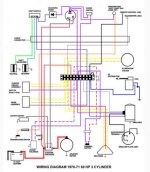
Both of these wires have been.replaced as stated before except for the last few inches and the main battery ground goes into a stud in the control box. The image is very similar to the setup of the motor although i think it is a little misleading in some places.... fetch.jpg
 
go back to your readings...you either had a bad motor ground with your meter or you got a problem between the negative side of your battery and motor ground...
 
Here are a bunch of photos... All of the readings are with the key switch off. I don't notice a voltage drop on the battery post of the key switch anymore with the switch on.

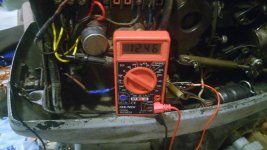
20160601_230732_resized.jpg
This photo shows the beginning voltage at the grey wire that brings the battery positive cable into the motor.
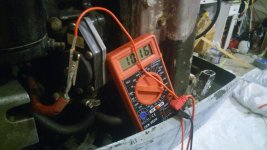
20160601_230901_resized.jpg
After the grey wire comes in it snakes trough the rectifier and a diode, notice the voltage drop of about .3
20160601_230922_resized.jpg
Here is the voltage at the battery post on the solenoid, one wire comes from the red wire you see on the rectifier, and the other wire leads back through the wire that has a fuse (thick red wire that had wires sticking out and has since had the connector replaced to include all the wires as I far as I can tell) back to the battery pick on the key switch.
20160601_231029_resized.jpg
Here is voltage the solenoid pick from the start wire at the ignition switch with the key turned to on
20160601_231047_resized.jpg
Here is a picture of the control box for kim the ground is to the left of the yellow screw on connector, I think it is hidden by that yellow butt connector, anyways the black wire from the battery simply goes here and that is all. You can't really see it but just outside the control box on each wire is a butt connector, which is where I connected the new battery wires to the old wires. At the top right is the gear control which I sometimes have to jiggle as mentioned previously or the voltage is about a volt lower than usual (11.5 volts).
20160601_231629_resized.jpg
Here is the voltage at the starter, it reads 10.16 volts.
 
Are you getting battery voltage on the start side of the start solenoid after you disconnect the starter cable at the starter. I would be willing to bet your start wire from the solenoid to the starter needs replaced. Your local boat dealer will likely have one you can match up. Pull the wire out and bend it end to end looking for weak spot/s. They normally corrode under the insulation you cant see.
 
Yes, wouldn't the voltage stay the same regardless if it were hooked up (which would be the 4th photo, otherwise I will test for that)? I didn't have a high amount of resistance between that cables ends. Also, I am pretty sure that the voltage on the starter pick of the solenoid is fairly low as well (~10.5 volts) same as the wire end going to the solenoid. Is there any way to know for sure?
 
Last edited:
Disconnect the wire at the starter and then check voltage on both sides of the start solenoid large terminals with the key on start. You should have very close to battery voltage.
 
looking for a voltage drop with no load on the wiring will not show a high resistance..the voltage will show the same on both ends of the disconnected cable unless there is a complete open...
 
Ok I think I have found the issue. I worked back the battery using jumper cables from the solenoid back, and the engine stopped engaging the flywheel at on of the connections. I stripped the wire and found it was black, like it had burned. Right now I have pulled this wire back about a foot and still no luck. I am hoping that once I get rid of this wire enough I will reconnect the two pieces with a new one. I remember now that that wire used to get warm (main wire from battery to rectifier) before I replaced the rectifier so it may be my fault, but I think all of this corrosion is messing up the current through the wire. Also, probably for a separate thread, do any of you know about a small ticking noise coming from the power pack when the engine is turned electronic on or start. Is that a bad power pack? If so, I may not even waste my time replacing this wire. Power packs are expensive!
 
Huh? I thought you said you replaced the battery cables from the battery to the start solenoid. Does the engine run? Just splicing the old battery cables may work until it leaves you stranded, just replace all the battery cables from the battery to the motor and from the solenoid to the starter.
 
Back
Top