Logo

1968 Johnson 3hp JHL23M Compression Test

Swarlos

Regular Contributor
I'm no mechanic, but I can follow directions.

I have a 1968 Johnson 3hp JHL23M. It has been running for the last few years, although infrequently and not always easily, but I could get it running if I pulled it for a minute or two. This year I had it running as it has in years past, but suddenly last week no matter how long I tried I couldn't get it to go. I changed the spark plugs, one of which seemed to have some kind of corrosion on it. I checked the oil level near the prop, it was dark, but full so I drained it and replaced it. While I was working I decided to check the impeller which seems fine so I put it back. Somewhere online I read that I should do a compression test, so I borrowed a gauge from a mechanic friend who told me I should try squirting a little bit of oil into the cylinders to see if that helped.

First I did a dry compression test, I read 60 in the top cylinder and 58 in the bottom. Then I squirted a little oil into each cylinder which yielded 68 in the top and 65 in the bottom.

Are these values low for this model motor? If they are, what can I do to try to fix it up?

Thanks in advance for reading and, potentially, helping me out!

P.S. I'm using a 40:1 Fuel/Oil mixture, is this correct?
 
Oil is cheating, and will cover up or hide a low compression problem. Do you intend to squirt oil in it every time you start it? 60 psi is low but it should run. 80 would be ideal. Having said that, not all compresson gages are compatible with that small displacement engine. The downfall comes with the volume of air in the passage between spark plug adapter and gage check valve.

50:1 was the official mix, but suggesting that will always start a war. 40:1 will at least lessen the conflict.
 
Last edited:
Oil is cheating, and will cover up or hide a low compression problem. Do you intend to squirt oil in it every time you start it? 60 psi is low but it should run. 80 would be ideal. Having said that, not all compresson gages are compatible with that small displacement engine. The downfall comes with the volume of air in the passage between spark plug adapter and gage check valve.

50:1 was the official mix, but suggesting that will always start a war. 40:1 will at least lessen the conflict.

The length of the tube from the spark plug adapter to the check valve is 21-3/8" including the quick connect fitting in the middle.

I don't intend on squirting oil in there everytime I start it, but if I have to do it I would. You say it should run at 60, but 80 would be ideal. Do you have any recommendations for a permanent fix to bring up the compression?

I went out of my way to get "real gas" without ethanol this year, should I switch back to regular ethanol gas?
 
So, 21" hose is the problem. You have to add the air in that 21" of hose to the amount of air in the combuston chamber. Not a problem with a 4' bore car engine, but a big problem with a less than 2" bore of a 4hp outboard.

With all that in mind, I'd say your 60 psi is fine.

Another war-starter: Ethanol gas. My motors would all die of shock if I went out of my way to get non-ethanol. I get all my gas up at the corner Cheapo station. Do whatever pleases you though.
 
Last edited:
The length of the tube from the spark plug adapter to the check valve is 21-3/8" including the quick connect fitting in the middle.

I don't intend on squirting oil in there everytime I start it, but if I have to do it I would. You say it should run at 60, but 80 would be ideal. Do you have any recommendations for a permanent fix to bring up the compression?

I went out of my way to get "real gas" without ethanol this year, should I switch back to regular ethanol gas?

I would check for two good sparks before going any further

The reason many would suggest a more oily mix ( 24:1 even) is that none of the bearings are needle rollers and there are no crankshaft seals. It relies on an oil film in the crankshaft bearings to form a seal
 
What is the best way to check for sparks? Is there a good tutorial someone can recommend? I'm seeing a few Youtube videos, but I don't have a ton of confidence in them.
 
What is the best way to check for sparks? Is there a good tutorial someone can recommend? I'm seeing a few Youtube videos, but I don't have a ton of confidence in them.

Initially perhaps worth trying the time honoured method used ever since stone age man invented the wheel by holdimg the spark plugs ,one at a time while attached to their leads against a metal part of the engine while an assistant cranks the engine, Hold with something well insulated or you could get a bit of an electric shock and do it in deep shade, preferably in the workshop, or you wont see the spark,

But a spark across the plug gap while not in the engine does not guarantee it will be strong enough under compression in the engine . If you don't get a sparks suspect the coils, points or condensers If you do see sparks you need to confirm that they are strong enough to jump at least 6mm from the ends of the leads or with an adjustable spark tester

Beware of Youtube videos especially the very amateurish, very boring and rambling ones made by idiots who think they are being helpful. Stick to the more professional ones.
 
Actually there is one crankshaft seal, the upper one. And also there is oil slinger before the upper seal. My seal was leaking and it was not possible to buy new one from the dealer, i needed to order that from the shop, where they made all kind of gaskets according the individual orders. I use 24:1 mix, and it works very good.
 
What was the part # for the upper seal on this 1968 model 3 HP.-----The 69 and newer 4 HP shows a seal.
 
Last edited:
1966 model, 3hp, seal is: 308117
I think it must be same in 1968, since the powerhead and crankshaft have same part numbers as 1966 model.
But my dealer even didnt find that number from the database.
 
I found something in my grandfather's shop. It's like a screwdriver with a light bulb in it. It has a wire with an alligator clip which I assume is for ground. I'll give that a try.
 
I don't see a seal till 1969 4hp--same year they went to a needle bearing, which is why the slinger system would no longer work.
 
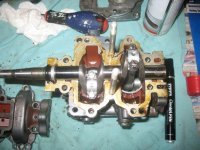
Here we can see the seal-ring (or O ring) in my 1966 3hp block, after the oil slinger
Inside.jpg
 
I did a spark test with an in-line spark tester, and both lines are working. I'm suspicious that there isn't any fuel getting into the carburetor. My grandfather told me that I could check to see if the fuel pump is bad by lifting the gas can above the engine and let gravity work the fuel in. Obviously I couldn't run it in the water like that, but if I can diagnose a bad fuel pump on land (in a water bucket) doing that I would be one step closer to finishing the job.
 
You need to make sure that spark can jump a 1/4" air gap. Why don't you just pump the primer ball to see if that makes a difference.
 
Back
Top