Logo

1963 75 HP Johnson Reeds

Duke1973

New member
Out on the lake and slowing down, the engine simply died and wouldn't start. We pulled the plugs and they were dry as a bone. The sediment bulb was full and when I drained the bowl on the carburetor, all the fuel drained out. After we got towed back I went through the carburetor and it was fine. But to make sure, I ordered a kit and did a thorough rebuild, so I can eliminate my carburetor as being the problem. I've been advised that I may have one or more bad reeds. I haven't started pulling the reeds out yet because I want to make sure I have replacement parts. Looking under my year, I see that the reeds are not available. In 1964 I see I can get the leaf plate including the reeds for 50.21 each. I also see in 1964 they had the complete assembly. part number 379124. This included the plate with all four leaf plates, but this assembly isn't available. I am wondering if there is a chance that these 1964 leaf plates, 379571, would work on my 1963 model? I have very good, even compression and great spark. The engine simply isn't getting gas. it was running fine until it simply stopped while slowing down but still on moderate plane. All hoses are attached. There is no residue when looking under the flywheel, which makes me thing the top seal is okay. So mainly wondering about the interchange possibilities for now.
 
Model # of your motor ?----Those reeds rarely fail.--So I doubt it is a reed issue.-----Top quality stuff.====And if you have one bad reed valve the motor will start and run on the other 3 cylinders.----does spark jump a gap of 5/16" on each lead ?----Post actual compression values.-----You have installed a new water pump impeller ?----Belt timing checked ??
 
Last edited:
It's a V4SL-15. 80 lbs. compression on all four. Timing right on. Good spark. The problem is that it's not getting fuel. It should get fuel when cranking, timing, ignition integrity and water pump not withstanding. There's a compromise in the crankcase somewhere. There was no warning. It simply quit. It hasn't started since. When I pull it over, I don't hear the reeds "singing". One bad reed would cause that. I guess I'm going to do some exploratory surgery and pull the leaf plate base. I would hate for the engine to completely ingest a reed if it might be partially broken. I have the gaskets. I was mainly curious about the compatibility of the newer leaf plates. This engine has never run as well as I thought it should have. I guess it didn't help that the timing was, in fact, off when I got it, by one cog in the retarded direction. When installing points a couple weeks ago I noticed it was off still another cog. So I guess it was off by 21 degrees. No wonder the idle was so low.
 
Last edited:
Each cylinder has a separate crankcase.---Each crankcase has it's own reeds.----One bad reed is NOT your issue.---With one bad reed the motor will run nicely on the other 3 cylinders.------Note---a 1963 model V-4 was practically NEW when I starter working on them !
 
I agree with Racerone. One bad reed will take out only 1 cylinder.

How are you testing spark? Double check the timing. It should not have been off 1 cog once much less twice.

Those ignition rotors are known to carbon track thru the body to ground out on the distributor shaft. Spark yes but not to the plugs. Instant failure.
 
All good advice. But even if my distributor was in the corner of my garage, if I'm cranking my engine over with the choke on, wouldn't I flood the engine and it show as my plugs being very wet. My plugs are dry as a bone.
 
Some simple trouble shooting will lead you to the issue.-----Guessing will just add to the frustration with this simple motor.----Worked on lots of them back in the day !!----Good luck with your efforts.
 
Will it bark, if you just give a very small shot of gasoline in the carburetor throats and hit the starter? Or, into the plug holes? Do you have the low speed mixture needles set correctly after rebuilding the carburetor?
 
Last edited:
I'm going to lake test it again and squirt a little gas into the carburetor. Because it has a new impeller I want it in the water because I don't have the proper attachment to run it out of the water. The answer to your question is, yes, that it jumps a 5/16 gap. Now if you could answer my question; Wouldn't the plugs get wet as if I was flooding the engine if I cranked on it for a good amount of time with the choke on? Because I'm not getting an iota of gas on the plugs. Thanks for your help.
 
Are you positive that the carburetors are filling with fuel when you squeeze the primer bulb? You are positive that the choke butterflies are closing when you choke the engine? When cranking the engine, your hand over the carb throat, can you feel the engine trying to suck in air when the pistons are cycling up and down. If you had a broken reed you would feel air trying to come back out of the throat on the piston downstroke.
 
Yes. The bowl on the carburetor fills up because after it didn't start I drained the bowl. and, yes, the butterflies are closing, both on auto and manual. I pulled the rope with one hand after I took the screens off and I don't feel suction or blowing back. I have 80 pounds of even compression on all four, and my gauge has traditionally read a little low. Is there a leak-down test to test the bottom seal? Would I have suction on the top half if the bottom seal was bad? Is a bottom seal failure quite rare, like reed failures? It's strange how this motor died when it was still at around 2000 RPM's as I was slowing down, never to even hint at wanting to start again.
 
A bad lower crankshaft seal would be much more subtle than that, it would be lean on number 2 or 4, but still want to run on 1 or 3. The engine would have no power or a lean sneeze at idle. You can drop the lower unit and see if the top on the driveshaft looks and smells like raw gasoline and oil from a seal leak. May be hard to distinguish since I don't think she had an exhaust tuner to keep exhaust separate from the drive shaft area. You may have a situation where this engine isn't firing under compression but fires well with a static spark checker. Most fueling issues have symptoms before they just shut off and no restart. I'd still make sure, you have a good coil and condenser and the points are firing at the right time, and are gapped and cleaned. 2nd time I've asked this; does the engine bark with a small shot of fuel in the carbs or in the cylinders? Stick the engine in a garbage can full of water 6" above the cavitation plate if your worried about your new impeller. Is your engine electric or mechanical shift?
 
Last edited:
That's good to know about the seals. I'm going to check everything in my distributor again. And I will try to find a large enough garbage can to test it in with fuel down the carburetor. The fact that I don't feel suction when I pulled over the engine worries me. And I'm perplexed why when I crank the engine over for quite a while in an attempt to start it, fully choked, that my plugs are dry.
 
As Fitz said, I’d pull the plugs, squirt 5-10 drops in each cylinder, replace plugs a turn it over. If it barks, it’s a fuel delivery issue. No noise- spark issue.
You can do that just on the stand, the short bark won’t hurt your impeller.
I just did that with a ‘96 9.9 I bought. Pulled 20 times, not a single bark. 6 drops in each sparkplug hole- instantly barked for 2 seconds.
Crab removed & fully cleaned, it started on 2nd pull
 
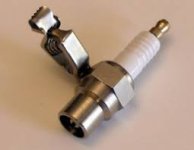
So today, after a somewhat sleepless night, I checked my spark again today. It was very weak. I'm glad I finally listened to you guys. I dug out some distributors and a couple of them look like they will be a good replacement. The spark jumps reliably a good distance on my spark tester. My coil I had replaced must have gone bad, I guess. So tomorrow I plan on switching distributors. I'll post my results. Thanks for dissuading me from digging into my reeds.
 

Attachments

  • images.jpg
    images.jpg
    4.5 KB · Views: 35
Nothing more fun than trying to drill down to a root cause. All we can do is offer our experiences, they may or may not add value. I too, lost sleep over your GD 1963 75, my second pee at 3:15 am, laid back down, petted one of our Mainecoon cats and pondered about why you haven't shot fuel into this motor to dispel a fueling or spark issue? You are affecting our lives. LOL!
 
LOL I remember about 30 years ago, out in my 1957 Glastron with a 1960 75 HP, it did the same thing as this boat and it turned out simply to be the rotor. Stay tuned.
 
It's Alive !! In some respects, it runs better than it ever did. I was never able to get any RPM's in neutral but it ran fine once moving. The timing was off two cogs. It runs much better now, except it is missing some. I think I'm going to get new points, condenser and rotor. The problem was a weak coil. Weak spark.
 
Post 1 & 3 stated “great spark, good spark”. What changed?
If the issue all along was weak spark, that should have been obvious from the beginning. If you just guessed, the statement of great spark led others to look for trouble in other places.
 
As my grandfather used to say, "wait a minute" how did this engine go from running fine to shut down and no start with two cogs off of the timing belt? You must prepare to feed the elders with a value steak we can consume! Details are encouraged...
 
This has been a learning process. When I said good spark, it did test as good but not with the spark tester that I posted. It was simply testing the plug itself grounded against the head. When I got this boat 25 years ago it never ran very well and would die when warm. As a novice, I heard that coils would have a tendency to fail once warm so I replaced it and in the process noticed that the timing was off by a cog. On July third I was out and it wasn't running right so I dug into a parts distributor to see what makes the distributor tick and to find where the points were. One set was only opening around .005 and the block was worn down so I replaced what I think were Sierra points with the OEM OMC points that were in my parts distributor and tested my spark and the plugs sparked so I figured I was good to go. In the process of doing this I noted that my timing was off another cog and, in fact, wasn't using the correct timing mark on the flywheel but some other scratch someone had made over the years. So I corrected the timing and figured everything was good to go. As it turned out, no, I wasn't. Checking spark again and noticing I had spark, as tested before, and the plugs being dry, I figured it was a fuel issue. I went through the carburetor and it looked good but it still didn't start so I ordered a kit to make sure. I went through the carburetor thoroughly again. Still no luck. Bent on thinking it was a fuel issue and that my ignition could be ruled out, I thought it might be reeds. Long story short (too late for that) it did , in fact turn out to be an ignition issue. Once switching to yet another parts distributor, the spark jumped reliably using my spark tester. I lake tested it yesterday and was happy with the results. Having the timing right on, now I can get to high idle in neutral, and it performs nicely. It still is missing some but I think I can iron it out. Like I said, this has been a learning process. I'm quite familiar now with magneto distributors and the timing and synchronization process. So my original distributor, in my best estimation, has a weak coil, because I cleaned and gapped the points and switched rotors and there was no difference. Still inadequate spark. I guess I will deep six the coil so I don't use it in the future and have to deal with all of this again. So that's the history of my boat and my ignition issues.
 

Attachments

  • 249.jpg
    249.jpg
    1,013.7 KB · Views: 36
Back
Top