Logo

1958 CD15 power head

Chilkoot

New member
Have powerhead questions regarding the JOHNSON CD-15, 5 1/2 hp motor.
Recently decided to restore my Johnson 5.5 hp outboard. Purchased in 1958.

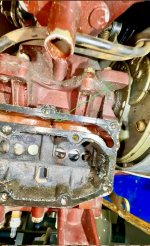
Disassembled the motor to refurbish and repaint the entire unit. After I removed what I call the exhaust port cover.
What I thought would have been a water cooled portion of the powerhead, appears to have never had water pass through it.
All the other areas have plentiful signs of water mineral deposits. Except for this one.
I am enclosing a photo showing The area in question.
Apparently no water has ever passed through it. With the paint still appearing as original finish.
There is a small passageway in the cylinder head directly between the two pistons.
There is no sign of any water deposits ever in that entire area.
After looking at the diagram of the entire powerhead unit, I also have discovered a small hose that in it description is defined as an oil hose.
Both the oil hose and the exhaust cover area in question are circled in green in the diagram of the powerhead.
Is it possible that the area in question within the CD15 powerhead was actually an oil reservoir /cooling feature?
Explaining the function of the oil hose.?

Appreciate any help with these questions
Hopefully someone knows the answers here.
 

Attachments

  • IMG_6963.jpeg
    IMG_6963.jpeg
    595.7 KB · Views: 52
  • IMG_6948.jpeg
    IMG_6948.jpeg
    248.3 KB · Views: 45
The arrow in the first picture points to a water jacket.----Nothing to do with oil at all.-----The oil recirculation hose does as it sounds.----Takes oil and returns it to the top cylinder.
 
Thank you racerone;
For that information.That being the case. It would then indicate, there is a blocked water passage somewhere in that powerhead.
If I understand you correctly..
Is there anything that I can fill that powerhead with to dissolve any mineral buildup that may be causing such a blockage?
As for the oil hose, where is it receiving the oil from?
As I know of no oil reserve on this motor. That I have had it for 66 years, since it was new.
Except for replacing the impeller for the water pump about 10 years ago, I have never had this entire unit apart.
Thank you again for your help.
 
There is no oil reservoir !-----Oil collects at the bottom of the crankcase.------It then goes to the top.----No oil pump needed.-----I have said it many times.----" oil / lubrication in 2 strokes is not well understood "
 
Thank you racerone;
For that information.That being the case. It would then indicate, there is a blocked water passage somewhere in that powerhead.
If I understand you correctly..
Is there anything that I can fill that powerhead with to dissolve any mineral buildup that may be causing such a blockage?
As for the oil hose, where is it receiving the oil from?
As I know of no oil reserve on this motor. That I have had it for 66 years, since it was new.
Except for replacing the impeller for the water pump about 10 years ago, I have never had this entire unit apart.
Thank you again for your help.
To clarify for you, as a two stroke engine runs, it is typical for excess oil to puddle in the bottom of the crankcase, the hose you refer to and usually a check valve is used to pump that oil to the top crankshaft bushing/bearing to lubricate it. Engine pulses provide the pumping action to lift the oil to the top. Those engines had little water cooling the exhaust, most of them will have some form of discoloration of the outer exhaust plate. Run a pin through the little weep hole in that cooling jacket to make sure its not plugged. Your engine looks very clean in the cooling area compared to some of them I have worked on. I have a dozen of those engines in Gale, Evinrude or Johnson variants. Wonderful little engines.
 
A1+++. That cooling area looks very clean, Those cyl blocks were dipped into that at red "paint" looking stuff before machining. The red stuff is there to protect the cooling passages from saltwater corrosion (Or any other water, for that matter. DO NOT attempt to flush it with anything that may damage the coating.

If I were to evaluate that motor further, I do see some signs of water damage on the lower piston. That water intrusion is often seen on those motors and typically comes from leakage past the carbon seal assembly at the top end of the drive shaft/lower end of the crankshaft. That water intrusion will eventually destroy the whole powerhead, given enough time to continue. People disassemble that seal to replace the water pump and ignore it when reassembling. Make sure it is100% good condition and assembled correctly. ALWAYS replace the 303347 o-ring and 303355 gasket parts of the seal.
 
A1+++. That cooling area looks very clean, Those cyl blocks were dipped into that at red "paint" looking stuff before machining. The red stuff is there to protect the cooling passages from saltwater corrosion (Or any other water, for that matter. DO NOT attempt to flush it with anything that may damage the coating.

If I were to evaluate that motor further, I do see some signs of water damage on the lower piston. That water intrusion is often seen on those motors and typically comes from leakage past the carbon seal assembly at the top end of the drive shaft/lower end of the crankshaft. That water intrusion will eventually destroy the whole powerhead, given enough time to continue. People disassemble that seal to replace the water pump and ignore it when reassembling. Make sure it is100% good condition and assembled correctly. ALWAYS replace the 303347 o-ring and 303355 gasket parts of the seal.
Thank you, fdrgator
Most definitely I will replace everything at the top of that driveshaft.
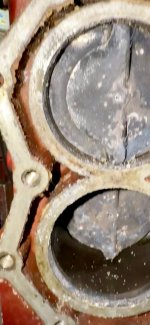
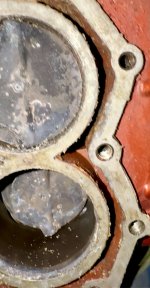
After removing the head and gasket, there doesn’t seem to be much buildup.
I think I will just fill it with white vinegar and let it set for for a week.
Well, I prep the other components for painting.
I’ve been thinking lately it may be the temperature of our waters that has influence the amount of buildup.
Our waters are cold. All waters here and in the Yukon are cold.
I don’t feel any need to go any further in breaking this powerhead down. I’ll let it soak in vinegar for a week and then I’ll turn the hose on it to see if I can get the water to go where it should be.
It will be spring before this project is ready for barrel testing. And that is at least 7 to 8 months away.
Will post several views of the cylinder head, only slight buildup there. Which makes me think it might be our water temperatures.

And I thank you again for all your help.
 
Enclosed are the photos upper cylinder head.
Not at all what I expected find.
 

Attachments

  • IMG_7750.jpeg
    IMG_7750.jpeg
    549.7 KB · Views: 33
  • IMG_7749.jpeg
    IMG_7749.jpeg
    544.9 KB · Views: 31
  • IMG_7752.jpeg
    IMG_7752.jpeg
    260.8 KB · Views: 30
  • IMG_7753.jpeg
    IMG_7753.jpeg
    342.3 KB · Views: 32
There is nothing wrong in there.-----Do NOT soak it for a week.------The cylinder head is warped .----Refinish it with emery paper on a flat surface such as plate glass.
 
I have had great results on removing carbon buildup by applying Hoppes#9 firearm solvent.
Brush on let penetrate for a bit than brush than rag wipe.
 
To clarify for you, as a two stroke engine runs, it is typical for excess oil to puddle in the bottom of the crankcase, the hose you refer to and usually a check valve is used to pump that oil to the top crankshaft bushing/bearing to lubricate it. Engine pulses provide the pumping action to lift the oil to the top. Those engines had little water cooling the exhaust, most of them will have some form of discoloration of the outer exhaust plate. Run a pin through the little weep hole in that cooling jacket to make sure its not plugged. Your engine looks very clean in the cooling area compared to some of them I have worked on. I have a dozen of those engines in Gale, Evinrude or Johnson variants. Wonderful little engines.
Thank you. Will do that and check it with a light also.
It’s going to be a long winter. There is more going on with it than I had realized. Will definitely take my time with it, to see that I don’t miss something.
Have this same year Johnson in a FDE-12 18hp also. Had been planning to do both this winter. I’m glad now that I didn’t start working on them both, together at the same time.
With only concentrating on the cooling passages. I would have likely missed that warped head.
And i thank you all for sharing your knowledge.
It is much appreciated.
 
Back
Top