Logo

Looking for a manual for a Riva Crusader V8 210HP engine

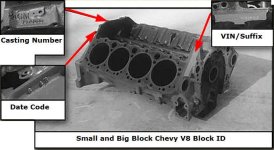
Just check these numbers, see pictures, they are casting numbers regarding your engine type.
 

Attachments

  • Small and big block number.jpg
    Small and big block number.jpg
    45.9 KB · Views: 77
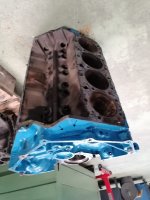
  • IMG-20240618-WA0001.jpg
    IMG-20240618-WA0001.jpg
    274.7 KB · Views: 81
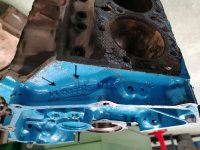
  • IMG-20240618-WA0004.jpg
    IMG-20240618-WA0004.jpg
    325.5 KB · Views: 65
as Hans stated in post #32, those pics are of the GM Casting Number....for the block in the pics, its 14088551, which is a late 1980's, one-piece rear main seal, 305 CID block. It is NOT the Crusader Serial Number...those get stamped into the ID plate affixed to the flywheel cover.
 
as Hans stated in post #32, those pics are of the GM Casting Number....for the block in the pics, its 14088551, which is a late 1980's, one-piece rear main seal, 305 CID block. It is NOT the Crusader Serial Number...those get stamped into the ID plate affixed to the flywheel cover.
thank for the info guys , so crusader got the engines from chevrolet, then marinazed them and screwed the id plate with a new serial number on them hence the serial number from chevrolet is different to the serial number crusader gave each engine?
 
For the most part, that's the jist of it.

I don't think you will find full GM VIN info on a crusader block as they were never destined for a road vehicle (with a VIN). The GM marine builds were typically "standard production" builds that were shipped to the "Marinizing House" that ordered them...there, they would get their final "dressing" of accessories and then get shipped to the hull maker that ordered them (or shop for replacement/repower use)...
I went back to search the engine serial number and my casting number on the engine block is different than Hans's, it says 39 GM and has a 7 digit serial number that starts with 39 , do you have any insight regarding this difference? Any help appreciated.
 
I would ask that you provide all of the data you have so your question can be answered as well as possible....
 
I would ask that you provide all of the data you have so your question can be answered as well as possible....
The engine is from a riva boat, valve covers say thermo electron built for riva specs model 270, I found a 13 letter VIN number starting with V10........ on the engine block afterwards, it's exactly opposite to the gm casting number as shown in the picture from hans, l don't know where the id plate is , the boat has been sitting in storage 30 plus years.
 
The papers have a different 5 letter number starting with 93... while the block has a 13 letter VIN where the first line is V10119WR which is standard for chevrolet engines giving the factory, date and engine type and on the second line is the 5 letter serial number starting with 46... which is not the same serial number as what thermo electron gave which is very weird because the engine is stock and this is how it came from the factory.
 
if you think the serial number is of the form 46xxx, then that would be a crusader manufacturing year of 1984...the WR suggests a 350 CID block assembled in a RH rotation configuration, assuming it was original...and, FWIW, a "model 270" was never rated at 210HP. Also, if the engine is as listed, the cylinder head ID symbol would be a solid triangle, pointed "up" which I mean to be perpendicular to the block-head interface...
 
if you think the serial number is of the form 46xxx, then that would be a crusader manufacturing year of 1984...the WR suggests a 350 CID block assembled in a RH rotation configuration, assuming it was original...and, FWIW, a "model 270" was never rated at 210HP. Also, if the engine is as listed, the cylinder head ID symbol would be a solid triangle, pointed "up" which I mean to be perpendicular to the block-head interface...
the engine should have been made in '83 , the serial number on the block is different to the serial number from thermo electron which is weird, I don't know where's the cylidner head ID symbol, there's a number right beneath the distributor between the valve covers saying 623 OT and the GMC logo beneath it, there're different numbers on every part of this engine I don't know what's going on.
 
They must have sent me the wrong papers, there are two rivas one year apart from each other, so the real S/N should be 46xxx I guess, the engine is stuck is it worth rebuilding?
 
If they can't tell you what engine went into there boat, I'd be suspect of everything they have...there is a HIN on the boat?
 
Very possible, especially given the age.

very common to get a replacement block and use the tin and iron bolt-ons from the 'old engine'...then you have a bunch of conflicting data...

either way, any good machine shop should be able to determine what they are working on and obtain the correct replacements as needed,
 
Hi all, resurrecting this thread nearly two years later. The engine rebuild is still happening, just apparently on a geological timescale!

I’m hoping someone here can help identify how the original crankshaft pulley and harmonic balancer assembly went together on my Riva Marine 210.

Mine appears to match the early Crusader arrangement: a thin, wider inner pulley, a flat-faced outer pulley driving the raw-water pump, and three pulley mounting bolts. The outer pulley has 6946 cast into it, corresponding (I think) to Crusader part 96946. There’s also a centre sleeve which, from memory, passes through the inner pulley and locates in the balancer bore.

I need to replace the central retaining hardware, particularly the substantial flat washer. My engineer recalls removing a central bolt with an external-tooth lockwasher (aka he lost it…) and we’re struggling to establish exactly where the retaining washer originally seated.

Does the bolt and thick washer secure the balancer directly, with the pulleys fitted afterwards? Or does the washer bear somewhere inside the outer pulley’s centre opening e.g. against the sleeve?

I’ve found another example with a large washer across the outside face, but others, including mine before dismantling, have an uncovered centre opening. Same as one of Han’s blocks from above (Second image on his original post).

Has anyone dismantled this particular setup, or got photos or dimensions of the original bolt and washer? I’d really appreciate help establishing the original arrangement.
 
I looked thru the rest of the data I have and the pulley setup appears consistent on the big blocks as well as the small blocks.

My conclusion is you may not have the classic 'thick washer' under the bolt securing the balancer to the crankshaft. I would say the bolt goes thru the water pump pulley after it is secured to the balancer with the inner pulley and the spacer(sleeve) is the bearing surface for the head of the bolt.

You should be alble to measure the exposed length of the bolt (with it threaded into the crank <but not bottomed out>and the balancer on the crank and seated <fully installed>) from the face of the balance to the bottom of the head of the bolt. Then stack the water pump pulley onto the inner pulley on the bench. then measure from the bench to the top of the sleeve inside the water pump pulley. that disance should be real close to the exposed bolt length.
 
The service manual says you need 1/2" of the damper retaining bolt to thread in...so that's 6 1/2 turns.

If there isn't enough exposed bolt, then you need to go with the classic washer approach...but you need to make sure there's enough clearance on the hub area of the inner pulley and to make sure that there's a recess for the head on the mating face of the raw water pump pulley...
 
Back
Top