Logo

No Fuel Rail Pressure but HP Pump Puts Out 60 psig

Green 2000

New member
Year 2000 PCM GT40 that will not start. This is a summary of many hours of troubleshooting but basically there is no pressure on the fuel rail test port. I have replaced the scrader valve and used 3 different gauges and verified as best I can there is no pressure at the schrader relief valve. Both pumps run as expected when KOEO and I have removed hose fittings and verified fuel flow from both pumps. With no pressure at the scrader valve but with both pumps running, and in order to verify fuel pressure off the HP pump, I bought a barbed hose fitting and attached a fuel pressure gauge to the outlet of the first flexible hose exiting the FCC. I dead-ended that hose with the pressure gauge. I ran the pumps by grounding the appropriate lead on the EEC test port and the HP pump puts out 60 psig immediately when dead-ended like this. Pressure remained above 40 psig for a few minutes.

I reconnected the flexible HP hose to the first fuel rail and ran the pumps again using the EEC test port. The fuel rail pressure gauge still reads zero. So somehow I have pressure going into the first fuel rail but have no pressure coming into the second fuel rail where the schrader relief valve is located.

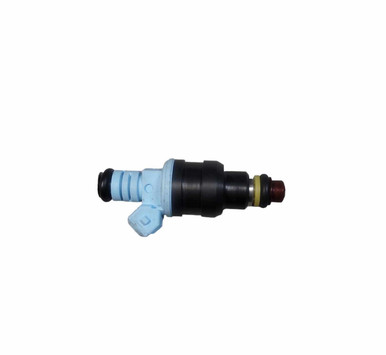
Can I have an injector that is failed open? I am not a mechanic, is it a complex process to get to and remove injectors?
 
The Schrader valve may be be gummed up or stuck at an angle and not allowing fuel to flow into the gauge… the center part is like a car tire valve stem that should be removable… local auto stores should have a schrader valve removal tool… Remove it and carefully be prepared to absorb any fuel that might spray out on your next power up.

And/or remove the the center valve of the fuel pressure gauge hose too and connect it to see if you gain pressure.

You’ll probably have to remove the whole fuel rail and clean it up and possibly have the injectors tested and cleaned then reinstall with new o-rings and seals.

If possible, finding the he correct engine service manual for your model (online?) should help guide you best to R&R the rail system.

Plus find your engine parts catalog for the right o-rings and seals.
local auto stores should have a schrader valve removal tool
 
As stated in the original post, I have replaced the schrader valve and used multiple gauges.

I have not figured out yet how to remove the fuel rails. I am going to try to blow air pressure through them tomorrow to see if they are clear.
 
Oh gotcha… guess I missed the replacement part near the beginning, my mistake.

I don't know your engine but in studying, your fuel rail part number is 9F792 which may help give you some visuals of what it may take to start dissembling the related parts to get to them. There are many good views searching the part numbers but here's one to start out with,
https://www.fordpartsgiant.com/parts/ford-manifold-asy-fuel_7c2z-9f792-a.html

Looking at the design of the schrader valve stem that sits away from the rail a bit could help indicate a blockage further inward that needs cleared out with the inner valve removed and a hose or two much like you plan to do.

Your engine parts catalog seems challenging to locate though the following are of a few parts to maybe help,


Though seemingly not extremally helpful with details, found a service manual of your engine model,

 
unbolt the retainer clips and the rails will pop off the injectors - similar to the triton engines used on the trucks.

if the path is blocked from one sde of the fuel rail to the other, then the side that is wet is likely at full pump pressure (no regulator connection) and probably flooding...never seen it but possible.

I'd pop the rails and the interconnect as start inspecting to find the blockage...
 
Thanks for the replies. I was convinced the flexible rail crossover had to be collapsed and plugged. I removed the plenum (and all the stuff associated with it) and pulled the rails and injectors off. There was no pluggage in either rail nor the crossover.

I am at loss now except that I think my new pressure regulator must be faulty. I think the regulator should be completely closed when there is no vacuum. However, when I take an air hose and apply air to the inlet of the regulator, air discharges from the outlet side. That may be proper since I dont have a regulated air line and I may be just applying enough pressure to lift the valve. As I write this and think about it, that probably is appropriate since only a few inches of vacuum will lift the valve.

I tested, cleaned and rebuilt all the injectors and there were none which indicated a problem. I don't know what I will do from here except reinstall the rails and hope for a miracle.
 
The vacuum connection just adjusts the operating point of the regulator. This is to maintain a fairly constant pressure difference across the injector as the throttle plate opens and closes.

There may be small 'leakage' past the regulator when the inlet is pressurized. Ideally, the 'leakage ' shouldn't be there but it is common...you can check the manual that Fun Times linked for what is acceptable.
 
Back
Top