Logo

1977 Mercruiser 165 Water in Cylinder #6

Agarico

New member
Hi all, new to boating and purchased my first boat (1977 Invader Executive 18ft)

This boat has the Mercruiser 165 Straight 6 engine (Chevy 250) with a pre alpha lower unit.

Anyways, brought it home and found it to have water in the oil, however it does run decent. When hooking up the muffs and running it in the driveway It doesnt overheat according to the gauge and the water level in the oil hasn't gone up any, its about half an inch over the full mark on the dipstick. Did a bunch of lurking on here and found other posts with cracked blocks, I got down under the manifold and the freeze plugs look original and I don't see any cracks or external leaks from the block.

So I decided to pull the spark plugs and borescope the cylinders to see what the deal was. All cylinders look good except #6 (the one farthest back) has signs on water sitting on top of the piston for a period of time. I decided to run a compression test, all were great ranging from 120-130 except #6 shot up to max out my gauge and found that it had shot water into my compression gauge (UGH) but it does seem to have compression and the spark plug looks fine like all of the other ones. All plugs are a darkish black color with soot on them so I think #6 was firing.

My question is, do you guys think these symptoms sound like the notorious exhaust manifold riser gaskets and or cracked riser/manifold causing water to run back when its not running and drain into the back cylinder? My plan is to pull the riser next and check for signs of water in the exhaust side of the manifold but I'm kind of just nervous that something more nefarious is going on. I just want to take this thing to the lake and at least have it going for this summer!

I have attached some pictures below

IMG_5688.jpegIMG_5692.jpegIMG_5687.jpeg
 
A Little update:

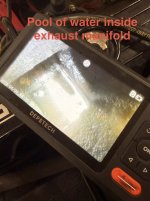
I got the exhuast elbow off of the manifold and there is standing water inside the exhaust manifold. really don't know my next course of action any help would be appreciated.

Should I replace the riser gasket and see if that fixes it?

Should I pull the manifold and just replace it all? (I don't want to put $500 worth of stuff into the boat if the Head gasket is blown)

I don't really know what I should do.

IMG_5699.jpegIMG_5698.jpegIMG_5695.jpeg
 
I had same issue on my 350 mercruiser. I saw water in the oil, pull the exhaust manifold and found a rust color. It should be black like exhaust. I pulled my exhaust manifold, scraped all residue from both surfaces, replaced with new gaskets. This is the first step I would take before pulling the head .
 
I had same issue on my 350 mercruiser. I saw water in the oil, pull the exhaust manifold and found a rust color. It should be black like exhaust. I pulled my exhaust manifold, scraped all residue from both surfaces, replaced with new gaskets. This is the first step I would take before pulling the head .
I pulled the exhaust elbow off of the manifold and can see standing water inside the manifold. I think im going to order a new elbow riser and gasket and see if thats my issue. Definitely need to get the milky oil out of the motor too!
 
Question,
Why would you buy a 1977 boat (50 yrs old) if your new to boating?

At a minimum, You should have bought a boat from the mid 1980's or better yet buy and Finance a new one and have fun boating.

You will be spending ALL of your boating time fixing your 50 yr old boat......
 
Question,
Why would you buy a 1977 boat (50 yrs old) if your new to boating?

At a minimum, You should have bought a boat from the mid 1980's or better yet buy and Finance a new one and have fun boating.

You will be spending ALL of your boating time fixing your 50 yr old boat......
Because I didn't want to spend a lot of money buying a boat 🤷‍♂️ Guy said it ran fine and everything worked on it. (as one does when selling a boat) My day job is working on cars so figured if anything is wrong I could fix it myself. Tried to do my due diligence when purchasing but missed the fact that the oil was overfilled a bit and then as soon as it fired up: milkshaked. I know that these engine are fairly reliable so figured that it couldn't be too bad.
 
Id say 120-130 is decent compression on a 50 year old engine
It will get by for a while but its not good.

A 1977 is going to be hard to get mercruiser parts. Pre Alpha parts are also getting rare.this could be an issue for some parts if there needed.

The engine is the engine, most internals are the same as automotive.

That engine may get 140 hp if your lucky. A mid '80s inline 4 cyl is (140hp)

Every used boat for sale always ran perfect the year before. Everyone.

It is always recommended to lake test any boat before purchase.....
 
You have water in the manifold. Maybe the riser, riser gasket or manifold itself. Maybe a combination of all 3.

Starting with a DRY manifold interior, slide manifold away from head about 1" & carefully fill the water jacket with water until full up to riser gasket surface. You already have the riser removed. Let it sit overnight & check to see if water has appeared inside the manifold.
If water, manifold is junk.

Why #6 cylinder? Most likely, boat was stored nose high & water pooled aft.
 
You have water in the manifold. Maybe the riser, riser gasket or manifold itself. Maybe a combination of all 3.

Starting with a DRY manifold interior, slide manifold away from head about 1" & carefully fill the water jacket with water until full up to riser gasket surface. You already have the riser removed. Let it sit overnight & check to see if water has appeared inside the manifold.
If water, manifold is junk.

Why #6 cylinder? Most likely, boat was stored nose high & water pooled aft.
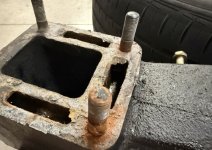
Yeah so I went ahead and just pulled the manifold entirely and put it on the floor. Poured water into the cooling jackets and even after a few minutes it had drained down into the exhaust portion. I already have a new manifold and riser elbow on order. Manifold is cracked inside somewhere letting water down into the bottom and yeah the boat on the trailer is tilted back and the first cylinder to get water is #6
IMG_5705.jpegIMG_5706.jpeg
Water is pooling in the exhaust portion. Manifold is SHOT!
 
FYI, fresh water boat lasts a long time. But 50 years may be it, IDK.

These inline 4 & 6 cyl manifolds can collect sand along the interior bottom. It can & will trap water that doesn't drain completely when winterizing. I always pour antifreeze into the forward hose port until it drained out the plug along bottom aft portion. That way any trapped water will be an antifreeze cocktail.

New manifold most likely does NOT come with the end caps. So when you remove the old ones, see if the old manifold has a sand filled bottom.
 
Yeah so I went ahead and just pulled the manifold entirely and put it on the floor. Poured water into the cooling jackets and even after a few minutes it had drained down into the exhaust portion. I already have a new manifold and riser elbow on order. Manifold is cracked inside somewhere letting water down into the bottom and yeah the boat on the trailer is tilted back and the first cylinder to get water is #6
View attachment 36878View attachment 36879
Water is pooling in the exhaust portion. Manifold is SHOT!
test you block to see if the cooling passages hold 15 psi air pressure. The manifold being cracked may be from freeze damage. Before you put more money into it makes sure the engine is not freeze damaged too.

Also cheap boats can be some of the most expensive projects.. if you have a background in automotive maintenance that will help. Do yourself a favor and get the factory manuals for engine and drive. Often used ones are relatively cheap on ebay ($35-50), this will help fill in the blanks. If you have a mechanical background I have found them invaluable
 
test you block to see if the cooling passages hold 15 psi air pressure. The manifold being cracked may be from freeze damage. Before you put more money into it makes sure the engine is not freeze damaged too.

Also cheap boats can be some of the most expensive projects.. if you have a background in automotive maintenance that will help. Do yourself a favor and get the factory manuals for engine and drive. Often used ones are relatively cheap on ebay ($35-50), this will help fill in the blanks. If you have a mechanical background I have found them invaluable
From doing some research, mercruiser put out a TSB on this engine stating that due to poor water flow in the manifold they can crack due to heat. The fix is a reverse flow kit to send water backwards through the manifold and then through a hose to the riser.

I will have to do more research into this but it’s hard because not many people run these motors anymore.

I have pressure tested the block and all seems well.
 
From doing some research, mercruiser put out a TSB on this engine stating that due to poor water flow in the manifold they can crack due to heat. The fix is a reverse flow kit to send water backwards through the manifold and then through a hose to the riser.

I will have to do more research into this but it’s hard because not many people run these motors anymore.

I have pressure tested the block and all seems well.
YES, Those older drive systems use a 5/8 ID diameter hose from the bell housing to the water inlet at transom. Then a small diameter hose to the engine/manifold.

Newer models went to a 3/4 inch ID water hose and a 1 1/2 inch water line to engine. Basically the same impeller design but far more water volume to engine.
 
From doing some research, mercruiser put out a TSB on this engine stating that due to poor water flow in the manifold they can crack due to heat. The fix is a reverse flow kit to send water backwards through the manifold and then through a hose to the riser.

I will have to do more research into this but it’s hard because not many people run these motors anymore.

I have pressure tested the block and all seems well.
good on the block. Yes these engines went out of production in 1981 or 82 so certainly not many guys working on stuff now have worked on them.

We had I think the 230 CID version - 150 hp in my grandfathers Penn Yann. That was 30+ years old when we got rid of it in late 90s or 2000.
 
YES, Those older drive systems use a 5/8 ID diameter hose from the bell housing to the water inlet at transom. Then a small diameter hose to the engine/manifold.

Newer models went to a 3/4 inch ID water hose and a 1 1/2 inch water line to engine. Basically the same impeller design but far more water volume to engine.
you probably worked on a few back in the day? or was that before your time as a marine mechanic?
 
I have worked on inline 6 before, many.

When i started in the business it was 1990 so 20 and 30 yr old stuff came thru our marina, it was on a fresh water lake so lots of old stuff. The other mechanic he even worked on '50's ans 60's johson outboards with mechanical driven distributors......

So yes I saw my share.
 
YES, Those older drive systems use a 5/8 ID diameter hose from the bell housing to the water inlet at transom. Then a small diameter hose to the engine/manifold.

Newer models went to a 3/4 inch ID water hose and a 1 1/2 inch water line to engine. Basically the same impeller design but far more water volume to engine.
The tube size was changed in '82 with the "R" drive, a 1 year hybrid as the "MR"/Alpha 1 was being introduced in '83.
To the best of my memory, no inline 6 was used after '81. So they all had the #1 drive, in other words 5/8 tube size. The hose from transom to t-stat housing is also 5/8.
Not to worry, the 888/233 Ford 302/351 V8 was used from 71 to 77 and the 198/228/250/260 Chevy 305/350 from 77 thru 81 with the 5/8 tube also.
I have never seen any such service bulletin but I'm not disputing 1 may exist.
Something to ponder on:
Since the water pump is driven by the vertical shaft, it's output is determined by RPM which depends on engine speed AND gear ratio. The 160/165 inline 250 CID had a 1.65 ratio, so the pump turned faster than a 470/488 with a 1.84R (assuming it ran at all) or a 4 cyl 120/240 with a 1.98R

I suggest you verify your new manifold does not have any thin casting residue creating little dams that can trap sediment prior to installing the end caps.

I have been running a '73/'74 vintage 165 salvaged out of a derilect Larson in the early 00's. I did a complete rebuild, reusing the original manifold & riser and installed it in my SeaRay SRV180 in '04. Never an issue, but this is a fresh water boat. Salt water is a whole new story.
 
Last edited:
Back
Top