Logo

25hp 2 stroke Merc. Starter solenoid.

gabtrac

New member
I'm fixing up an old 25HP 2 stroke 1998 merc.
It has remote/cable controls.
I've been able to get it to turn over with the pull cord.
When I connect the battery and turn the key, the solenoid clicks.
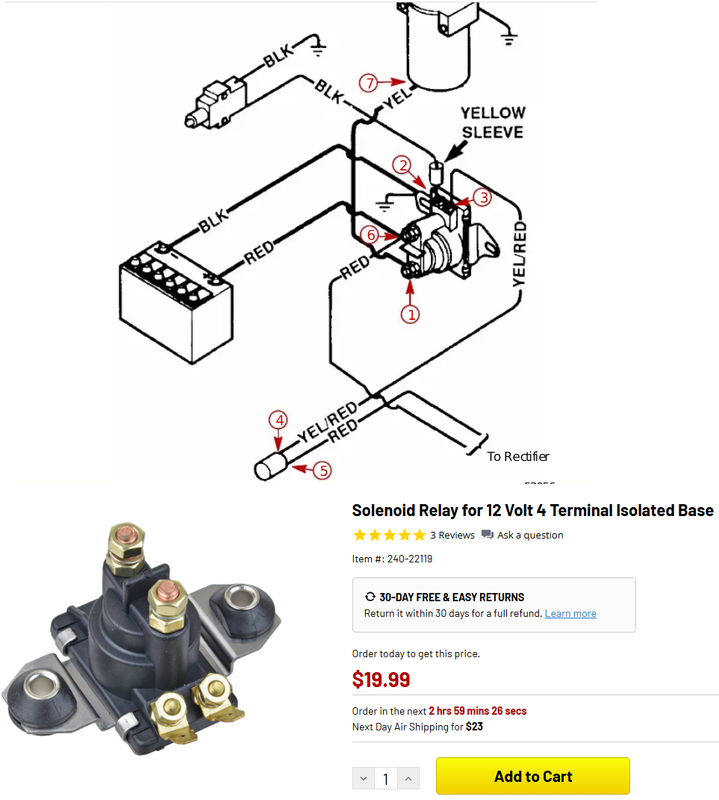
When I jump the 2 terminals (on the solenoid) the motor turns over.
I've cleaned all the terminals/wire connections on the solenoid.
Is my solenoid shot or is there something else I should check?

Also...
I have a service manual (downloaded) which labels not only the above as a starter solenoid (connects from battery and to the starter motor), but also another box which is attached to the motor down and towards the rear of the engine. Are there 2 starter solenoids on these motors?
It's not a very good manual - are there better quality, more in depth manuals available?

Thanks,
a
 
Last edited:
You say jumpering the 2 big terminals on solenoid causes the starter to turn.

If the solenoid clicks but starter doesn't turn, solenoid is bad. It is possible there is a dirty connection on 1 or both big terminals of the solenoid since jumpering them would most likely conceal a dirty connection. Not likely since you have cleaned the connections. But usually the internal contacts of solenoid are dirty or burned.

2nd box? 2 Yellow wires going to it & 1 red wire? ...Rectifier... Turns AC voltage to DC to charge the battery.
 
You say jumpering the 2 big terminals on solenoid causes the starter to turn.

If the solenoid clicks but starter doesn't turn, solenoid is bad. It is possible there is a dirty connection on 1 or both big terminals of the solenoid since jumpering them would most likely conceal a dirty connection. Not likely since you have cleaned the connections. But usually the internal contacts of solenoid are dirty or burned.

2nd box? 2 Yellow wires going to it & 1 red wire? ...Rectifier... Turns AC voltage to DC to charge the battery.
I have given new life to many solenoids over the years. What happens is that when the solenoid is de-energizing after rolling the starter over to start the engine, there is current flowing through the contacts and upon opening, this current continues to flow for a short period. Current flowing upon release creates a voltage drop across the contacts and with the current flowing produces a fire (contact arc) that causes the copper in the solenoid points to evaporate....burn away. As a result of this loss of contact area, over time, it gets to a point where the contact surfaces left aren't adequate to supply the current necessary to roll the starter.....result you get the click (it energized) but no spin on the starter.

The solenoid can be opened (carefully) and the contacts can be rotated to a non-used area, subsequently reassembling the solenoid and the result is a solenoid like new. Or, if there isn't any unused space, just sanding/grinding off the pits on top (smooth) of the contacts will do the trick. Otherwise you can go through the process of obtaining a new one!
 
Other than the key switch, there is only one other relay/solenoid/switch that is used on your model motor. Key switch powers the solenoid and the solenoid powers the starter motor.


Try a new solenoid.-----Cheap item.-----Hardly worth the bother of repairing.------Many good used ones available if you search.
 
Thank you to all. I truly appreciate your generosity.
I took the Solenoid off and checked it for continuity as per the manual and it checked out fine.
I began to take it apart and found corrosion in one small area near a
The tabs holding the plate on are very tough to open without the risk of damage - so I ordered a new one.
My other question concerning the mislabelled part in the manual, is in fact the rectifier, which I will also be replacing as the terminals have corrosion damage - as mentioned by racerone the parts are relatively cheap and... new parts should be more dependable when out in the chuck.

I just want to say how much I appreciate you guys and all the other people on the web who share their expertise and knowledge so generously. Whether you know it or not, you are changing the world for the better, and know-nothings like me... love ya!
Cheer... more questions to come... no doubt.
 
Thank you to all. I truly appreciate your generosity.
I took the Solenoid off and checked it for continuity as per the manual and it checked out fine.
I began to take it apart and found corrosion in one small area near a
The tabs holding the plate on are very tough to open without the risk of damage - so I ordered a new one.
My other question concerning the mislabelled part in the manual, is in fact the rectifier, which I will also be replacing as the terminals have corrosion damage - as mentioned by racerone the parts are relatively cheap and... new parts should be more dependable when out in the chuck.

I just want to say how much I appreciate you guys and all the other people on the web who share their expertise and knowledge so generously. Whether you know it or not, you are changing the world for the better, and know-nothings like me... love ya!
Cheer... more questions to come... no doubt.
Thanks for appreciating your assistance....usually the poster gets his questions answered and you never hear from him again.....contributors don't know the outcome and that supports confusion in the responder as to whether his/her comments helped.......besides offering a little consideration for the person(s) volunteering their time and expertise to help the poster.

In my case I am retired and farm to have something to do. When it's time to do a farming activity, usually weather related, and you have a malfunction, usually whatever is the quickest "fix it" is the solution that prevails. In the case of solenoids, it didn't take me an hour to fix one, has happened numerous times over the years with 7 tractors, and I was back up and running long before other options could have occurred.
 
Hey Texasmark, we sound alike. I am also retired and have a small market farm/garden.
I can relate to "the quickest fix" gotta git'r going NOW thinking.
I'm going to take another crack at the solenoid now that it won't matter if I destroy it ( new one on the way) and hopefully I'll learn something.
 
Hey Texasmark, we sound alike. I am also retired and have a small market farm/garden.
I can relate to "the quickest fix" gotta git'r going NOW thinking.
I'm going to take another crack at the solenoid now that it won't matter if I destroy it ( new one on the way) and hopefully I'll learn something.
The thing that you tear up on plastic housing units in particular, are the rivets (4 each) that hold the top to the bottom. They drill out easily...aluminum.....but we all are aware of the bolt (screw) and the nut when reassembly time comes. Good luck and you will feel good about yourself (for what it's worth) for fixing it.......I did and it encouraged me to do it more often when I had a failure...and I have done that....besides it gives me something positive to do with my free time....lots of that lately.....rain needs to stop so that I can plant my summer hay crop.....but we needed the water so I'm not griping....thankful actually.

On the farm thing, nothing I'd rather be doing. At 84 I have been looking into the crystal ball trying to see where my life is headed. One set of thoughts was to sell my farm and move to a city................I can't believe this mind of mine even considered such a preposterous thing for me to do. Boredom would drive me nuts.....and I would be loosing the peace and tranquility my farm gives me and in particular, the resources I have here (tools and shop) where I can fix most everything that breaks.....but reroofing my house I leave to roofing contractors.......my daughter likes to come out here and mentions how peaceful it is here with nature and all as compared to the rigors of employment and the rigors of city life. Smart girl.....60 year old woman.
 
Back
Top