Logo

Mercruiser 5.0 twin engine high water pressure

mgsunrunner

New member
Hi

I have twin 5.0 Mercruisers (one is 2002 and the other 2017) - Both have Hitek stainless steel manifolds (around 7 years old)

Starboard engine has suddenly shown an increase in water pressure to over 35 psi at 3000 rpm - port is normal (3-4 at idle and 17 psi at 3000 rpm)

No high temps on either engine / manifolds are cool to touch

I rigged up a small pressure gauge on the power steering water sensor hole and it confirmed high water pressure. I then put the gauge on the thermostat housing and again high pressure.

I've pulled both manifolds off, mild acid cleaned them and they are not blocked / water runs thru them easily

The rubber hoses from the thermostat housing to the manifolds are clean so can't be the cause.

I've inspected both exhaust flaps and they seem fine.

Exhaust blows out the stern drive so its not blocked

Given the blockage appears to be downstream of the thermostat housing, any ideas ?
 

Attachments

  • guage on manifold.JPG
    guage on manifold.JPG
    146 KB · Views: 43
To start with you can fill in all the missing information from your original post.

1. Are these engines EFI or TBI or Carbed?
2. Serial numbers would also be helpful clearly identifying which serial number belongs to which engines (understanding the replaced engine may not have an OEM serial number unless it came out of another boat vs a reman or new from a aftermarket source).
3. I was unaware of a water pressure sensor hole on the power steering cooler???? Are you sure it is not a winterization plug to drain water?
4. Are these Raw water cooled or Closed cooling?
5. You say "Starboard engine has suddenly shown an increase in water pressure". Had you measured it prior and what was it, if you did?
6. Maybe indicate which engine is Starboard and which is Port. We cannot see it from our keyboards.
7. Alpha drives or Bravo drives or inboards?

I have never seen a threaded port on a thermostat housing like the one in your pic. May be my fault as I have not worked on much past mid 2000's build dates and 99.9% are carbed and raw water cooled.
 
Last edited:
Agree serial number will help and guessing the 2002 motor which is most likely original

The thermostat housing is what was used on the Easy Drain system.

With this system there are a few check valves on the bottom hose of exhaust manifolds

1 and 3 point check balls.jpg

I would start by taking each hose off and back flushing
Has any of the system been changed from what is seen below?

1 and 3 point cooling SBC.JPG


Look at item 20 in pic above, is this Tee clogged ?
 
Agree serial number will help and guessing the 2002 motor which is most likely original

The thermostat housing is what was used on the Easy Drain system.

With this system there are a few check valves on the bottom hose of exhaust manifolds

View attachment 36750
I would start by taking each hose off and back flushing
Has any of the system been changed from what is seen below?

View attachment 36751


Look at item 20 in pic above, is this Tee clogged ?
I find it so stupid, for over 15-20 years the basic and manual means to drain the water and the simplicity of the cooling syatems which had a near zero failure rate or item failures to all these added failure points/parts. What were/are thinking????? KISS keep it simple stupid!!
 
Thanks for the responses

Its a MPI / raw water cooled / bravo 2 drives. Serial of the starboard engine is 0M334633. Boat is in the water (its 5000 kgs)

Pressure reading before this issue arose was the same as the port engine - around 3 psi idle and 10-15 psi at 3000 rpm. This is both via the manual gauge plus via the Navman Smartcraft ECU readout.

The only change in the plumbing is that I have a single water inlet pipe into the manifold that goes underneath into the check value (item 8 above) (eg don't have the additional inlets to the top exhaust elbow (item s pipes 22 and 23 - they go into a tee and then to the bottom check valve). Cooling has worked ok for the last 7 years and pressure is still ok on the port engine.

The check ball (10) is loose (I've seen that get blocked before with salt build up) plus manifolds would get hot if no water :)

I'll check the water distribution (item 20) but as this is before the thermostat housing, doubt its blocked.

There is a plug (item 2 in the pic above) in the thermostat housing that I screwed the manual pressure gauge into to measure pressure at point.

My power steering cooler (item 17) has a separate tap for the Mercruiser pressure sensor - this is where I screwed in the manual pressure gauge to check pressure as that unit sometime gets blocked.

As far as I can see, the water from the thermostat housing goes thru the engine and then directly to manifold and then out thru the stern drive exhaust pipe.

Given the engine runs ok and spins up to 4000 rpm on the water, manifolds and engine do not get hot (eg gets to 70 C and stays there) and I can see exhaust coming out in the water, what could be blocking it past the manifolds to cause high pressure. The exhaust yoke at the rear takes both the water and exhaust from the manifold to the sterndrive and out to the water.
 

Attachments

  • mercruiser exhaust yoke pipe #8M0115149.JPG
    mercruiser exhaust yoke pipe #8M0115149.JPG
    66.5 KB · Views: 24
ok all hoses that use to be separated between upper elbow and lower manifold all go into lower fitting.
Note: if they all go into lower, hoses 19, 22 and 23 should be removed, but most likely ok if left

The high pressure most likely could be coming from exhaust shutters (item 7) in your pic and broken off and is blocking the exhaust port, or another restriction in the Y-pipe or prop hub
 
Thanks

I checked both exhaust flaps when I had the manifolds off and they are both there and flipping up so seem okay

On my Maxum (now sold) with the same engine / drives, it had two ways for the exhaust / cooling water to get out - thru the prop hub but also thru two holes on each side of the transom assembly under the trim rams.

What I don't get is if those where all blocked, why the exhaust is not killing the engine with built up back pressure if the exhaust was blocked (and probably flooding the engine with the cooling water from the manifold)

ps - I had new transom assemblies fitted around 7 years ago (and refitted three years ago by Mercruiser due to the new metal style clamp Mercruiser inlet water pipe failing due to lack of corrosion protection).
 
The exhaust holes on the side of the transom assembly are on Alpha not Bravo

The Bravo 2 drives normally don't have Issues with exhaust out the hub because such a large casing as well as prop.
The Bravo 3 drives do have issues with exhaust exist and this is why many use the exhaust tube boot and not bellow

Since you tested pressure with mechanical gauges than I'm pretty sure you actually have pressure increases as you state. The only way for pressure to increase that high is a restriction, just need to find out where it is
 
Thanks

One area I have not tested is the actual pressure in the manifolds so will try and rig up a manual pressure gauge there.

Given there is just one pipe from the thermostat housing to the manifold (on each side) I assumed it would be the same pressure.
 
I find it so stupid, for over 15-20 years the basic and manual means to drain the water and the simplicity of the cooling syatems which had a near zero failure rate or item failures to all these added failure points/parts. What were/are thinking????? KISS keep it simple stupid!!
Agreed the stupid part comes from the boat makers who refuse to design an I/O boat where you can get to the drains on a V6 or V8 without taking out the back seats, hanging upside down or otherwise contorting yourself into an un-natural position to get at them. So now you have this very complex system which is STILL only raw water cooled! On my old boat my compromise was to make the rear seat in 2 halves, so not too heavy to remove and the wood support panels come out easily with machine screws and wing nuts. The bulkhead behind the seats is hinged with take off hinges so I can lift the whole thing out of the way.
88 FW engine bulkheads.jpg

how I set it up
engine access panel on hinges.jpg

so to winterize it I just remove the seat on one side, undo some wing nuts/machine screws and remove the side panel, open up the vertical bulkhead and slide in to change the oil. I can easily get at the drain on that side and usually can get to the one on the other side and the fuel filter as well. If not, then I can slide the other seat about a foot forward and pull out the rest of the wood panels easily enough.
Can any boat manufacturer think of this? Apparently not!
Since I never have a lot of people on this boat at this point in the future I am going to probably get rid of the big rear seats and have the rear bulkhead upholstered to make it look decent and install a couple of small folding jump seats and rod holders.
 
Last edited:
The vast majority know about the 'lack of maintenance access'....its the bottom line and the bean counters in the office that usually say no regarding improvements. Same can be said regarding auto makers and access they provide for routine maintenance... Sad situation but that's the world we are living in...
 
As far as boats I think this is one of the things driving the trend to outboards. Not that they're simple or cheap to repair, but regular maintenance is not a struggle like with I/O style boats. Especially winterizing, so much easier.
 
Hi

I have twin 5.0 Mercruisers (one is 2002 and the other 2017) - Both have Hitek stainless steel manifolds (around 7 years old)

Starboard engine has suddenly shown an increase in water pressure to over 35 psi at 3000 rpm - port is normal (3-4 at idle and 17 psi at 3000 rpm)

No high temps on either engine / manifolds are cool to touch

I rigged up a small pressure gauge on the power steering water sensor hole and it confirmed high water pressure. I then put the gauge on the thermostat housing and again high pressure.

I've pulled both manifolds off, mild acid cleaned them and they are not blocked / water runs thru them easily

The rubber hoses from the thermostat housing to the manifolds are clean so can't be the cause.

I've inspected both exhaust flaps and they seem fine.

Exhaust blows out the stern drive so its not blocked

Given the blockage appears to be downstream of the thermostat housing, any ideas ?
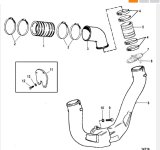
This picture you posted shows a hose below the thermostat housing. There is a T in that hose. That T usually has a orifice in the bottom of it where the hose goes to the "easy" drain housing. The two hoses that come out of the T horizontally go to the exhaust elbows. But you say that you don't have any hoses to the elbows? Where do those two hoses go?
 
MUC - the two hoses that come out of the thermo housing go to the bottom of the ss manifolds each side via T fitting that joins hoses 23 and 6 (starboard side) and 22 and 5 (port side) and enters the manifolds via the check ball fitting (item 8)

I put a gauge on both manifolds and the PSI is basically zero (they are cold/ warm to touch and so assume have water flowing thru them) .

This suggest the restriction is somewhere between the thermostat housing (35 + psi at WOT) and the manifolds (zero Psi) which serviced by a single hoses (hoses 22 / 5 and 23 / 6 in the pic above) on each side

I'll pull the thermostat housing off again in case I have missed something.
 
MUC - the two hoses that come out of the thermo housing go to the bottom of the ss manifolds each side via T fitting that joins hoses 23 and 6 (starboard side) and 22 and 5 (port side) and enters the manifolds via the check ball fitting (item 8)

I put a gauge on both manifolds and the PSI is basically zero (they are cold/ warm to touch and so assume have water flowing thru them) .

This suggest the restriction is somewhere between the thermostat housing (35 + psi at WOT) and the manifolds (zero Psi) which serviced by a single hoses (hoses 22 / 5 and 23 / 6 in the pic above) on each side

I'll pull the thermostat housing off again in case I have missed something.
Check that the thermostat fully opens @160° ±5°
When you have it apart ---- it might be a good idea to check the orifice in #20 T as @AllDodge and I have suggested. A blockage there will cause high water pressure. A Bravo sea water pump supplies way more water volume and pressure than the engine needs, this excess water is supposed to dumped to the elbow to cool the exhaust gases. Someone has modified this engine, there is a valid reason this water should go to the elbow. But that affects engine longevity and I don't think it has too much effect on this current issue.

Note that Alpha and Bravo engines use a different T, This is because a Bravo sea water pump is very different from the Alpha pump. I can't remember how to i.d. the difference, but it should be in the service manual or parts look-up.

I also noted that you can only reach 4000 RPM@WOT? This is something you NEED to address.
 
Thanks - will check the T out

My 4000 rpm is what I run to get up on a plane (when hull is clean) and bring in down to 3300 rpm and still get 35 km/p - the fuel reading at 4000 + rpm scares me - I can go higher to 4600 rpm but I've seen bad things happen at WOT and try and treat my engines gently given I'm pushing a 5000 kg brick thru the water :)

Also pic of the Hitek manifolds set up on the starboard engine - there is a plastic T on the right that combines hoses 23 and 6 that I will get a better pic of and post

hitek manifold.JPG
 
there is a plastic T on the right that combines hoses 23 and 6
These should not be connected together with the Hi-Tek manifolds.

IMO you should completely remove the 3 point draining hoses, Tee's, quick drain and check valves and use the 7 point drain system and thermostat housing

Pic is from V6 (Alpha) but same for V8 (Alpha or Bravo)

V6 Open cooling.jpg
 
Update to my advice: The T on your engine should NOT have an orifice in it. That was only used with Alpha packages.
I would still check it and the distribution housing for any restrictions, the Bravo raw water pump can put out a lot of pressure. My guess is your problem is in housing, 3 Ts or the hoses. I would suspect the 2 into 1 setup you have going to the exhaust manifolds ---- but you said this problem is new.
 
I’d wonder as a test if you ran the engine with the blue vent plug removed at the thermostat housing if it would lower the pressure… maybe the bypass part of thermostat system is compromised somehow causing odd issues.🤔
 
Back
Top